Inter-Caste Marriage in India – Legal Rights, Procedure & Protection
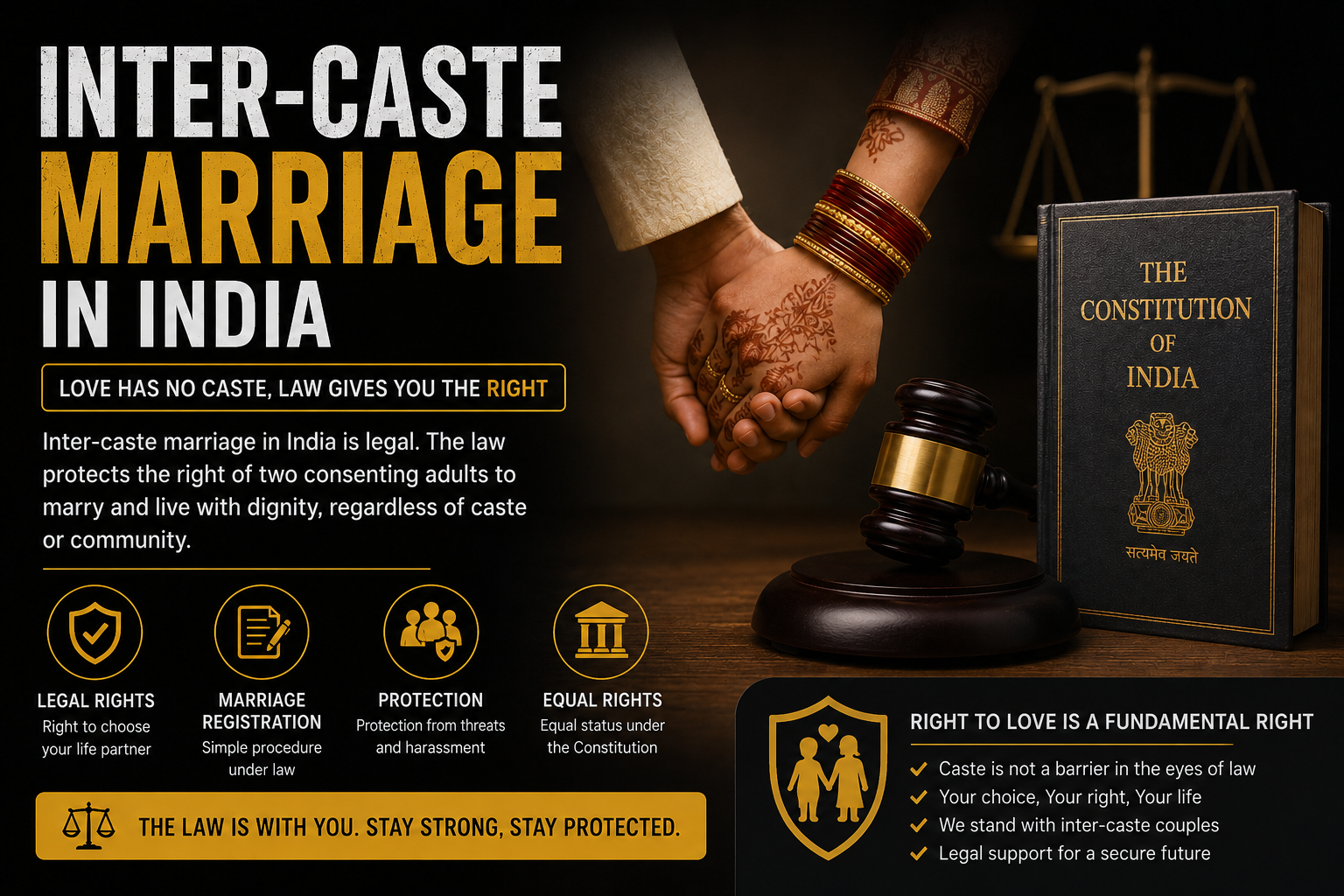
Inter-Caste Marriage in India is legally possible for two consenting adults, even when they belong to different castes or communities. In India, the law recognises an adult’s freedom to choose a life partner, and caste difference by itself does not make a marriage illegal.
For many couples, however, the legal process can become confusing when families oppose the relationship or when questions arise about marriage registration, legal protection, documents, or the appropriate marriage law.
The Supreme Court has repeatedly recognised the importance of an individual’s choice in selecting a life partner. Courts have also emphasised that adult couples should not be subjected to threats, coercion or unlawful interference merely because their relationship is opposed by family or community.
What Is Inter-Caste Marriage?
An Inter-Caste Marriage is a marriage between two people belonging to different castes. The caste difference does not, by itself, prevent two adults from marrying.
Depending on the personal circumstances of the couple, marriage may be solemnised under the applicable personal law or through the Special Marriage Act, 1954. The Special Marriage Act provides a statutory framework for civil marriages and is listed as a central law on India Code.
The important point is that the legal validity of a marriage depends on the requirements of the applicable law—not simply on whether the families approve of the relationship.
Is Inter-Caste Marriage Legal in India?
Yes. Inter-Caste Marriage in India is legal when the marriage satisfies the applicable legal requirements.
For adult couples, caste difference alone is not a legal ground for preventing the marriage. The Supreme Court has recognised that the choice of a life partner is closely connected with individual autonomy, dignity and privacy. In Shafin Jahan v. Asokan K.M., the Court recognised the importance of a person’s choice in matters concerning marriage and intimate relationships.
Therefore, family disagreement does not automatically invalidate an otherwise legally valid marriage.
Can Parents Stop an Inter-Caste Marriage?
Parents may express their disagreement, but an adult’s decision to choose a life partner cannot simply be overridden because the partner belongs to another caste.
Where an adult couple faces threats, coercion or unlawful interference, they may seek appropriate legal remedies and protection. The Supreme Court has stressed that couples exercising their lawful choices should be protected from physical threats and coercive action.
Inter-Caste Marriage Under the Special Marriage Act, 1954
The Special Marriage Act, 1954 is particularly relevant where couples want a civil marriage without relying on the personal law of either party.
It provides a statutory mechanism for solemnisation and registration of marriages subject to the conditions and procedure prescribed by the Act.
Basic Conditions for Marriage
The exact legal requirements should be checked according to the couple’s circumstances, but the law generally requires conditions relating to matters such as:
-
- Age of the parties
-
- Existing marital status
-
- Mental capacity to consent
-
- Prohibited degrees of relationship
-
- Statutory marriage requirements
Caste difference itself is not a disqualification under the Special Marriage Act.
Inter-Caste Marriage Registration Process
The Inter-Caste Marriage Registration process can vary depending on the law under which the marriage is being solemnised or registered.
For a marriage under the Special Marriage Act, the couple generally needs to approach the appropriate Marriage Officer and comply with the statutory procedure.
Step 1: Check Legal Eligibility
Before beginning the process, both parties should confirm that they satisfy the applicable legal conditions.
Step 2: Prepare Required Documents
Commonly requested documents may include:
-
- Identity proof
-
- Age proof
-
- Address proof
-
- Passport-size photographs
-
- Affidavits or declarations where required
-
- Marital-status related documents, where applicable
The exact document list can vary by state and local Marriage Officer.
Step 3: Submit the Marriage Notice/Application
Where the Special Marriage Act procedure applies, the prescribed notice is submitted to the Marriage Officer having the required jurisdiction.
Step 4: Complete the Statutory Procedure
The parties must comply with the applicable notice, verification and other statutory requirements before solemnisation or registration.
Step 5: Marriage Certificate
After completion of the applicable legal formalities, the marriage certificate can serve as important documentary proof of the marriage.
Because procedures and document requirements can differ between jurisdictions, couples should verify the current requirements with the relevant Marriage Officer before submitting an application.
Legal Rights of Inter-Caste Couples
Couples entering an Inter-Caste Marriage in India have important legal rights.
Right to Choose a Life Partner
An adult generally has the autonomy to choose whom to marry. The Supreme Court has repeatedly treated individual choice in marriage as an important aspect of dignity and personal liberty.
Right to Live Together
Where two consenting adults choose to live together, family or community pressure cannot automatically justify unlawful interference with their personal choices.
Right to Seek Protection
If an adult couple faces threats, violence, unlawful confinement or coercion because of their relationship, appropriate legal remedies may be available depending on the facts.
The Supreme Court has specifically recognised the need for protection where individuals exercising their lawful choices face threats or coercive action.
Right to Approach the Courts
Depending on the circumstances, a couple may approach the appropriate court or legal authority for remedies concerning protection, marriage-related disputes or other legal issues.
What If Family Opposes an Inter-Caste Marriage?
Family opposition can make an otherwise straightforward marriage legally and emotionally difficult.
The first step is to distinguish between family disagreement and an actual legal threat.
If relatives merely disagree with the relationship, that does not by itself make the marriage illegal. However, if the couple faces threats, violence, confinement, forced separation or other unlawful conduct, the situation becomes a legal matter.
In such circumstances, the couple should preserve relevant evidence and obtain appropriate legal advice rather than attempting to handle serious threats alone.
Protection in Inter-Caste Marriage Cases
Inter-Caste Marriage Protection may become important when a couple fears harm from family members, relatives or other persons.
Depending on the facts, legal assistance may involve:
-
- Making a representation to the appropriate police authority
-
- Seeking protection where there is a genuine threat
-
- Approaching the appropriate court
-
- Preserving messages, call records or other relevant evidence
-
- Taking action in cases involving violence, intimidation or unlawful confinement
The appropriate remedy depends on the nature and seriousness of the threat.
What Does the Supreme Court Say About Inter-Caste Marriage?
The Supreme Court has consistently recognised the importance of personal choice in marriage-related matters.
In a 2021 judgment, the Court observed that once two adults agree to marry, the consent of the family, community or clan is not required to validate their personal choice. The Court also connected the choice of a life partner with dignity and Article 21 protections.
The broader principle is clear: family or community pressure cannot replace the free choice of consenting adults.
At the same time, marriage remains subject to the requirements of the applicable marriage law. Therefore, couples should distinguish between their constitutional freedoms and the statutory requirements governing solemnisation or registration.
Why Legal Advice Can Help
Although Inter-Caste Marriage in India is legally recognised, individual cases can become complicated when there are issues involving family opposition, documentation, previous marriages, age disputes, threats or jurisdiction.
A lawyer can help a couple understand:
-
- Which marriage law may apply
-
- Marriage registration requirements
-
- Necessary documents
-
- Legal protection options
-
- Court remedies where required
-
- Steps to take if threats or coercion arise
Early legal guidance can help the couple understand their position before the situation becomes more complicated.
Inter-Caste Marriage in India – Key Points to Remember
If you are considering an Inter-Caste Marriage, remember these important points:
-
- Caste difference alone does not make a marriage illegal.
-
- Both parties must satisfy the legal requirements applicable to their marriage.
-
- The Special Marriage Act, 1954 may provide a civil marriage route in appropriate cases.
-
- Adult couples have important rights concerning personal choice and autonomy.
-
- Family disagreement does not automatically invalidate a lawful marriage.
-
- Threats, violence or coercion should be treated as serious legal issues.
-
- Marriage registration provides important documentary proof.
-
- The exact procedure and documents can depend on the applicable law and jurisdiction.
Frequently Asked Questions About Inter-Caste Marriage in India
1. Is Inter-Caste Marriage legal in India?
Yes. Inter-Caste Marriage in India is legally possible when the parties satisfy the requirements of the applicable marriage law. Caste difference alone does not make the marriage illegal.
2. Can two adults marry without their parents’ permission?
An adult’s choice of life partner is protected by important principles of personal liberty and autonomy. The Supreme Court has recognised the importance of an individual’s choice in marriage.
3. Which law is commonly used for civil Inter-Caste Marriage?
The Special Marriage Act, 1954 provides a statutory framework for civil marriages, subject to its legal requirements and procedure.
4. Can parents legally stop an Inter-Caste Marriage?
Family members cannot simply use caste or community disagreement as a basis for unlawfully interfering with the choices of consenting adults. Where threats or coercion occur, legal remedies may be available.
5. Can an Inter-Caste couple seek police protection?
Where there is a genuine threat to life, safety or liberty, the couple may seek appropriate protection through the relevant authorities or courts, depending on the circumstances.
6. Is marriage registration compulsory for every Inter-Caste Marriage?
The answer depends on the law under which the marriage is solemnised and the applicable state procedure. Couples should verify the requirements relevant to their particular marriage.
7. What documents are needed for Inter-Caste Marriage Registration?
Documents commonly include identity proof, age proof, address proof and photographs, along with other documents or declarations required by the relevant authority.
8. Can an Inter-Caste couple approach the High Court for protection?
Depending on the facts and the nature of the threat or legal issue, appropriate proceedings may be available before a High Court. A lawyer can assess the correct legal remedy.
9. What should a couple do if family members threaten them?
The couple should take genuine threats seriously, preserve available evidence and seek appropriate legal assistance. In urgent situations involving immediate danger, contacting the appropriate emergency or police authority may be necessary.
10. Can a lawyer help with Inter-Caste Marriage matters?
Yes. A lawyer can assist with understanding the applicable marriage law, documentation, registration procedure, protection-related issues and court remedies where necessary.
Legal Assistance for Inter-Caste Marriage Matters
Inter-Caste Marriage in India is not merely a family or social issue; depending on the circumstances, it can involve important questions of personal liberty, marriage registration, legal protection and court remedies.
If you or someone you know is facing difficulty because of an inter-caste relationship or marriage, obtaining case-specific legal advice can help clarify the available options.
HoBo Legal & Associates can assist clients in understanding marriage-related legal issues, documentation, registration and appropriate legal remedies based on the facts of the individual matter.
Disclaimer: This article is provided for general legal information only and should not be treated as legal advice. Marriage laws, procedures and documentation requirements may vary depending on the facts and jurisdiction. For advice relating to a specific matter, consult a qualified legal professional.