
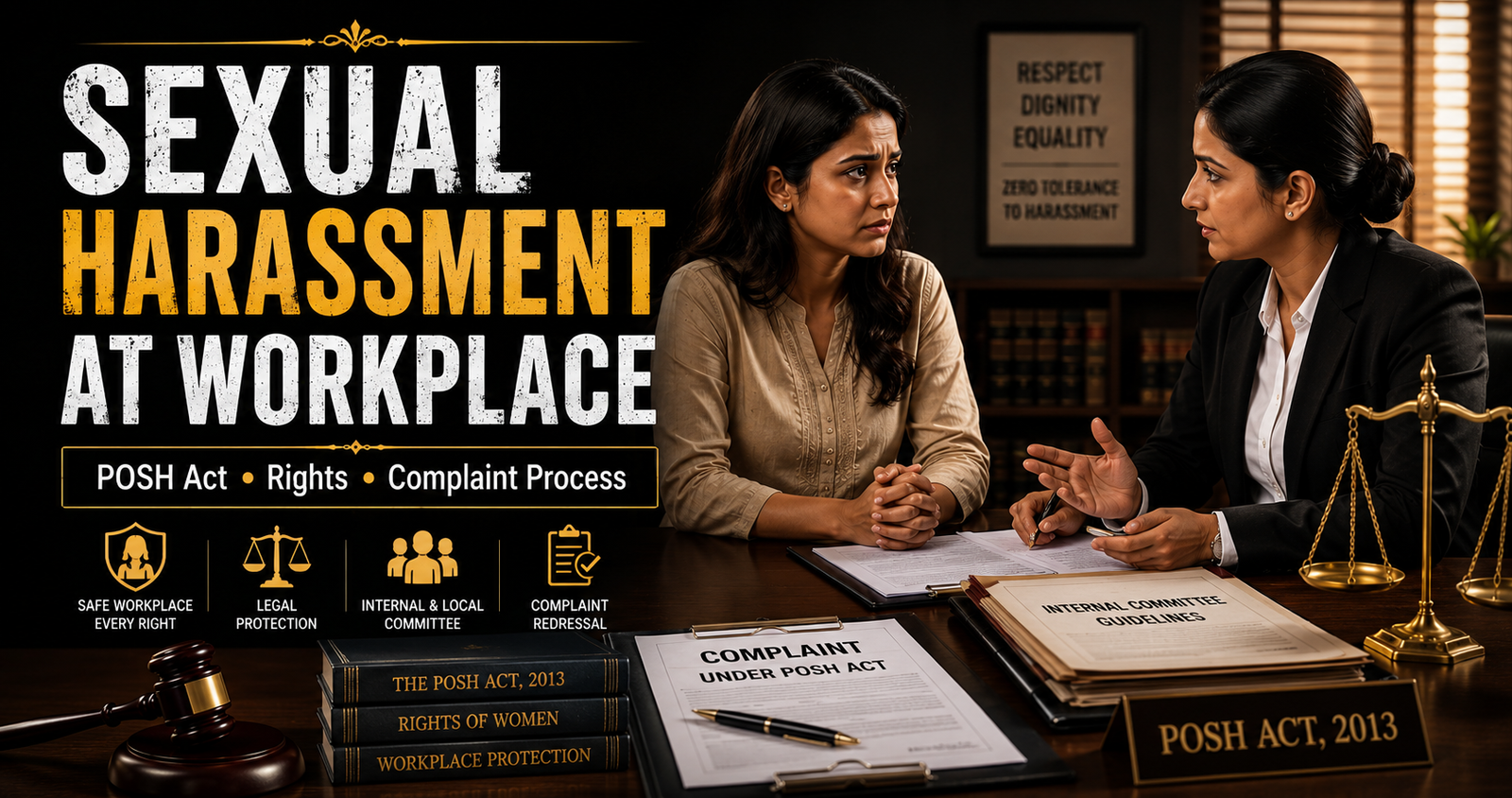
Sexual Harassment at Workplace in India
Sexual harassment at the workplace is not simply inappropriate behaviour or an uncomfortable interaction. Depending on the facts, unwelcome physical, verbal or non-verbal conduct of a sexual nature can amount to sexual harassment and may have serious legal consequences.
In India, workplace sexual harassment involving women is specifically addressed by the Sexual Harassment of Women at Workplace (Prevention, Prohibition and Redressal) Act, 2013, commonly known as the POSH Act. The law provides a framework for prevention, prohibition and redressal of complaints at the workplace.
For an employee facing such conduct, understanding the complaint process and available legal remedies is important. For employers, compliance with the POSH framework is equally important.
What is Sexual Harassment?
The POSH Act defines sexual harassment to include certain unwelcome acts or behaviour, whether directly or by implication.
These may include:
- Unwelcome physical contact or advances
- A demand or request for sexual favours
- Sexually coloured remarks
- Showing pornography against the person’s wishes
- Other unwelcome physical, verbal or non-verbal conduct of a sexual nature
The Act also recognises circumstances where such behaviour may involve an implied or explicit promise of preferential treatment, a threat of detrimental treatment, a threat concerning employment status, interference with work, creation of an intimidating or hostile work environment, or humiliating treatment affecting health or safety.
Therefore, sexual harassment at workplace is not limited to physical touching. Words, messages, conduct and workplace circumstances may also become relevant depending on the facts.
What is the POSH Act, 2013?
The POSH Act, 2013 was enacted to provide protection against sexual harassment of women at the workplace and to establish a mechanism for prevention and redressal of complaints. The Act came into force on 9 December 2013.
The law places responsibilities on employers and provides a formal mechanism through which an aggrieved woman can raise a complaint.
The Act is particularly important because workplace sexual harassment can occur in many professional environments, including offices, institutions, hospitals, educational organisations, private-sector establishments and other places covered by the statutory definition of workplace.
What Counts as a Workplace?
The legal meaning of workplace under the POSH Act is broader than an ordinary office.
Depending on the circumstances, it can include:
- Government and private organisations
- Offices and commercial establishments
- Educational institutions
- Hospitals and nursing homes
- Sports institutions and venues
- Places visited during employment
- Employer-provided transportation
- Certain dwelling places or houses
- Other establishments covered by the Act
This means that an incident does not necessarily have to happen inside a traditional office building to raise a workplace sexual harassment issue.
Examples of Sexual Harassment at Workplace
Every uncomfortable interaction is not automatically a legally established case of sexual harassment. The facts, context, nature of the conduct and whether it was unwelcome are important.
Examples that may raise concerns include:
1. Unwanted Physical Conduct
Unwelcome touching, physical advances or other inappropriate physical behaviour may fall within the statutory definition.
2. Sexual Remarks or Comments
Repeated sexually coloured comments, inappropriate jokes or remarks of a sexual nature may become relevant.
3. Unwanted Sexual Requests
A demand or request for sexual favours can amount to sexual harassment under the POSH Act.
4. Unwanted Pornographic Material
Showing pornography against the will of a woman is specifically included within the statutory definition.
5. Employment-Related Pressure
A situation where workplace benefits, promotions or employment consequences are connected with unwanted sexual conduct may require serious legal attention.
6. Hostile or Intimidating Environment
Conduct that creates an intimidating, offensive or hostile work environment may also fall within the circumstances recognised by the POSH framework.
Who Can File a Sexual Harassment Complaint?
The POSH Act provides protection to an aggrieved woman who alleges that she has been subjected to sexual harassment at the workplace.
The statutory definition covers a woman of any age in relation to a workplace, whether employed or not, who alleges that she has been subjected to an act of sexual harassment. Special provisions also apply to domestic workers in the circumstances covered by the Act.
The precise legal remedy in a particular situation can depend on the facts and the identity of the parties involved.
How to File a Sexual Harassment Complaint?
One of the most important aspects of the POSH framework is the formal complaint mechanism.
Step 1: Prepare the Complaint
The complaint should be made in writing and should provide relevant details of the incident or incidents.
Where the woman is unable to make the complaint in writing, the Presiding Officer or a member of the Internal Committee, or the Chairperson/member of the Local Committee, as applicable, is required to provide reasonable assistance in making the complaint.
Step 2: Submit the Complaint to the Appropriate Committee
Where an Internal Committee has been constituted, the complaint can ordinarily be submitted to that committee.
Where the statutory conditions for a Local Committee apply, the complaint may be made to the Local Committee. This can include establishments where an Internal Committee has not been constituted because there are fewer than ten workers, or where the complaint is against the employer himself.
Step 3: Preserve Supporting Material
Depending on the circumstances, relevant material may include:
- Emails
- Messages
- Screenshots
- Letters
- Workplace communications
- Relevant documents
- Names of potential witnesses
- Other records connected with the incident
The material should be preserved in its original form wherever possible.
Step 4: Participate in the Process
The complainant may be required to provide information and participate in the inquiry process. The committee examines the complaint and the response of the respondent according to the applicable procedure.
What is the Time Limit for a POSH Complaint?
Under Section 9 of the POSH Act, a complaint is generally to be made within three months from the date of the incident.
In the case of a series of incidents, the period is generally calculated from the date of the last incident.
The Internal Committee or Local Committee may extend the period by up to another three months where it records reasons in writing and is satisfied that circumstances prevented the woman from filing the complaint within the original period.
Because limitation requirements can affect the complaint process, it is advisable not to delay unnecessarily.
What is the Role of the Internal Committee?
The Internal Committee (IC) is an important part of the POSH framework.
The Act requires employers to constitute an Internal Committee at covered workplaces in accordance with the statutory requirements. Its composition includes a woman Presiding Officer, employee members and an external member meeting the requirements prescribed by law.
The committee is responsible for dealing with complaints within its jurisdiction and conducting the statutory inquiry process.
An employer should not treat the Internal Committee as merely a formality. Proper constitution and functioning of the committee are important aspects of POSH compliance.
What is the Local Committee?
The Local Committee is intended to receive complaints in circumstances where an Internal Committee has not been constituted because the establishment has fewer than ten workers, or where the complaint is against the employer himself, subject to the statutory framework.
The District Officer constitutes the Local Committee for the district.
This mechanism is particularly important for women working in smaller establishments where an Internal Committee may not exist.
Can a Sexual Harassment Complaint Be Settled?
The POSH Act provides for conciliation before the inquiry, but it can be undertaken at the request of the aggrieved woman and subject to the statutory conditions.
The law specifically provides that monetary settlement should not be made the basis of such conciliation.
Therefore, a complainant should understand the consequences of any proposed settlement before agreeing to it.
What Happens During the Inquiry?
Once a complaint proceeds to inquiry, the committee considers the allegations and the response of the respondent in accordance with the applicable procedure.
The parties may be required to provide relevant information, documents or other material.
The committee’s role is not simply to accept an allegation or a denial without examination. The inquiry is intended to assess the complaint based on the material and procedure prescribed under the law.
Confidentiality is also an important part of the POSH framework. Information relating to the complaint and inquiry should not be casually disclosed or circulated.
Can Sexual Harassment Also Become a Criminal Case?
Yes, depending on the conduct and circumstances.
The POSH Act provides a workplace complaint and redressal mechanism, but certain acts may also constitute offences under criminal law.
Under Section 75 of the Bharatiya Nyaya Sanhita, 2023, specified acts including unwelcome explicit sexual overtures involving physical contact, demands or requests for sexual favours, showing pornography against a woman’s will, and sexually coloured remarks are addressed as the offence of sexual harassment, subject to the statutory requirements.
Therefore, a workplace complaint and a criminal complaint are not necessarily the same legal process. The appropriate course depends on the facts of the incident.
What Should an Employer Do in a Sexual Harassment Matter?
Employers have important responsibilities under the POSH framework.
A workplace should have an appropriate mechanism for receiving and dealing with complaints and should take reasonable steps to prevent sexual harassment.
Employers should also ensure that the Internal Committee is properly constituted where required and that employees are aware of the applicable complaint mechanism.
Ignoring a complaint, discouraging a complainant from reporting an incident, or treating POSH compliance as paperwork can create serious legal and organisational problems.
Why Legal Advice Can Be Important
A sexual harassment complaint can involve sensitive facts, workplace relationships, evidence, confidentiality and legal consequences.
Legal advice may be useful when:
- The allegations are disputed
- The complaint involves a senior employee or employer
- The Internal Committee is not functioning properly
- The complainant is concerned about retaliation
- Important evidence needs to be preserved
- A criminal offence may also be involved
- A party wants to understand the inquiry procedure
- The matter may proceed to another legal forum
A lawyer can review the available facts and documents and explain the legal options applicable to the particular situation.
Frequently Asked Questions About Sexual Harassment
1. What is sexual harassment at workplace?
It includes specified unwelcome physical, verbal or non-verbal conduct of a sexual nature and other circumstances covered by the POSH Act.
2. What is the POSH Act?
The POSH Act is the Sexual Harassment of Women at Workplace (Prevention, Prohibition and Redressal) Act, 2013, which provides a statutory framework for prevention and redressal of workplace sexual harassment complaints.
3. How long do I have to file a POSH complaint?
The complaint is generally required to be made within three months from the incident or, for a series of incidents, from the last incident. The committee may extend this by up to another three months for recorded reasons in appropriate circumstances.
4. What if my workplace has fewer than 10 employees?
The Local Committee mechanism may apply where an Internal Committee has not been constituted because the establishment has fewer than ten workers, subject to the statutory conditions.
5. Can I complain against the employer?
Yes. The POSH framework specifically provides for situations where the complaint is against the employer, including the circumstances in which the Local Committee receives the complaint.
6. Is every inappropriate comment sexual harassment?
Not necessarily. Whether conduct legally amounts to sexual harassment depends on the nature of the conduct, whether it was unwelcome, the circumstances and the applicable statutory provisions.
7. Can WhatsApp messages or emails be relevant?
They may be relevant evidence depending on the facts. It is advisable to preserve potentially important electronic communications rather than deleting or altering them.
8. Is a criminal complaint possible in addition to a POSH complaint?
Depending on the facts, conduct may also constitute an offence under criminal law. Section 75 of the Bharatiya Nyaya Sanhita, 2023 addresses specified forms of sexual harassment.
9. Is the POSH inquiry confidential?
The POSH framework contains confidentiality requirements concerning information relating to complaints and proceedings. Parties should avoid publicly circulating sensitive details.
10. Should I consult a lawyer before filing a complaint?
Legal advice can be useful where the matter is complicated, disputed, involves senior management, raises criminal-law issues, or requires careful handling of evidence and procedure.
Sexual harassment at workplace is a serious legal issue that should not be ignored. The POSH Act provides a structured mechanism for prevention and redressal of complaints involving women at covered workplaces, while criminal law may also apply where the conduct amounts to an offence.
If you are facing sexual harassment, it is important to preserve relevant evidence, understand the applicable complaint mechanism and act within the prescribed time limits. Employers should also ensure that their workplace complies with the statutory requirements and that complaints are handled through the appropriate process.
HoBo Legal & Associates can assist with legal matters involving workplace sexual harassment, POSH complaints, employment disputes and related legal proceedings.
Legal Disclaimer
This article is provided for general legal information and awareness only. It does not constitute legal advice or create an advocate-client relationship. The applicable legal remedy depends on the facts, evidence, parties involved and current law. For advice concerning a specific matter, consult a qualified legal professional.