Motor Accident Claim Process in India: Step-by-Step Guide to MACT Claims and Compensation
A road accident can change a person’s life within minutes. Apart from physical injuries, an accident may result in hospital expenses, loss of income, permanent disability, vehicle damage or even the death of a family member.
In such situations, understanding the Motor Accident Claim Process in India becomes important. Depending on the facts of the accident, an injured person, property owner or the legal representatives of a deceased person may have a right to seek compensation under the Motor Vehicles Act, 1988.
Motor accident compensation claims are commonly dealt with before the Motor Accident Claims Tribunal (MACT). The Tribunal can adjudicate claims arising from death, bodily injury and third-party property damage resulting from the use of motor vehicles.
This article explains the Motor Accident Claim Process in India, MACT claims, required documents, compensation, insurance involvement and the general procedure from the accident to the final award.
What Is a Motor Accident Claim?
A motor accident claim is a legal claim for compensation arising from an accident involving a motor vehicle.
Depending on the circumstances, a claim may involve:
- Road accident injuries
- Permanent disability
- Death in a motor vehicle accident
- Medical expenses
- Loss of income
- Future loss of earning capacity
- Pain and suffering
- Rehabilitation expenses
- Loss suffered by dependants
- Third-party property damage
Section 166 of the Motor Vehicles Act provides for applications for compensation in specified motor accident cases. An injured person, owner of damaged property, legal representatives of a deceased person, or an authorised agent may make an application as provided by law.
What Is MACT?
MACT stands for Motor Accident Claims Tribunal.
Under Section 165 of the Motor Vehicles Act, State Governments may constitute Claims Tribunals to deal with compensation claims arising from motor vehicle accidents involving death, bodily injury or third-party property damage.
A MACT case is therefore different from an ordinary civil money-recovery case. The Tribunal examines the accident, evidence, injuries or death, liability and the amount of compensation payable under the applicable law.
Who Can File a Motor Accident Claim?
The person who suffered the injury can file a claim.
In a fatal accident case, the legal representatives of the deceased may file the claim in accordance with Section 166. The law also provides for situations where one or more legal representatives make the application for the benefit of all legal representatives.
Depending on the case, a claim may therefore be made by:
- An injured accident victim
- The owner of damaged property
- Legal representatives of a deceased victim
- An authorised agent, where legally permitted
Motor Accident Claim Process in India
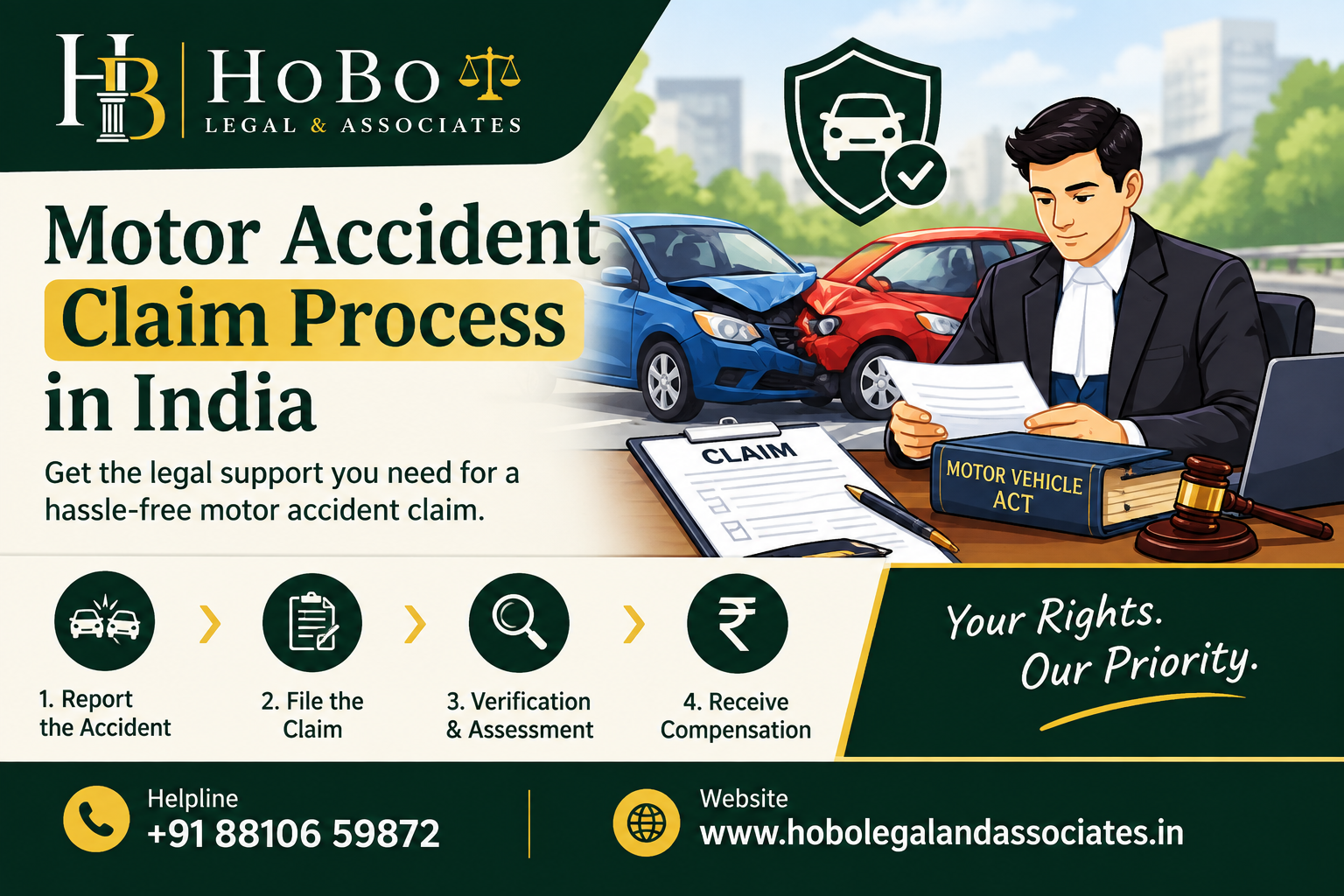
The Motor Accident Claim Process in India generally involves several stages. The exact procedure can vary depending on the facts of the accident, the documents available, the insurance position and the proceedings before the Tribunal.
Step 1: Report the Accident
After an accident, the incident should be reported to the police as required by the circumstances.
The police record, accident information, site details, witness information and other investigation material may become important evidence in a subsequent MACT claim.
The victim should also preserve any available photographs or videos of the accident scene, damaged vehicles and injuries.
Step 2: Obtain Medical Treatment
Medical treatment should be taken as soon as reasonably possible.
Keep records such as:
- Hospital admission papers
- Emergency treatment records
- Medical prescriptions
- Diagnostic reports
- Medical bills
- Discharge summary
- Physiotherapy records
- Disability-related medical documents
- Follow-up treatment records
Medical evidence can become particularly important when compensation is claimed for serious injuries or permanent disability.
Step 3: Collect Accident-Related Documents
A proper document file can make the claim process easier.
Common documents may include:
- FIR or police complaint, where applicable
- Accident report and investigation documents
- Medical records
- Medical bills
- Discharge summary
- Identity proof
- Address proof
- Driving licence, where relevant
- Vehicle Registration Certificate
- Insurance policy
- Income documents
- Employment records
- Disability certificate, where applicable
- Photographs and videos
- Witness details
- Death certificate in fatal accident cases
- Post-mortem report, where applicable
- Legal-heir documents in death cases
The exact documents required can differ from one case to another.
Step 4: Identify the Vehicles and Insurance Details
The registration number of the vehicle involved in the accident is important.
The claimant may need to identify:
- The vehicle owner
- The driver
- The insurer
- Insurance policy details
- Vehicle registration details
- Driving licence details, where relevant
Insurance issues can become complicated where there are questions concerning policy coverage, licence conditions, vehicle use or other circumstances.
Step 5: Determine the Appropriate Compensation Claim
The amount claimed should be supported by the facts and available evidence.
In an injury case, relevant factors may include:
- Nature of injuries
- Medical expenses
- Duration of treatment
- Loss of income
- Permanent disability
- Effect of disability on earning capacity
- Future medical needs
- Rehabilitation requirements
- Other legally recognised heads of compensation
In a death claim, the assessment may involve factors such as the deceased person’s income, age, dependants and other legally relevant circumstances.
There is no single fixed compensation amount applicable to every accident. The facts and evidence of each case matter.
Step 6: Filing the MACT Claim
A compensation application may be filed before the appropriate Claims Tribunal.
Section 166 provides jurisdictional options for filing an application, including the Tribunal having jurisdiction over the area where the accident occurred and, subject to the statutory requirements, certain jurisdictions connected with the claimant or defendant.
The claim petition generally sets out details such as:
- Date and place of accident
- Vehicles involved
- Circumstances of accident
- Injuries or death
- Medical treatment
- Income and occupation
- Dependants, where applicable
- Insurance details
- Compensation being claimed
- Supporting documents and evidence
Step 7: Notice to the Respondents and Insurer
Once the claim is before the Tribunal, notice may be issued to the relevant parties, including the insurer.
Section 168 provides that the Claims Tribunal conducts an inquiry after giving the insurer and other parties an opportunity to be heard.
The insurer may raise issues concerning liability, policy coverage and other legally relevant defences depending on the facts of the case.
Step 8: Evidence and Tribunal Proceedings
The Tribunal examines the evidence presented by the parties.
Evidence may include:
- Police records
- Medical records
- Hospital documents
- Bills
- Witness statements
- Photographs
- Accident reports
- Income records
- Insurance documents
- Disability evidence
- Other relevant documents
The Claims Tribunal has powers relating to evidence and attendance of witnesses under the statutory framework.
Step 9: Determination of Compensation
After considering the evidence, the Tribunal determines the compensation payable according to law.
Section 168 provides that the Tribunal may make an award determining the amount of compensation that appears to it to be just and specify the person or persons to whom the compensation is to be paid.
The award can also specify the amount payable by the insurer, owner or driver, as applicable.
Step 10: Payment of the Award
After an award is passed, the amount is required to be deposited in accordance with the Tribunal’s directions.
Section 168 provides that the person required to pay the awarded amount shall deposit it within the period specified by the provision, subject to the Tribunal’s directions.
What Compensation Can Be Claimed in a Motor Accident Case?
The compensation depends on the facts of the case and the evidence available.
Potential components may include:
Medical Expenses
Reasonable medical expenses supported by appropriate records may form part of an injury claim.
Loss of Income
If an accident prevents the victim from working, the resulting loss of income may be relevant to the compensation assessment.
Permanent Disability
Where an accident results in permanent disability, the effect of the disability may need to be examined, including its impact on earning capacity.
Future Medical Expenses
In appropriate cases, future medical treatment or rehabilitation requirements may be relevant.
Compensation in Death Cases
Where an accident results in death, the legal representatives may pursue compensation under the applicable legal framework. The assessment can involve factors such as the deceased’s income, age and dependency.
Property Damage
Third-party property damage arising from the use of a motor vehicle can also fall within the Claims Tribunal framework under Section 165.
How Long Does a MACT Case Take?
There is no universal fixed period within which every MACT case will be decided.
The duration may depend on:
- Complexity of the accident
- Number of parties
- Insurance disputes
- Availability of documents
- Medical evidence
- Witnesses
- Court or Tribunal workload
- Settlement discussions
- Appeals or other proceedings
Some matters may resolve through settlement, while others may require a full Tribunal proceeding.
Can a Motor Accident Claim Be Settled?
In suitable cases, parties may explore settlement.
The possibility of settlement depends on the nature of the dispute, the parties involved, the insurance position and the applicable legal procedure.
Eligible motor accident claim matters may also be considered in Lok Adalat proceedings where the matter is legally capable of settlement. HoBo Legal & Associates’ existing information on Lok Adalat explains that motor accident claim matters can be among disputes considered for settlement, subject to eligibility and the applicable process.
However, a settlement should be considered only after understanding its legal effect and the compensation being offered.
What If the Insurance Company Disputes the Claim?
An insurer may raise various legal issues depending on the facts.
For example, disputes may concern:
- Whether the policy covered the vehicle
- Whether the vehicle was insured on the accident date
- Driving licence issues
- Policy conditions
- Nature of vehicle use
- Liability of different parties
- Amount of compensation
Such disputes are generally examined on the basis of the applicable law, policy documents and evidence before the competent forum.
Important Things to Do After a Motor Accident
If you are involved in a road accident, some practical steps can help preserve important evidence:
- Seek medical attention promptly.
- Report the accident to the appropriate authorities where required.
- Keep copies of all medical records and bills.
- Preserve photographs and videos of the accident.
- Note vehicle registration and insurance details.
- Keep details of witnesses, if available.
- Preserve employment and income documents where loss of income is involved.
- Do not discard damaged vehicle or medical evidence before it is properly documented.
- Keep copies of all notices and correspondence from insurers.
- Obtain legal advice where liability, serious injury, disability, death or insurance disputes are involved.
HoBo Legal & Associates – Motor Accident Claim Assistance
HoBo Legal & Associates – Motor Vehicle Accident Law assists clients with motor accident claims, MACT cases, road accident compensation, personal injury claims, fatal accident claims, permanent disability matters, insurance disputes, third-party claims, vehicle damage claims and related legal proceedings.
The firm also lists Motor Accident Law as a practice area covering MACT claims, injury compensation, insurance disputes and road accident legal matters.
For readers dealing with a road accident claim, relevant internal resources include:
- Motor Vehicle Accident Law
- Motor Accident Claims (MACT)
- Road Accident Compensation
- Traffic Challan & Driving Offence Cases
- Lok Adalat Online Registration Process
The appropriate legal route depends on the facts of the accident, the evidence available and the applicable law.
Frequently Asked Questions About Motor Accident Claims
1. What is the Motor Accident Claim Process in India?
The process generally involves reporting the accident, obtaining medical treatment, collecting evidence, identifying the vehicle and insurer, preparing the compensation claim, filing the claim before the appropriate MACT, participating in proceedings and obtaining an award or settlement.
2. What is MACT?
MACT means Motor Accident Claims Tribunal. It is a statutory Tribunal constituted to adjudicate specified compensation claims arising from motor vehicle accidents.
3. Who can file a motor accident claim?
An injured person, owner of damaged property, legal representatives of a deceased person and an authorised agent in appropriate circumstances may file a claim under Section 166.
4. Can family members claim compensation after a fatal accident?
Yes. Section 166 provides for claims by all or any of the legal representatives of a person whose death resulted from the accident, subject to the statutory framework.
5. What documents are required for a MACT claim?
Documents may include police records, medical documents, bills, identity documents, vehicle and insurance details, income records, disability documents and other evidence relevant to the accident and compensation claim.
6. Can compensation be claimed for permanent disability?
A claim involving permanent disability may include compensation based on the nature and consequences of the disability, subject to the evidence and applicable law.
7. Can medical expenses be included in a motor accident claim?
Medical expenses supported by relevant records and bills may be considered as part of an injury compensation claim, depending on the facts of the case.
8. Can a motor accident claim be settled through Lok Adalat?
Eligible motor accident matters may be considered for settlement through Lok Adalat where the matter is legally capable of settlement and the applicable procedure is followed.
9. Does every motor accident automatically result in compensation?
Not every accident results in an identical compensation award. Liability, evidence, injuries, insurance, causation and other legal issues have to be examined in the particular case.
10. Why is legal advice useful in a MACT case?
A motor accident claim may involve medical evidence, insurance disputes, income records, disability assessment, liability questions and Tribunal procedure. A legal review can help identify the appropriate claim, documents and legal proceedings for the particular circumstances.
The Motor Accident Claim Process in India involves more than simply submitting an insurance claim. A serious accident may require police records, medical evidence, insurance documents, income records and proceedings before the Motor Accident Claims Tribunal (MACT).
The Motor Vehicles Act, 1988 provides the statutory framework for compensation claims arising from specified motor vehicle accidents. The appropriate compensation and legal remedy depend on the facts and evidence of each case.
If an accident has resulted in serious injury, permanent disability, death, property damage or an insurance dispute, keeping the relevant documents and understanding the applicable legal procedure can be important before taking the next step.
Legal Disclaimer
This article is provided for general informational and educational purposes only and should not be treated as legal advice or a legal opinion. Motor accident claims depend on the facts of each case, applicable laws, evidence and judicial interpretation. Readers should obtain case-specific legal advice before taking legal action. Accessing this article or the HoBo Legal & Associates website does not create an advocate-client relationship.