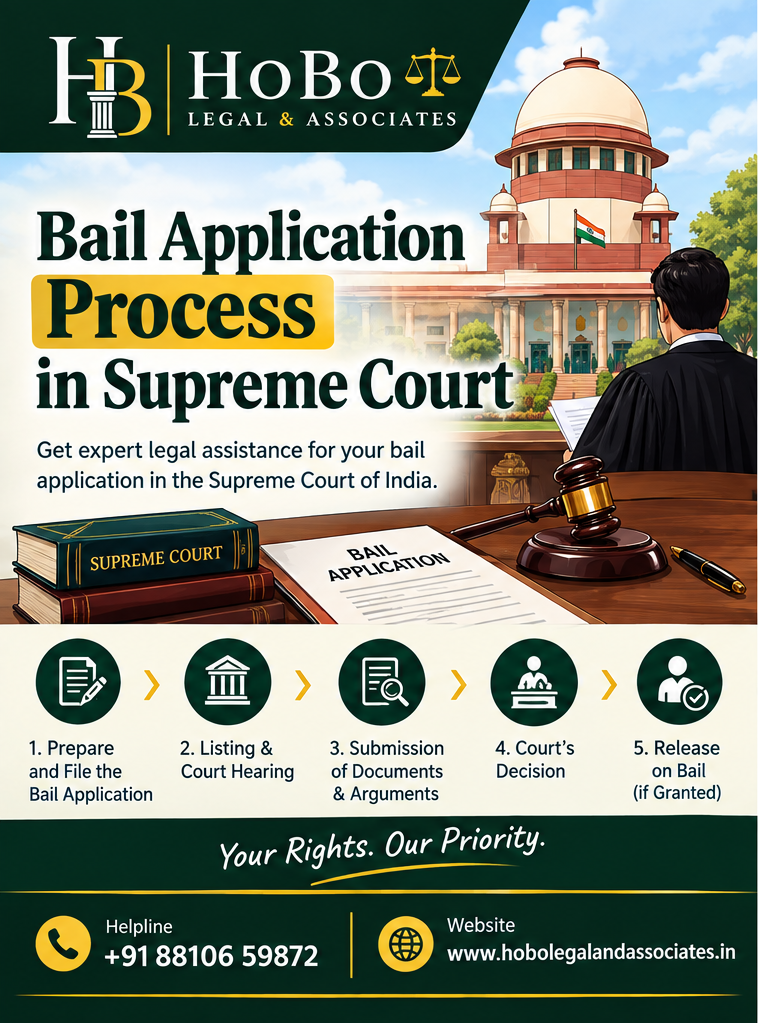
Bail Application Process in Supreme Court: Procedure, Documents & Legal Remedies
The Bail Application Process in Supreme Court involves specific procedural and jurisdictional considerations. A bail matter may reach the Supreme Court through an appropriate criminal appeal, Special Leave Petition or another legally maintainable proceeding.
The Supreme Court Bail process depends on the previous orders, nature of the criminal case and legal remedy available in the particular matter.
Can Bail Be Sought in the Supreme Court?
Yes, the Supreme Court can consider bail-related matters within its jurisdiction.
Depending on the circumstances, a matter may come before the Supreme Court through:
- Special Leave Petition (SLP)
- Criminal appeal
- Appropriate constitutional or statutory proceeding
- Other legally maintainable remedies
The appropriate route depends on the facts and previous court orders.
Bail Application Process in Supreme Court
Step 1: Review Previous Court Orders
The first step is to examine the orders passed by the Magistrate, Sessions Court or High Court.
Step 2: Identify the Appropriate Legal Remedy
An advocate should determine whether the matter should proceed as a Special Leave Petition (SLP), criminal appeal or another appropriate proceeding.
Step 3: Prepare the Case Documents
Important documents may include the FIR, previous bail applications, rejection orders, charge-sheet and other relevant records.
Step 4: Draft the Petition
The petition should contain the relevant facts, legal grounds and relief sought in accordance with applicable Supreme Court procedure.
Step 5: Filing and Registry Scrutiny
The matter is filed before the Supreme Court and is subject to applicable filing and registry requirements.
Step 6: Hearing
The court hears the matter and considers the submissions, documents, applicable law and circumstances.
Step 7: Compliance With the Order
If Supreme Court Bail is granted, the accused must comply with the conditions and directions contained in the order.
Documents Required for Supreme Court Bail
Depending on the matter, documents may include:
- FIR
- Charge-sheet, where available
- Previous bail applications
- Sessions Court orders
- High Court orders
- Medical documents, where relevant
- Details of previous proceedings
- Vakalatnama and filing documents
- Other documents required by the Supreme Court Registry
Anticipatory Bail and Supreme Court Proceedings
Anticipatory Bail is a pre-arrest remedy under Section 482 BNSS.
The provision concerns a person who has reason to believe that they may be arrested for a non-bailable offence and permits an application before the High Court or Court of Session subject to statutory requirements.
A Supreme Court proceeding concerning anticipatory bail must be assessed in light of the previous orders and appropriate legal remedy.
Interim Bail in Supreme Court
Interim Bail may be granted as temporary relief in an appropriate case.
The court may specify the duration and conditions of such relief. Interim relief does not automatically mean that final bail will subsequently be granted.
What Happens If Bail Is Rejected by the High Court?
Where legally maintainable, a person may approach the Supreme Court after an adverse High Court order.
The appropriate remedy depends upon:
- The High Court order
- Grounds for rejection
- Nature of the offence
- Stage of investigation or trial
- Available legal jurisdiction
- Any subsequent change in circumstances
HoBo Legal & Associates for Supreme Court Bail Matters
HoBo Legal & Associates assists clients in understanding criminal proceedings and available legal remedies relating to Supreme Court Bail and other criminal matters.
Website: https://hobolegalandassociates.in/
Helpline: +91 88106 59872
Frequently Asked Questions
1. What is the Bail Application Process in Supreme Court?
It generally involves reviewing previous orders, identifying the appropriate legal remedy, preparing the required petition and documents, filing the matter and appearing for hearing.
2. Can bail be sought directly from the Supreme Court?
The maintainability of a matter depends on the circumstances and jurisdiction. Not every bail issue can simply be filed directly before the Supreme Court.
3. What is an SLP?
A Special Leave Petition (SLP) is a constitutional remedy under Article 136, subject to the Supreme Court’s jurisdiction and applicable requirements.
4. Can the Supreme Court grant Interim Bail?
Yes, the Supreme Court may grant Interim Bail in an appropriate matter subject to its order and conditions.
5. What documents are required?
The documents depend upon the case but previous court orders, FIR and relevant criminal case records are generally important.
6. Can Supreme Court Bail have conditions?
Yes. The court may impose conditions while granting bail.
7. How long does a Supreme Court bail matter take?
There is no fixed period. Filing, scrutiny, listing, urgency and court directions can affect the timeline.
8. Can anticipatory bail matters reach the Supreme Court?
Yes, where an appropriate and legally maintainable proceeding reaches the Supreme Court.
9. Can bail be sought after rejection by the High Court?
A higher-court remedy may be available depending on the circumstances and applicable law.
10. Should I consult an advocate?
Yes, case-specific legal advice can help determine the appropriate remedy, documents and procedural requirements.
Legal Disclaimer: This article is for general legal awareness and does not constitute legal advice.