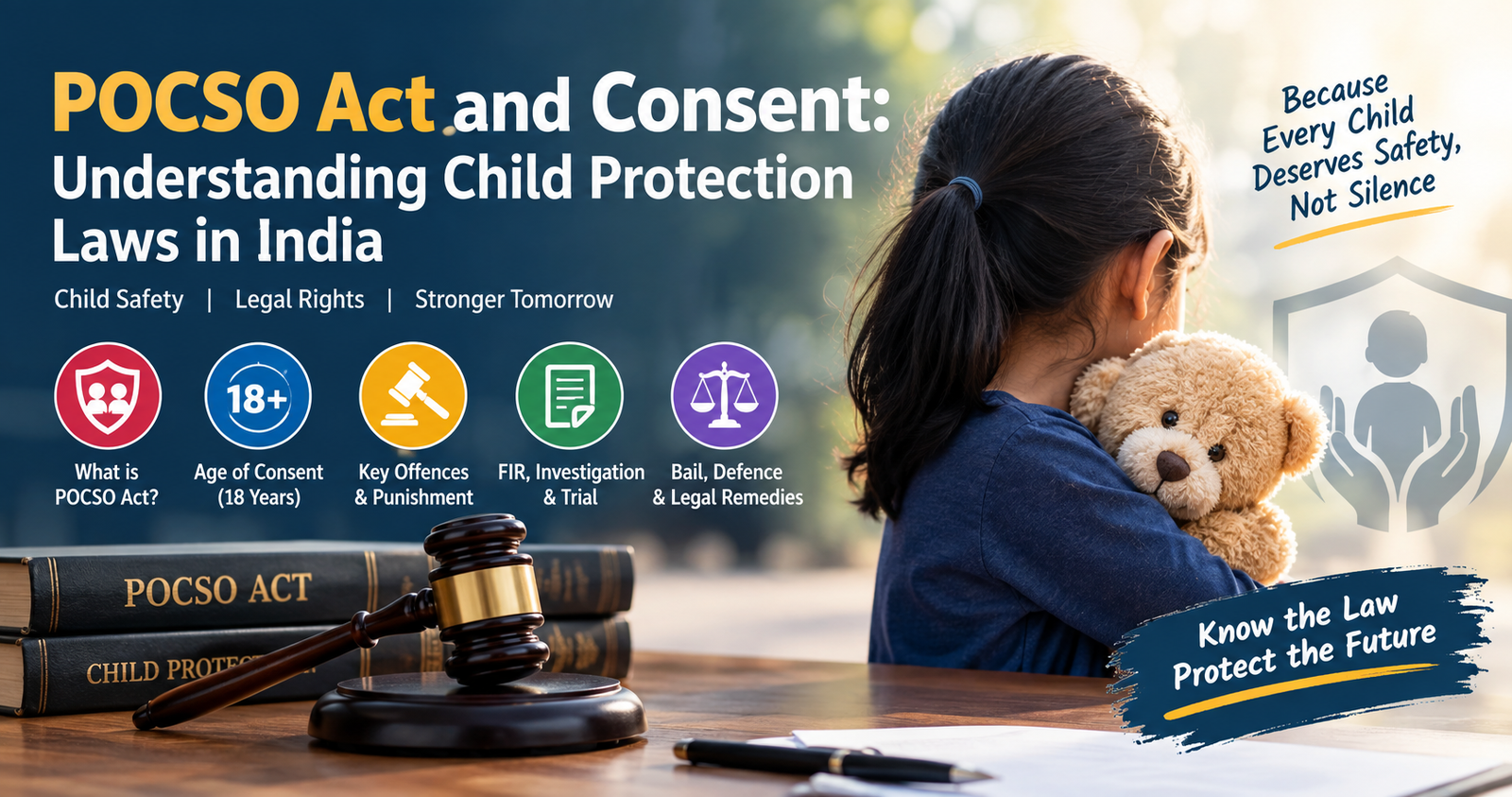
Understand POCSO Act and consent in India, including the 18-year age rule, offences, bail, evidence, FIR, trial and legal remedies.
POCSO Act and Consent is an important legal issue in India, particularly in cases involving sexual acts where one person is below the age of 18 years. The Protection of Children from Sexual Offences Act, 2012, commonly known as the POCSO Act, was enacted specifically to protect children from sexual assault, sexual harassment and pornography and to provide a child-sensitive legal framework for investigation and trial.
One of the most misunderstood questions is whether a child’s consent can be used as a defence in a POCSO case.
The short answer is that the legal position concerning a child below 18 is fundamentally different from the concept of consent between adults. POCSO defines a child as a person below 18 years of age, and the Supreme Court has recognised that the statutory framework protects children from sexual activity even where the circumstances are described as consensual.
This blog explains the relationship between POCSO and consent, relevant offences, age determination, FIR and investigation, bail, trial, evidence, and important legal considerations.
Quick Answer: Does Consent Matter in a POCSO Case?
Under the POCSO framework, a child is a person below 18 years of age. Therefore, an allegation involving sexual activity with a child cannot be treated in the same manner as a consensual sexual relationship between two adults.
The Supreme Court has expressly noted that the POCSO Act elevates the age of consent to 18 years and that the Act applies to children regardless of gender.
This means that simply saying:
“The child consented”
does not by itself remove the applicability of POCSO.
However, every POCSO case still depends upon its specific facts, age evidence, allegations, medical and electronic evidence, witness statements, statutory ingredients and other material placed before the court.
1. What Is the POCSO Act?
The Protection of Children from Sexual Offences Act 2012 is a special legislation designed to protect children from sexual offences.
The Ministry of Women and Child Development lists the POCSO Act, along with the POCSO Rules, 2020, among the relevant child-protection legislation and rules.
The Act deals with offences including:
- Penetrative sexual assault
- Aggravated penetrative sexual assault
- Sexual assault
- Aggravated sexual assault
- Sexual harassment
- Using a child for pornographic purposes
- Certain offences involving storage or possession of child sexual abuse material
The law also provides special procedures intended to make investigation and trial more sensitive to the needs and protection of children.
2. Who Is a “Child” Under POCSO?
The age of the person involved is one of the most important facts in a POCSO proceeding.
For the purpose of POCSO, a child means a person below 18 years of age.
Therefore:
| Age on the relevant date | POCSO definition |
|---|---|
| Below 18 years | Child |
| 18 years or above | Not a “child” under POCSO |
The relevant date is generally the date on which the alleged offence occurred.
Why Is Age So Important?
Because the legal consequences can change substantially depending upon whether the person was below 18 on the date of the alleged incident.
For this reason, age-related documents and evidence may become extremely important in a POCSO investigation and trial.
3. POCSO Act and Consent: The Central Legal Issue
The concept of consent under criminal law becomes particularly important when comparing adult sexual relationships with allegations involving children.
For adults, consent can be a significant legal issue depending upon the offence and circumstances.
For a child below 18, however, POCSO operates on a different statutory framework.
The Supreme Court has observed that the POCSO Act applies to all children regardless of gender and that the Act effectively treats the age of 18 as the relevant age of consent for the statutory protection of children.
Therefore, the following circumstances do not automatically prevent POCSO provisions from being invoked:
- The child allegedly agreed to the relationship.
- The child and accused were in a romantic relationship.
- The child voluntarily met the accused.
- The child voluntarily travelled with the accused.
- The parties communicated through phone or social media.
- The parties claimed to intend marriage.
The legal effect of each fact depends upon the specific offence alleged and the evidence available in the case.
4. Why “We Were in a Relationship” Does Not Automatically End a POCSO Case
Teenage relationships can create complicated factual situations.
A person accused in a POCSO case may claim that:
- the relationship was voluntary;
- there was no force;
- the child initiated communication;
- both parties were emotionally involved;
- there was a promise of marriage; or
- the relationship continued for some period.
These facts may form part of the defence narrative, but they do not automatically eliminate the statutory question of whether the alleged conduct falls within a POCSO offence.
The Supreme Court has dealt with cases involving adolescent relationships and has emphasised the statutory protection afforded to children under POCSO.
5. Consent and Promise of Marriage
A particularly sensitive category involves allegations where the accused and the minor were allegedly in a relationship and the accused allegedly made a promise of marriage.
Such cases require careful examination of:
- The actual age of the child.
- The date of the alleged incident.
- The exact nature of the alleged promise.
- The conduct of the parties.
- Communications between them.
- The allegations in the FIR.
- Statements recorded during investigation.
- Medical and forensic evidence, where relevant.
- Electronic evidence.
- The precise statutory provisions invoked.
A promise of marriage does not automatically make every case legally identical. The court must consider the statutory ingredients and evidence applicable to the particular case.
The Supreme Court has also considered cases where allegations involved a relationship and a claimed promise of marriage, demonstrating why the precise facts and evidence matter.
6. Important POCSO Offences
Section 3 – Penetrative Sexual Assault
Section 3 deals with penetrative sexual assault involving a child.
The statutory definition covers specified forms of penetration involving a child.
The punishment is provided under Section 4.
Section 5 – Aggravated Penetrative Sexual Assault
Section 5 identifies circumstances that make penetrative sexual assault aggravated.
The punishment is provided under Section 6.
Section 7 – Sexual Assault
Section 7 concerns sexual assault involving physical contact with sexual intent under the circumstances specified by the Act.
The punishment is provided under Section 8.
Section 9 – Aggravated Sexual Assault
Section 9 identifies circumstances that make sexual assault aggravated.
The punishment is provided under Section 10.
Section 11 – Sexual Harassment
Section 11 deals with specified forms of sexual harassment of a child.
The punishment is provided under Section 12.
7. Can a Child’s Statement Become Important Evidence?
Yes.
Statements of the child may become an important part of the investigation and trial.
POCSO proceedings are designed around child-sensitive procedures, and the law contains provisions concerning the recording of statements, reporting, investigation and trial.
However, the evidentiary value of any particular statement depends on the circumstances in which it was recorded, its consistency, corroborative material where relevant, and the overall evidence considered by the court.
A POCSO case should therefore not be assessed solely on the basis of one sentence or isolated allegation.
8. What Happens After a POCSO FIR?
A simplified POCSO case process may look like this:
Step 1 – Information / Complaint
Information regarding an alleged offence may be reported to the police or other competent authorities in accordance with law.
Step 2 – FIR / Registration of Case
Where the legal requirements are met, the police register the case and begin investigation.
Step 3 – Age Verification
The age of the child becomes a critical factual issue.
Relevant records may be examined to establish age.
Step 4 – Statements
Statements of the child and other relevant persons may be recorded according to applicable legal procedure.
Step 5 – Medical / Forensic Examination
Depending upon the allegations and circumstances, medical or forensic evidence may form part of the investigation.
Step 6 – Electronic Evidence
In appropriate cases, investigators may examine:
- Mobile phones
- Chats
- Call records
- Photographs
- Videos
- Social-media communications
- Location-related digital evidence
Step 7 – Chargesheet
After completing the investigation, the investigating agency may file the appropriate report/chargesheet before the competent court where the legal requirements are satisfied.
Step 8 – Trial
The case proceeds before the competent Special Court in accordance with the POCSO Act and applicable criminal procedure.
9. How Is Age Determined in a POCSO Case?
Age can become one of the most significant issues in a POCSO prosecution.
Possible evidence may include relevant documentary records and other legally admissible evidence concerning the person’s date of birth.
The court may examine the available evidence according to applicable law rather than relying merely on assumptions.
Why Does One Year Matter?
If a person is alleged to have been:
- 17 years and 11 months old, or
- 18 years and 1 month old,
the legal position can be materially different because the POCSO definition of “child” turns on the statutory age threshold.
Therefore, accurate age determination is extremely important.
10. What If the Accused Claims the Relationship Was Consensual?
A defence based on an alleged consensual relationship must be examined carefully.
The court may consider the complete factual and evidentiary record, including:
- Age evidence
- Statements
- Communications
- Medical evidence
- Digital evidence
- Circumstances of the alleged incident
- Conduct before and after the incident
- Other prosecution and defence evidence
A defence should not be built merely around the statement that “there was consent”.
The applicable statutory provisions and evidence have to be analysed together.
11. POCSO and Romantic Relationships Between Adolescents
This is one of the most complex practical areas associated with POCSO litigation.
Some cases involve relationships between adolescents rather than allegations resembling conventional force-based sexual offences.
The Supreme Court has considered the interaction between adolescent relationships and the statutory protection given to children under POCSO.
At the same time, courts have to apply the statute to the facts of each individual case.
Therefore, parties should not assume that:
“It was a love relationship, so POCSO cannot apply.”
That conclusion cannot safely be drawn without examining the age, alleged conduct, applicable sections and evidence.
12. What Is the Role of Digital Evidence in POCSO Cases?
Modern POCSO investigations can involve substantial electronic evidence.
Examples include:
- WhatsApp or other chat records
- SMS
- Emails
- Social-media messages
- Photographs
- Videos
- Call records
- Device data
- Cloud-stored material
- Location information
Digital evidence can sometimes help establish:
- Communication between parties
- Timeline of events
- Relationship between individuals
- Alleged threats or coercion
- Identity
- Relevant conduct before or after an incident
However, digital material must still be examined according to applicable rules of evidence and procedure.
13. POCSO Bail and Consent
A person accused under POCSO may need to consider bail at an early stage.
Depending upon the circumstances, the legal strategy may involve:
- Regular bail
- Anticipatory bail, where legally maintainable
- Bail before the appropriate court
- Challenge to procedural irregularities
- Examination of age-related evidence
- Examination of the FIR and statements
- Assessment of electronic and medical evidence
The existence of an alleged consensual relationship does not automatically guarantee bail.
Bail depends on the applicable law, allegations, evidence, procedural stage and judicial assessment.
The Supreme Court’s case classification itself recognises separate categories for regular-bail and anticipatory-bail matters involving POCSO offences.
14. Can a POCSO Case Be Compromised?
This is an area where people should be particularly careful.
POCSO offences involve statutory child-protection concerns. Therefore, parties should not assume that a private settlement, marriage, withdrawal of allegations or family compromise automatically terminates criminal proceedings.
Whether any proceeding can be quashed or otherwise brought to an end depends upon the specific facts, statutory provisions and applicable judicial principles.
A private agreement should never be treated as an automatic solution to a POCSO prosecution.
15. Presumptions Under the POCSO Act
The POCSO Act contains important provisions concerning presumptions, including Sections 29 and 30.
These provisions can significantly affect the manner in which a criminal case is litigated.
Therefore, a person facing a POCSO allegation should obtain legal advice at an early stage rather than assuming that the ordinary approach to a criminal case will automatically apply.
The exact operation of these statutory presumptions depends upon the offence charged and the evidence before the court.
16. Rights and Protection of the Child
POCSO is not only a punishment-oriented statute.
It also establishes a framework intended to protect children during reporting, investigation and trial.
The Ministry of Women and Child Development continues to publish POCSO-related legislation, rules and child-protection resources.
The Government also operates the Child Helpline 1098 under Mission Vatsalya, integrated with the emergency response system.
The Ministry has also implemented a scheme for care and support of victims under Sections 4 and 6 of the POCSO Act.
17. Why Legal Representation Matters in a POCSO Case
POCSO cases can involve serious criminal allegations and complex questions of:
- Age
- Consent
- Sexual intent
- Medical evidence
- Digital evidence
- Statements
- Presumptions
- Bail
- Charges
- Trial procedure
- Evidence appreciation
Early legal advice can help a person understand the allegations and the applicable legal procedure.
For an accused person, important documents may include:
- FIR
- Notice or summons
- Bail papers
- Medical documents
- Relevant communications
- Age-related records
- Chargesheet, if filed
- Court orders
For a child and family, legal assistance may help explain reporting, investigation, court procedure and available protections.
18. POCSO Case: Practical Checklist for the Accused
If a person is facing a POCSO allegation, the following steps can be important:
1. Obtain the FIR
Understand exactly what allegations and statutory provisions have been invoked.
2. Check the Age Issue
Examine the documents and evidence concerning the child’s date of birth.
3. Preserve Relevant Evidence
Do not delete or alter potentially relevant:
- Chats
- Emails
- Photos
- Videos
- Call records
- Documents
4. Avoid Direct Contact
Direct communication with the complainant or child can create additional legal complications.
5. Do Not Attempt to Influence Witnesses
Never threaten, pressure or induce a witness to change a statement.
6. Obtain Legal Advice
A POCSO matter should be assessed by an advocate familiar with criminal and child-protection laws.
7. Examine Bail Options
Depending upon the stage and facts, appropriate bail remedies may need to be considered.
19. Common Myths About POCSO and Consent
| Myth | Legal position |
|---|---|
| “The child agreed, so POCSO cannot apply.” | A child below 18 receives statutory protection under POCSO; alleged consent does not automatically exclude the Act. |
| “They were in love, so there is no offence.” | A romantic relationship does not automatically prevent POCSO from applying. |
| “A promise of marriage automatically makes the case invalid.” | The legal effect depends on the facts, allegations, age and evidence. |
| “A family settlement automatically ends the case.” | A private settlement does not automatically terminate a POCSO prosecution. |
| “Only girls are protected by POCSO.” | POCSO applies to children regardless of gender. |
| “The FIR alone proves guilt.” | An FIR is an allegation initiating criminal investigation; guilt is determined through the judicial process. |
20. POCSO Act and Consent: Key Legal Takeaways
The most important points are:
- A child under POCSO means a person below 18 years of age.
- POCSO provides special protection against sexual offences involving children.
- The concept of adult consent cannot simply be applied to a child in the same way.
- An alleged consensual relationship does not automatically take a case outside POCSO.
- Age determination can be crucial.
- A promise of marriage does not automatically decide the outcome of a POCSO case.
- FIR, statements, medical evidence and electronic evidence may all become relevant.
- Bail depends upon the facts, allegations, evidence and applicable law.
- A private settlement does not automatically terminate POCSO proceedings.
- Each POCSO case requires an individual legal assessment.
21. Why Choose HoBo Legal & Associates for POCSO Legal Assistance?
HoBo Legal & Associates handles criminal-law matters involving complex allegations and court proceedings.
For a POCSO-related matter, legal assistance may involve understanding the FIR, examining the applicable provisions, reviewing available evidence, considering bail remedies and preparing the appropriate legal strategy according to the facts of the case.
The focus should always be on the actual allegations, applicable law and admissible evidence, rather than assumptions based only on the existence of a relationship or the allegation of consent.
For a POCSO matter in Delhi, obtaining timely legal advice can be important because early procedural decisions may affect the subsequent course of the case.
22. Frequently Asked Questions About POCSO Act and Consent
Q1. Does consent matter in a POCSO case?
A child below 18 is protected by the POCSO Act, and alleged consent does not automatically exclude the application of POCSO.
Q2. What is the age of consent under POCSO?
POCSO uses 18 years as the relevant age threshold for the statutory protection of children. The Supreme Court has recognised that the Act elevates the age of consent to 18 for this framework.
Q3. Can a 17-year-old legally consent to sexual activity?
The legal position under POCSO is different from adult consensual relationships. A person below 18 is a child under the Act, so alleged consent does not automatically prevent POCSO provisions from applying.
Q4. Does a love relationship cancel a POCSO case?
No automatic rule exists that a romantic relationship cancels a POCSO case. The court considers the statutory provisions and facts of the particular case.
Q5. What if the minor agreed to elope?
The circumstances must be examined under the applicable criminal and POCSO provisions. Voluntary movement with another person does not by itself answer every legal issue arising from alleged sexual conduct.
Q6. What if the accused and minor planned to marry?
A proposed or promised marriage does not automatically remove POCSO liability. The relevant facts and statutory ingredients must be examined.
Q7. Can a POCSO accused get bail?
Bail may be legally available depending upon the facts, allegations, evidence and procedural stage. It is not automatic.
Q8. Can a POCSO FIR be cancelled?
Depending on the circumstances, legal remedies may exist to challenge criminal proceedings, but a POCSO FIR cannot be assumed to disappear merely because the parties reach a private understanding.
Q9. What evidence is important in a POCSO case?
Potentially relevant evidence may include age records, statements, medical evidence, forensic evidence, digital communications, photographs, videos and other legally admissible material.
Q10. Can the accused contact the child?
Direct contact can create serious legal complications. The accused should obtain appropriate legal advice and avoid conduct that could be interpreted as influencing, threatening or pressuring the child or witnesses.
Q11. Does POCSO apply to boys?
Yes. The Supreme Court has expressly recognised that POCSO applies to children regardless of gender.
Q12. Where can a child seek immediate assistance?
The Government’s Child Helpline 1098 operates under Mission Vatsalya and is integrated with the emergency response system.
The relationship between POCSO Act and consent is often misunderstood because the idea of consent in adult relationships cannot simply be transferred to cases involving a child below 18.
The POCSO Act establishes a special statutory framework for protecting children from sexual offences. The Supreme Court has recognised the significance of the 18-year threshold and the application of POCSO to children irrespective of gender.
At the same time, every criminal case must ultimately be examined on its own facts, allegations, statutory provisions and evidence.
Anyone involved in a POCSO matter—whether as an accused, parent, child or complainant—should obtain appropriate legal assistance at an early stage and avoid relying on assumptions about consent, relationships, marriage or settlement.
Legal Disclaimer:
This blog is provided for general legal information and educational purposes only. It does not constitute legal advice or create an advocate-client relationship. POCSO matters are highly fact-specific, and applicable law and procedure should be assessed by a qualified legal professional based on the individual case.