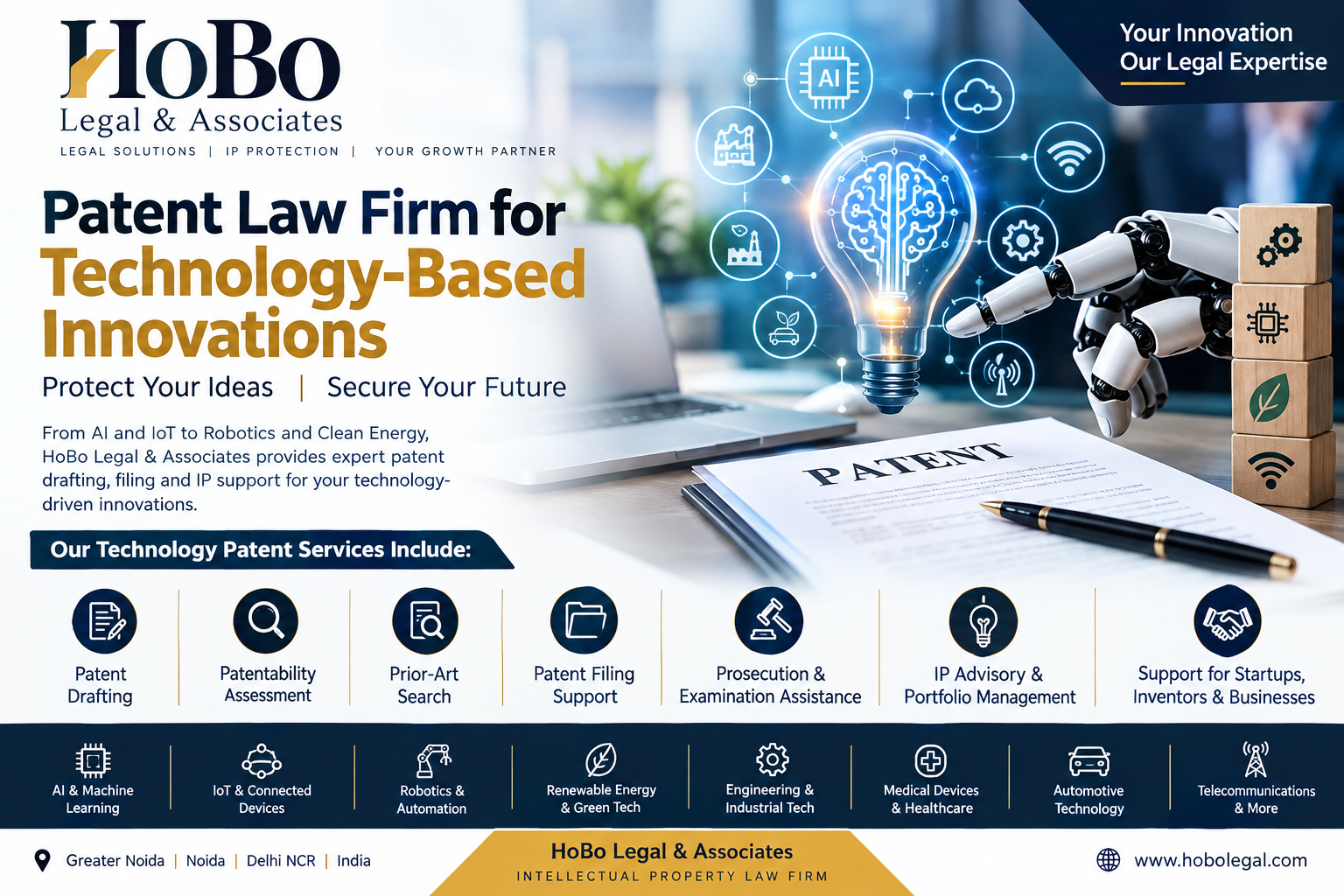
Patent Law Firm for Technology-Based Innovations in India – HoBo Legal & Associates
Technology-based innovations are transforming industries, creating new business opportunities and changing how organizations develop products, services and technical solutions. From advanced engineering and robotics to the Internet of Things (IoT), automation, electronics, software-enabled devices and next-generation manufacturing, technological innovation is becoming an important part of modern businesses.
For inventors, startups, technology companies, manufacturers, researchers and entrepreneurs, protecting these innovations through intellectual property rights can be an important part of long-term business planning. A properly prepared patent application can help an eligible inventor seek legal protection for a new technological invention.
HoBo Legal & Associates provides intellectual property legal assistance for individuals, startups, businesses, researchers and organizations seeking support with technology-based inventions, patent drafting, patentability assessment, patent claims, patent documentation, patent filing support and intellectual property strategy.
If you are searching for a Patent Law Firm for Technology-Based Innovations in India, HoBo Legal & Associates can assist you in understanding the legal and procedural aspects of patent protection for eligible technological inventions in Greater Noida, Noida, Delhi NCR and across India.
What Is a Technology-Based Innovation?
A technology-based innovation is a new or improved technical product, process, system, device or method developed to solve a technical problem, improve an existing process or introduce a technical advancement.
Technological innovations may involve physical devices, electronic systems, mechanical components, computer-implemented technologies, industrial processes, communication systems and integrated hardware and software solutions.
Examples of technology-based innovations include:
- Advanced engineering systems
- Electronic devices and components
- Robotics and automation
- Internet of Things (IoT) technology
- Industrial machinery
- Smart manufacturing systems
- Telecommunications technology
- Computer-related inventions
- Artificial Intelligence-enabled technical systems
- Renewable energy technology
- Medical devices and technical equipment
- Automotive engineering innovations
- Semiconductor-related technologies
- Sensor-based monitoring systems
- Smart infrastructure
- Data-processing hardware
- Advanced material technologies
- Industrial control systems
- Energy-efficient equipment
- Technology-enabled safety systems
Not every new product, business idea or software feature is patentable. The invention must meet the applicable legal requirements, including novelty, inventive step, industrial applicability and the relevant patentable-subject-matter provisions.
Why Do Technology-Based Innovations Need Patent Protection?
Technology companies and innovators invest time, research, capital and technical expertise in developing new products and processes. Without an appropriate intellectual property strategy, it may be difficult to manage the legal rights associated with those innovations.
A patent, when granted, provides the patentee with statutory rights over the patented invention for the prescribed period, subject to the Patents Act, 1970 and applicable conditions.
Patent protection may help businesses and inventors to:
- Establish legal rights over eligible inventions.
- Protect technical innovations against unauthorized commercial use within the scope of patent rights.
- Develop an intellectual property portfolio.
- Support technology licensing arrangements.
- Facilitate technology commercialization.
- Strengthen intellectual property documentation.
- Support research and development strategies.
- Manage intellectual property during business expansion.
- Support technology transfer and collaboration.
- Establish a framework for enforcing patent rights.
Patent protection is territorial and subject to statutory requirements. Filing an application does not itself guarantee that a patent will be granted or that every aspect of a product will be protected.
Patent Law Firm for Technology-Based Innovations – HoBo Legal & Associates
HoBo Legal & Associates provides legal and intellectual property assistance for technology-driven inventions and innovations. The firm assists inventors, entrepreneurs, startups, engineering companies, technology developers and research organizations with understanding the patent process and preparing relevant legal documentation.
The firm’s technology-related patent services may include:
- Patentability assessment
- Technology invention analysis
- Patent drafting
- Provisional patent specification drafting
- Complete patent specification drafting
- Patent claim drafting
- Patent abstract preparation
- Technical patent documentation
- Prior-art search coordination and review
- Patent filing support
- Patent examination-related assistance
- Patent prosecution support
- Intellectual property advisory
- Patent portfolio planning
- Technology licensing-related legal assistance
- Intellectual property documentation
The scope of assistance depends on the invention, the legal requirements and the professional arrangements applicable to each matter.
Types of Technology-Based Inventions That May Require Patent Drafting
Different technological innovations require different approaches to patent drafting. A mechanical invention, an electronic circuit, an industrial automation system and a computer-implemented invention may require substantially different technical descriptions and claim structures.
1. Mechanical and Engineering Innovations
Mechanical and engineering inventions can involve improvements in machines, equipment, industrial components, tools, mechanical assemblies and manufacturing processes.
Examples include:
- Advanced mechanical equipment
- New machine components
- Automated mechanical systems
- Improved industrial machinery
- Energy-efficient mechanical devices
- Precision engineering equipment
- Mechanical safety systems
- Innovative manufacturing tools
A patent specification for a mechanical invention may need to explain the structure, components, operating principles, technical advantages and alternative embodiments of the invention.
HoBo Legal & Associates can assist with organizing technical information and preparing patent-related documentation for eligible mechanical and engineering innovations.
2. Electronics and Electrical Technology
Electronic and electrical innovations are important in consumer electronics, telecommunications, industrial equipment, energy systems and modern infrastructure.
Potential areas of innovation include:
- Electronic circuit designs
- Electrical control systems
- Power management technology
- Signal-processing systems
- Embedded electronic devices
- Electronic monitoring equipment
- Smart electrical components
- Energy conversion systems
- Electronic safety mechanisms
Patent drafting for electronic inventions may involve detailed descriptions of circuit architecture, component interactions, technical processes and the functional relationship between different parts of a system.
3. Robotics and Industrial Automation
Robotics and automation technologies are increasingly used in manufacturing, logistics, healthcare, agriculture, warehousing and industrial operations.
Technology-based inventions in this area may involve:
- Robotic control mechanisms
- Automated manufacturing equipment
- Sensor-integrated robotic systems
- Automated material handling
- Intelligent robotic navigation
- Industrial process control
- Automated quality inspection
- Machine-to-machine communication
A patent application for an eligible robotic or automation invention may describe the hardware architecture, control methodology, sensor integration and technical operation of the system.
4. Internet of Things (IoT) Innovations
IoT technologies connect devices, sensors, communication networks and data-processing systems to facilitate monitoring, automation and control.
Examples of IoT-related inventions include:
- Smart monitoring devices
- Connected industrial equipment
- Sensor-based automation
- Remote equipment management
- Smart energy management
- Connected vehicle systems
- Industrial IoT platforms
- Intelligent environmental monitoring
Patent drafting for IoT inventions may need to explain how the components interact, how information is communicated and how the invention achieves its technical function.
5. Software-Enabled Technical Inventions
Some technological inventions combine software with hardware, networks, sensors or other technical systems.
Examples may include:
- Embedded software-controlled devices
- Technical data-processing systems
- Computer-controlled machinery
- Network communication systems
- Industrial software-hardware integration
- Real-time monitoring systems
- Technical signal-processing solutions
In India, Section 3(k) of the Patents Act, 1970 excludes mathematical methods, business methods, computer programmes per se and algorithms. Accordingly, a software-enabled invention requires careful analysis of its actual technical features, implementation and claims. Merely describing software as innovative does not establish patentability.
HoBo Legal & Associates can assist with reviewing the technical and legal aspects of eligible computer-related inventions and organizing appropriate patent documentation.
6. Artificial Intelligence-Enabled Technology
AI-enabled inventions may combine machine learning, computer vision, data processing, hardware, sensors and automated technical systems.
Examples include:
- AI-enabled industrial inspection
- Intelligent machine control
- Automated technical fault detection
- AI-based sensor systems
- Machine-learning-based predictive maintenance
- Intelligent robotics
- Technical image-processing systems
- Automated monitoring technologies
Patentability depends on the technical contribution, implementation, disclosure, claims, prior art and applicable statutory provisions.
7. Renewable Energy and Green Technology
Renewable energy and sustainable engineering continue to create opportunities for technical innovation.
Potential areas include:
- Solar energy systems
- Energy storage technology
- Battery management systems
- Wind energy equipment
- Power conversion technology
- Energy-efficient machinery
- Smart grid components
- Advanced thermal management
- Energy monitoring devices
For eligible inventions, patent drafting can describe the technical construction, operating mechanism, functional improvements and practical implementation of the technology.
8. Medical Devices and Healthcare Technology
Medical technology can involve technical innovations in devices, diagnostic equipment, monitoring systems and medical instrumentation.
Examples include:
- Medical monitoring devices
- Electronic diagnostic equipment
- Medical imaging technology
- Patient-monitoring systems
- Sensor-integrated healthcare devices
- Medical equipment control systems
- Assistive technical devices
Patent eligibility should be examined carefully, including applicable exclusions and the specific nature of the invention.
Patent Drafting Services for Technology-Based Innovations
Patent drafting is a crucial part of preparing a patent application. The specification should accurately describe the invention, while the claims should define the scope of protection being sought.
Under Section 10 of the Patents Act, 1970, a complete specification must describe the invention and its operation or use, disclose the best method of performing it known to the applicant and conclude with claims defining the scope of protection sought.
Provisional Patent Drafting
A provisional specification may be appropriate when an inventor wishes to establish an initial filing date while continuing to develop the invention.
HoBo Legal & Associates can assist with organizing technical details, identifying relevant components and preparing provisional patent documentation, where appropriate.
Where a provisional specification is filed, the complete specification generally needs to be submitted within twelve months, in accordance with Section 9 of the Patents Act.
Complete Patent Specification Drafting
A complete specification generally includes:
- Title of the invention
- Field of invention
- Background of the invention
- Technical problem
- Objects of the invention
- Summary of the invention
- Detailed description
- Working principles
- Technical embodiments
- Drawings, where applicable
- Claims
- Abstract
The specification must sufficiently disclose the invention and support the claims in accordance with applicable law.
Patent Claim Drafting
Patent claims are a fundamental component of a patent application because they define the protection sought.
For a technology-based invention, the claims may relate to a system, device, technical process, method or combination of technical features, depending on the nature of the invention and applicable patent law.
The drafting process may consider:
- Essential technical components
- Technical interactions
- Novel features
- Technical improvements
- Functional relationships
- Alternative implementations
- Scope of the proposed claims
- Support within the specification
Claims must satisfy statutory requirements for clarity, support and other applicable conditions. Their final scope depends on the patent application and examination process.
Patent Abstract and Technical Drawings
An abstract provides a concise technical summary of the invention. Technical drawings may be used to explain the structure, components, workflow or operation of an invention.
HoBo Legal & Associates can assist with relevant patent documentation and coordination of technical materials to support the specification.
Patentability Assessment for Technological Inventions
Before preparing a patent application, it is important to evaluate whether the invention may meet the applicable patentability requirements.
Novelty
The invention must be new in relation to relevant prior art. Public disclosures, earlier patent documents and technical publications may be relevant to this assessment.
Inventive Step
The invention must involve an inventive step as defined under Indian patent law. The assessment considers whether the invention involves a technical advance or economic significance, or both, and is not obvious to a person skilled in the art.
Industrial Applicability
The invention must be capable of being made or used in an industry.
Patentable Subject Matter
The invention must not fall within the exclusions specified under the Patents Act, 1970.
A patentability assessment can help an inventor understand relevant legal issues before committing to a filing strategy. However, no preliminary assessment can guarantee a patent grant.
Prior-Art Search for Technology-Based Innovations
A prior-art search can help identify existing inventions, technical publications, patent documents and other disclosures relevant to a proposed technological innovation.
For technology-based inventions, a search may focus on:
- Existing technical solutions
- Similar devices and systems
- Published patent applications
- Granted patents
- Technical research papers
- Industrial implementations
- Relevant international patent publications
A prior-art search may help identify similarities and technical distinctions that need to be considered during patent drafting.
HoBo Legal & Associates can assist with prior-art-related review and patent documentation as part of the broader intellectual property process.
Patent Filing Support for Technology Companies
Patent filing requires the submission of appropriate documents and compliance with the prescribed procedures of the Indian Patent Office.
Depending on the application, documentation may include:
- Applicant and inventor information
- Patent specification
- Claims
- Abstract
- Drawings, where applicable
- Prescribed forms
- Priority documents, where applicable
- Supporting declarations and documents, where required
HoBo Legal & Associates can provide patent-related documentation and filing support in accordance with the specific requirements of the matter.
Patent Prosecution and Examination Support
After filing, a patent application may undergo examination by the Patent Office. The applicant may receive examination objections or requests for clarification.
Patent prosecution-related assistance may involve:
- Reviewing examination reports
- Understanding technical and legal objections
- Preparing responses
- Reviewing claim amendments
- Organizing supporting documentation
- Preparing for hearings, where applicable
- Addressing procedural requirements
Any amendment or response must comply with applicable patent law and the requirements of the particular application.
Patent Law Firm for Technology Startups
Technology startups often develop innovative products, systems and processes while operating with limited resources and evolving business models.
A startup may need to consider its intellectual property strategy from the research and development stage through product development, commercialization and business expansion.
HoBo Legal & Associates can assist technology startups with:
- Preliminary invention discussions
- Patent documentation
- Patentability-related legal analysis
- Provisional and complete specification drafting
- Patent claim preparation
- Filing support
- IP portfolio planning
- Technology licensing-related legal assistance
- Intellectual property documentation
An organized IP strategy can help startups identify, document and manage potentially valuable intellectual property assets.
Patent Protection for Researchers, Engineers and Inventors
Individual inventors, research teams, engineers and academic institutions may develop technical solutions with potential commercial or industrial applications.
However, technical research documents and patent specifications serve different purposes. A patent specification needs to explain the invention in a way that meets statutory disclosure requirements and supports the claims.
HoBo Legal & Associates can assist inventors in organizing information such as:
- Research objectives
- Technical problems
- Existing solutions
- Proposed technical features
- Design specifications
- System architecture
- Experimental results
- Technical advantages
- Alternative embodiments
- Practical applications
Inventors should also consider confidentiality and filing strategy before publishing research or publicly disclosing an invention.
Patent Protection for Manufacturing and Industrial Companies
Manufacturing and industrial businesses may develop proprietary processes, machinery, equipment and technical improvements through research and development.
Potential innovations include:
- Production machinery
- Industrial automation
- Manufacturing processes
- Quality control systems
- Material processing technology
- Equipment safety systems
- Energy-efficient manufacturing
- Industrial sensors
- Process monitoring systems
Patent drafting can form part of a company’s broader strategy for documenting and protecting eligible technological innovations.
Technology Patent Law Firm in Greater Noida and Delhi NCR
Greater Noida and the wider Delhi NCR region are home to technology businesses, industrial units, engineering companies, startups, educational institutions and research organizations.
Businesses and innovators in Greater Noida, Noida, Noida Extension, Knowledge Park, Surajpur, Pari Chowk, Yamuna Expressway and nearby industrial areas may require legal assistance for their technology-based inventions.
HoBo Legal & Associates provides intellectual property legal assistance for technology-based innovations, including patent drafting, patent documentation, patent filing support and related IP advisory.
The firm also assists clients from other parts of India, subject to the nature of the matter and applicable professional requirements.
Patent Drafting and Confidentiality for New Innovations
Confidentiality is an important consideration when developing a new technological invention.
Publicly disclosing technical details through product demonstrations, online publications, research papers, exhibitions or commercial presentations may affect patent rights, depending on the circumstances and applicable law.
Before sharing confidential technical information with external parties, inventors and businesses may consider:
- Confidentiality agreements
- Restricted access to technical documents
- Internal invention records
- Secure documentation
- Patent filing timelines
- Appropriate IP ownership arrangements
Obtaining legal advice before public disclosure may help innovators assess the implications for their patent strategy.
Patent Portfolio Management for Technology Companies
Businesses that continuously develop new technologies may need to manage multiple patent applications and other intellectual property assets.
Patent portfolio management may involve:
- Identifying potentially patentable innovations
- Recording invention disclosures
- Monitoring patent application status
- Reviewing patent ownership
- Maintaining patent documentation
- Considering licensing opportunities
- Evaluating commercialization options
- Monitoring relevant competitor patents
- Reviewing portfolio requirements
HoBo Legal & Associates can provide related intellectual property advisory and documentation support, based on the company’s specific needs.
Why Choose HoBo Legal & Associates for Technology Patent Matters?
HoBo Legal & Associates provides legal and intellectual property assistance for technology-based innovations, serving inventors, entrepreneurs, startups, businesses and research-oriented organizations.
The firm’s technology-focused IP assistance may include:
- Technology invention assessment
- Patent drafting
- Patent claim drafting
- Patent specification preparation
- Patent documentation
- Patent filing support
- Patent prosecution-related assistance
- Prior-art review
- Intellectual property advisory
- Technology licensing-related legal assistance
- Patent portfolio planning
The approach focuses on understanding the invention, reviewing the available technical information and addressing relevant legal and procedural requirements.
Frequently Asked Questions
What does a patent law firm for technology-based innovations do?
A patent law firm can assist inventors and businesses with patentability-related legal analysis, patent drafting, claim preparation, documentation, filing support and prosecution-related matters for eligible technological inventions.
Can all technology-based innovations be patented in India?
No. An invention must satisfy applicable patentability requirements, including novelty, inventive step, industrial applicability and patentable subject matter. Certain categories are excluded under the Patents Act, 1970.
What is the difference between patent drafting and patent filing?
Patent drafting involves preparing the specification, claims, abstract and relevant technical documentation. Patent filing involves submitting the application and prescribed documents to the appropriate patent authority.
Can a startup apply for a patent for its new technology?
A startup may apply for a patent if the invention meets the applicable statutory requirements and the applicant is legally entitled to apply. The specific applicant structure, ownership and documentation should be reviewed.
Why are patent claims important for technological inventions?
Patent claims define the scope of protection sought. They must be clear, supported by the specification and compliant with applicable legal requirements.
Can software-based technological innovations receive patent protection in India?
Some computer-implemented inventions may be eligible, depending on their technical features, implementation and claims. Section 3(k) excludes computer programmes per se, algorithms and certain other subject matter, so individual assessment is necessary.
Should an inventor conduct a patent search before filing?
A prior-art search can help identify existing technical disclosures and provide useful information for patentability assessment and drafting strategy. It does not guarantee that a patent will be granted.
Can HoBo Legal & Associates assist with patent drafting in Greater Noida?
HoBo Legal & Associates provides patent-related legal and documentation assistance for technology-based innovations, including patent drafting and filing support, subject to the nature of the matter and applicable professional requirements.
Can a patent law firm guarantee patent registration?
No. Patent applications are examined under the applicable statutory framework, and grant depends on the facts, prior art, claims, examination and compliance with legal requirements.
Contact HoBo Legal & Associates for Technology-Based Patent Services
If you are an inventor, entrepreneur, technology startup, engineering company, manufacturer, researcher or business developing a new technical product, process, system or device, understanding the available intellectual property protection options can be an important part of your innovation strategy.
HoBo Legal & Associates provides legal and intellectual property assistance relating to technology-based inventions, patent drafting, patent claim preparation, patent documentation, patent filing support and IP advisory.
HoBo Legal & Associates
Technology Patent & Intellectual Property Legal Services
Greater Noida | Noida | Delhi NCR | India
Legal Disclaimer
This article is intended for general legal and informational purposes only and does not constitute legal advice for any specific invention or patent application. Patentability and patent protection depend on the facts of each invention, relevant prior art, applicable statutory provisions, examination and procedural compliance. No guarantee of patent grant or registration is made.