
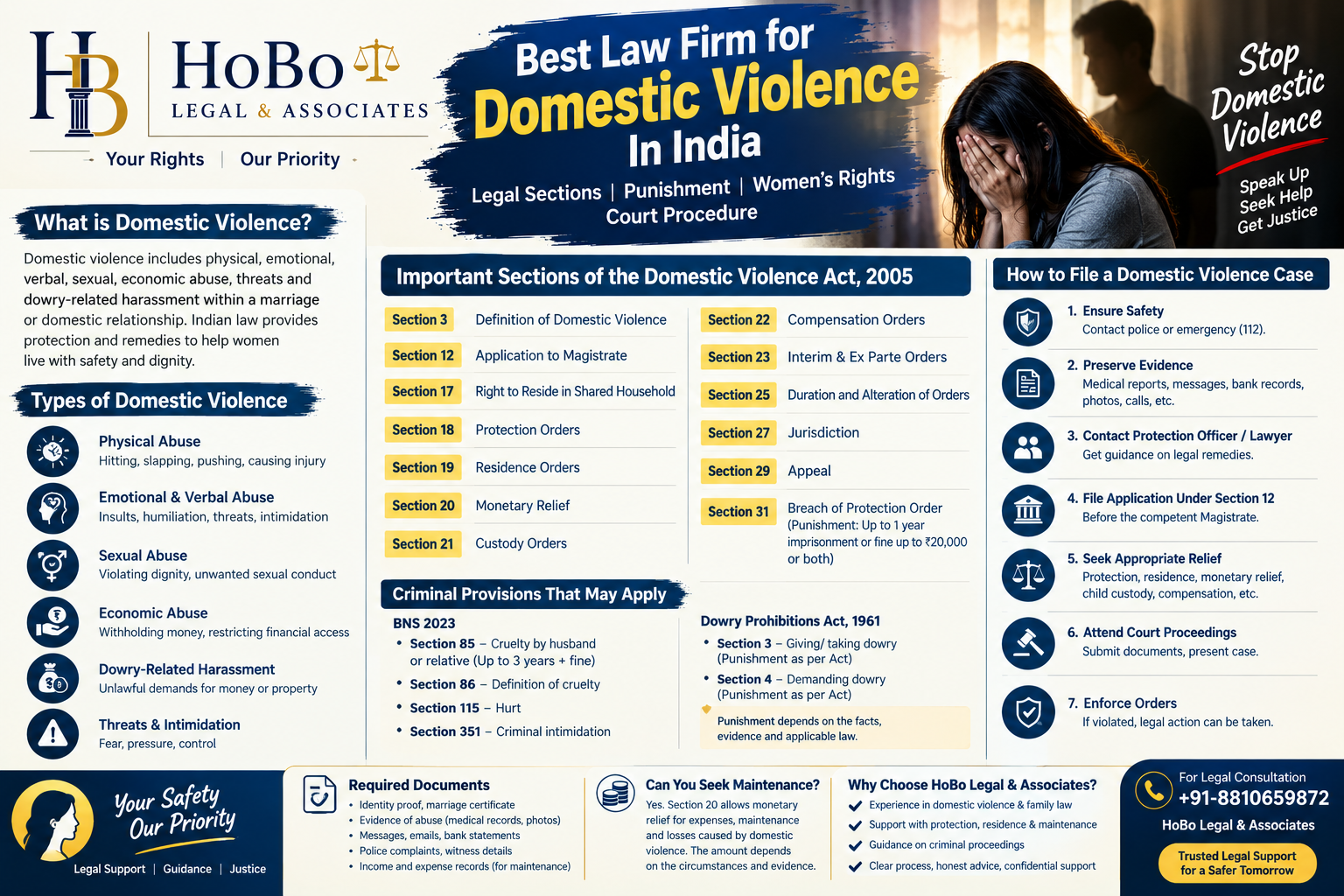
Domestic violence is a serious legal issue that can affect a woman’s physical safety, mental health, dignity and financial independence. It may include physical assault, emotional harassment, verbal abuse, sexual abuse, economic deprivation, threats and dowry-related harassment.
Indian law provides remedies for women facing domestic violence. The Protection of Women from Domestic Violence Act, 2005 (PWDVA) allows an eligible woman to seek protection orders, residence orders, monetary relief, temporary child custody and compensation. Depending on the facts, separate criminal proceedings may also be possible.
Understanding domestic violence law in India can help an affected woman identify her rights, preserve evidence and seek appropriate legal assistance.
What Is Domestic Violence Under Indian Law?
Section 3 of the Protection of Women from Domestic Violence Act, 2005 defines domestic violence. It covers several forms of abuse, subject to the statutory requirements.
Physical Abuse
Physical abuse may include hitting, slapping, pushing, causing bodily injury or threatening physical harm. Depending on the circumstances, the conduct may also constitute a criminal offence.
Verbal and Emotional Abuse
Repeated insults, humiliation, intimidation, threats and other abusive conduct may fall within the Act’s provisions, depending on the facts.
Sexual Abuse
Sexual conduct that abuses, humiliates, degrades or violates a woman’s dignity may qualify as sexual abuse under the Act.
Economic Abuse
Economic abuse may include withholding necessary money, denying access to household expenses, restricting access to financial resources or withholding property and resources to which a woman is legally entitled.
Dowry-Related Harassment
Harassment connected with unlawful demands for money, property or valuable security may attract the Domestic Violence Act and, where applicable, the Dowry Prohibition Act, 1961 and criminal law provisions.
Important Sections of the Domestic Violence Act, 2005
Section 3 – Definition of Domestic Violence
This section covers physical, sexual, verbal, emotional and economic abuse, as well as specified harassment connected with unlawful dowry or property demands.
Section 12 – Application to the Magistrate
An aggrieved woman, a Protection Officer or another person permitted under the Act may apply to the Magistrate for relief. The application should explain the domestic relationship, alleged incidents and remedies requested.
Section 17 – Right to Reside in a Shared Household
Section 17 recognises a woman’s right to reside in a shared household, subject to the Act and applicable court orders. This right does not automatically transfer ownership of the property to her.
Section 18 – Protection Orders
The Magistrate may issue a protection order prohibiting specified acts of domestic violence or other conduct authorised by the section.
Section 19 – Residence Orders
The court may pass appropriate residence-related orders, including restraining unlawful dispossession or directing other measures permitted by law.
Section 20 – Monetary Relief
The Magistrate may grant monetary relief for expenses and losses resulting from domestic violence. This may include qualifying medical expenses, loss of earnings and maintenance for the aggrieved woman or her children where legally justified.
Section 21 – Custody Orders
The Magistrate may make temporary custody arrangements for a child under the Act, considering the circumstances and the child’s welfare.
Section 22 – Compensation Orders
The court may award compensation for injuries, including mental torture and emotional distress caused by domestic violence.
Section 23 – Interim and Ex Parte Orders
The Magistrate may grant interim relief. Where the statutory requirements are met, an ex parte order may also be passed without first hearing the respondent.
Section 29 – Appeal
An appeal against an order of the Magistrate may be filed before the Court of Session within the period specified in Section 29, generally 30 days from service of the order as prescribed by the Act.
Section 31 – Breach of Protection Order
Breach of a protection order or interim protection order is an offence.
Punishment: Imprisonment for up to one year, a fine of up to ₹20,000, or both, subject to the statutory requirements.
Criminal Law Sections That May Apply
The Domestic Violence Act provides protective and related civil remedies. Separate criminal provisions may apply when the alleged conduct also constitutes a criminal offence.
Sections 85 and 86 of the Bharatiya Nyaya Sanhita, 2023
Section 85 deals with cruelty by a husband or a relative of the husband. Section 86 defines cruelty for this purpose.
Cruelty may include conduct likely to drive a woman to suicide or cause grave injury or danger to her life, limb or health. It may also include harassment intended to coerce her or her relatives to meet an unlawful demand for property or valuable security.
Punishment under Section 85: Imprisonment for up to three years and a fine.
Section 351 of the Bharatiya Nyaya Sanhita, 2023
Section 351 addresses criminal intimidation where its legal requirements are met. The applicable punishment depends on the nature of the threat and the relevant subsection.
Other criminal provisions may apply to assault or injuries depending on the facts and evidence.
Dowry Prohibition Act, 1961
Where domestic violence involves dowry-related demands, the following provisions may be relevant:
- Section 3: Addresses giving, taking or abetting the giving or taking of dowry, subject to the Act.
- Section 4: Addresses demanding dowry.
The punishment depends on the offence established and the applicable statutory provisions.
How to File a Domestic Violence Case in India
Step 1: Prioritise Safety
If there is an immediate threat to life or physical safety, seek a safe location and contact the police or emergency services. India’s national emergency number is 112.
Step 2: Preserve Evidence
Keep relevant records safely, including:
- Medical reports and photographs of injuries.
- Messages, emails and relevant call records.
- Lawfully obtained audio or video recordings.
- Bank statements and evidence of financial deprivation.
- Records of dowry demands, where relevant.
- Witness details and previous complaints.
- Copies of police complaints and court orders.
Do not put yourself at risk to collect evidence. Preserve original records and avoid altering messages or documents.
Step 3: Contact a Protection Officer or Lawyer
A Protection Officer, service provider, legal services authority or advocate may help explain the process and available remedies.
Step 4: Submit an Application Under Section 12
An application may be submitted to the competent Magistrate. It should describe the domestic relationship, incidents of alleged abuse, supporting evidence and the relief requested.
Step 5: Request Appropriate Relief
Depending on the circumstances, the applicant may seek protection, residence orders, monetary relief, temporary child custody, compensation or interim orders.
Step 6: Attend Court Proceedings
The court may consider the application, issue notices, hear the parties and assess the available evidence. Interim relief may be granted where the statutory conditions are satisfied.
Documents Required for a Domestic Violence Case
Commonly useful documents include:
- Identity and address proof.
- Marriage certificate, if available and relevant.
- Evidence of the domestic relationship and shared residence.
- A written chronology of the incidents.
- Medical reports and photographs, where relevant.
- Messages, emails and other relevant communications.
- Bank statements and expense records for monetary relief.
- Copies of police complaints and previous court orders.
- Details of witnesses.
- Income and expense information where financial relief is sought.
The documents required depend on the facts and the relief requested. The absence of one particular document does not automatically determine the case.
Can a Woman Claim Maintenance in a Domestic Violence Case?
Yes. Section 20 of the PWDVA permits monetary relief for qualifying expenses and losses caused by domestic violence. This may include maintenance for the aggrieved woman and her children where legally justified.
Other maintenance remedies may also be available under applicable law. The appropriate remedy and amount depend on the financial circumstances, evidence, needs and existing orders.
Can a Woman Be Removed from Her Matrimonial Home?
Section 17 recognises a woman’s right to reside in a shared household, subject to the Act and applicable court orders. Section 19 empowers the Magistrate to pass appropriate residence orders.
Residence rights do not automatically establish ownership rights. The facts and any relevant property proceedings must be examined.
How to Choose a Domestic Violence Lawyer
A lawyer experienced in domestic violence matters can help identify the appropriate legal remedies, prepare court documents, organise evidence and explain the court procedure.
When selecting an advocate, consider:
- Experience with domestic violence applications and protection orders.
- Understanding of the PWDVA and related criminal provisions.
- Ability to explain legal procedures and documentation.
- Experience with residence, maintenance and child custody matters.
- Clear communication about fees and the scope of legal services.
- Responsible handling of sensitive information.
No lawyer can guarantee a particular court outcome. Every case requires an individual assessment of the facts and applicable law.
Frequently Asked Questions About Domestic Violence Law
1. Can I file a domestic violence case without physical injuries?
Yes. The Act also covers qualifying sexual, verbal, emotional and economic abuse. Physical injuries are not necessary for every claim.
2. Can I seek an urgent protection order?
Yes. Section 23 permits interim and, where statutory requirements are met, ex parte orders.
3. Can I claim compensation for mental harassment?
Section 22 permits compensation for injuries, including mental torture and emotional distress, where justified by the facts and law.
4. What happens if a protection order is violated?
A breach may constitute an offence under Section 31 of the PWDVA, punishable with imprisonment up to one year, a fine up to ₹20,000, or both.
5. Can domestic violence proceedings and criminal proceedings occur together?
Depending on the facts, an affected woman may pursue remedies under the PWDVA and separate criminal proceedings where the alleged conduct constitutes an offence.
6. Can I obtain free legal aid?
Eligible persons may approach the appropriate District Legal Services Authority or another Legal Services Authority. Eligibility is governed by the Legal Services Authorities Act, 1987 and applicable rules.
7. Does filing a domestic violence case automatically result in imprisonment?
No. The PWDVA provides remedies such as protection orders, residence orders, monetary relief and compensation. Criminal punishment depends on whether a separate offence or punishable breach is established under the law.
Legal Assistance for Domestic Violence Matters
HoBo Legal & Associates assists with legal matters involving domestic violence, protection orders, residence disputes, maintenance, dowry harassment and related criminal proceedings.
Each matter requires an individual assessment of the facts, available evidence, applicable legal provisions and relief sought.
For legal consultation, contact HoBo Legal & Associates at +91-8810659872.
This article provides general legal information and is not a substitute for advice based on the facts of an individual case.