
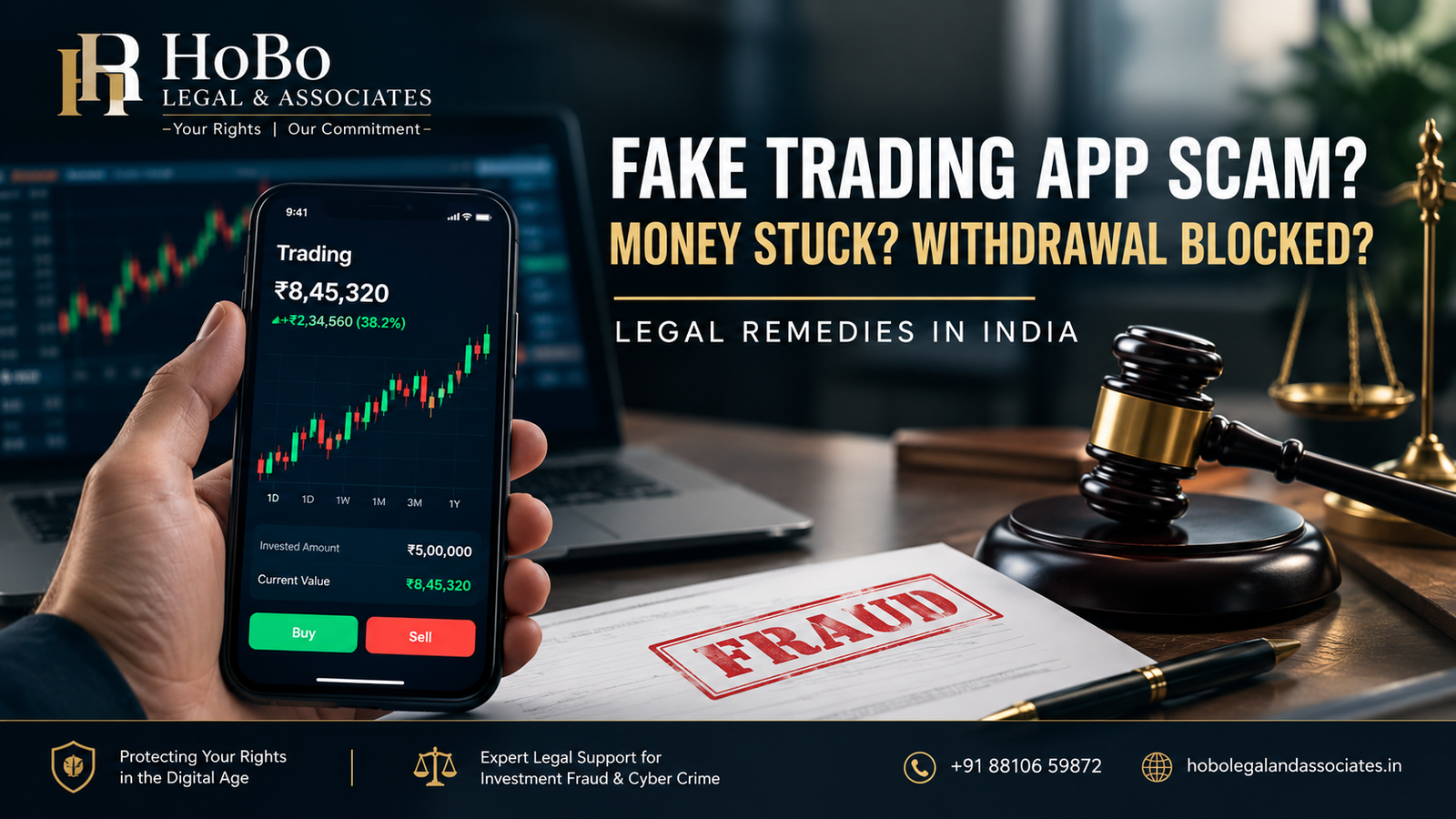
Learn how to report a fake trading app scam in India, preserve evidence, explore legal remedies and understand possible money recovery options.
Online trading has become increasingly accessible, but fraudulent trading applications and fake investment platforms are creating serious financial and legal problems for investors in India. People may be approached through WhatsApp, Telegram, Instagram, online advertisements or individuals pretending to be stock-market experts.
In many cases, the application displays attractive profits and encourages users to deposit more money. When the investor attempts to withdraw the funds, the platform may demand additional payments under the name of tax, processing fees, account verification or security deposits.
A displayed trading balance is not proof that the money actually exists or is available for withdrawal. Investors should verify the platform and preserve evidence before making further payments.
HoBo Legal & Associates presents this legal-awareness guide explaining how fake trading app scams operate, what legal remedies may be available, how to report the incident and what steps victims can take to support a potential recovery claim.
1. What Is a Fake Trading App Scam?
A fake trading app scam is a fraudulent scheme in which an application, website or online group misleads investors into believing that they are participating in genuine stock-market trading.
The fraudsters may imitate legitimate brokerage firms, display fabricated trading charts or show fictitious profits to persuade victims to transfer money.
The Securities and Exchange Board of India (SEBI) has warned investors about this pattern, including fake profit displays, pressure to increase investments and blocked withdrawals.
2. How Does a Fake Trading App Scam Work?
The scam may develop through the following stages:
| Stage | How the fraud may operate |
|---|---|
| 1. Initial contact | The victim receives an investment offer through social media, a message or an advertisement. |
| 2. False credibility | The person claims to be an investment expert or representative of a recognised financial institution. |
| 3. App installation | The victim is directed to a suspicious application or website. |
| 4. Initial investment | The victim deposits money into an account specified by the operators. |
| 5. Fake profits | The application displays profits or an increasing account balance. |
| 6. Additional deposits | The victim is persuaded to invest more money to unlock higher returns. |
| 7. Withdrawal blocked | The platform refuses withdrawals or demands additional payments. |
| 8. Disappearance | The operators may stop responding, delete their profiles or disable the platform. |
Not every failed withdrawal automatically establishes fraud. However, fabricated profits, misleading representations, suspicious payment instructions and repeated demands for money may justify urgent investigation.
3. Common Warning Signs of Fake Trading Apps
Investors should exercise caution when they encounter any of the following:
- Guaranteed or unusually high returns with little or no risk.
- WhatsApp or Telegram groups filled with profit screenshots and success stories.
- Applications that imitate established brokerage brands.
- Requests to transfer funds to unrelated personal or third-party bank accounts.
- APK files or app links shared directly by unknown individuals.
- Requests for trading account passwords, OTPs or remote access to a device.
- Demands for additional money before a withdrawal can be processed.
- Claims that an account will be blocked unless a fee is paid immediately.
A platform appearing in an app store does not, by itself, establish that it is authorised to provide securities-market services. Verify the relevant intermediary and trading application through official SEBI and recognised stock-exchange resources.
4. What Should You Do If Your Money Is Stuck?
Time is important when financial cyber fraud is suspected. A victim should avoid further payments and take the following steps.
Step 1: Stop Transferring Money
Do not pay additional amounts merely because the operators promise to release your existing balance.
Fraudsters may repeatedly introduce new charges, such as withdrawal tax, clearance fees or account-unlocking charges. Seek independent verification before making any further payment.
Step 2: Report the Financial Cyber Fraud Immediately
Contact the national cybercrime helpline at 1930 as soon as possible.
You can also submit a complaint through the National Cyber Crime Reporting Portal.
Provide accurate details of the incident, the amount transferred, transaction references, beneficiary account information and available supporting evidence.
Prompt reporting can help authorities and participating financial institutions take timely steps to trace transactions or restrict suspected proceeds where legally justified. It does not guarantee that the money will be recovered.
Step 3: Inform Your Bank or Payment Provider
Notify the bank or payment service through which the funds were transferred.
Request that the complaint be formally recorded and that the bank take appropriate action under its applicable procedures. Provide transaction IDs, UPI references, beneficiary details and the cybercrime complaint acknowledgement.
Retain the complaint number and copies of all correspondence.
Step 4: Preserve Digital Evidence
Keep the following records safely:
- Screenshots and screen recordings of the trading application.
- The application name, website address and download link.
- WhatsApp or Telegram conversations and group details.
- Mobile numbers, email addresses and social media profiles used by the operators.
- Bank statements and payment receipts.
- UPI IDs, beneficiary account details and transaction reference numbers.
- Screenshots showing the displayed balance and failed withdrawals.
- Messages demanding additional payments.
- Complaint acknowledgements and communication with the bank.
Do not delete the original conversations or alter the evidence. Preserve available information lawfully and share it with the investigating authorities when required.
Step 5: Submit a Police or Cyber crime Complaint
If the matter indicates cheating, impersonation or another criminal offence, provide a detailed complaint to the appropriate cybercrime police station or police authority.
Describe the sequence of events, the representations made by the accused, the money transferred and the subsequent refusal to release funds.
Where the facts disclose a cognisable offence, the applicable legal procedure for registration of an FIR may be pursued. If the complaint is not acted upon, further remedies may be available depending on the circumstances and applicable law.
5. Which Laws May Apply to Fake Trading App Fraud?
The applicable provisions depend on the facts, evidence, the role of each person involved and whether the platform was engaged in genuine but unsuccessful trading or a fraudulent scheme.
A. Bharatiya Nyaya Sanhita, 2023 (BNS)
Section 318 — Cheating
Section 318 may be relevant where a person dishonestly deceives another and induces them to deliver money or property, provided the statutory ingredients are established.
Section 319 — Cheating by personation
This provision may be relevant where an individual fraudulently impersonates another person or assumes a false identity to deceive the victim.
The precise provision and applicable punishment depend on the facts and the statutory requirements.
B. Information Technology Act, 2000
Section 66D — Cheating by personation using a computer resource
This section may apply where cheating by personation is committed using a communication device or computer resource. Its application depends on whether the required legal elements are established.
Other provisions of the Information Technology Act may be relevant if the incident also involves unauthorised access, identity misuse or other offences covered by the Act.
C. SEBI Act, 1992 and Securities-Market Regulations
Where the conduct involves unauthorised securities-market activities, fraudulent practices, misleading investment representations or violations by regulated market participants, the SEBI Act and applicable securities-market regulations may become relevant.
SEBI’s jurisdiction depends on the nature of the activity and the entities involved. Not every online payment scam automatically falls within SEBI’s investor-grievance or enforcement framework.
D. Bharatiya Nagarik Suraksha Sanhita, 2023 (BNSS)
The BNSS governs criminal procedure, including applicable processes relating to investigation, complaints, FIRs and other criminal proceedings.
The appropriate procedural remedy will depend on the circumstances, the police response and the stage of the case.
6. Can the Victim Recover the Lost Money?
Recovery may be possible, but it is not guaranteed.
The available options depend on how the money was transferred, whether it can be traced, whether funds remain in beneficiary accounts and the evidence available.
Potential steps include:
- Immediate reporting through the cybercrime helpline and portal.
- Requesting appropriate action from the bank or payment provider.
- Seeking investigation and tracing of suspected beneficiary accounts.
- Pursuing applicable criminal proceedings against the persons responsible.
- Considering civil recovery proceedings where legally maintainable.
- Seeking appropriate court directions where the facts and procedural requirements justify such relief.
A bank freeze, lien or hold does not automatically mean that the victim will receive the entire amount. The ownership of funds, competing claims, investigation findings and applicable legal procedure may affect the outcome.
Victims should also be cautious of people who claim they can guarantee recovery for an advance fee. A second recovery scam may follow the original fraud.
7. What If the Fraudsters Demand Tax or Fees Before Withdrawal?
A demand for an additional payment should be examined carefully, particularly when it is made by an unverified platform or an individual claiming to be an investment manager.
For example, a victim may be told that an account contains ₹8 lakh and that a payment of ₹80,000 is required before withdrawal.
The displayed balance may be fictitious, and paying the additional amount may result in further demands. The victim should independently verify the platform, preserve the demand and report suspected fraud rather than relying on the operators’ assurances.
Whether a payment is genuinely due cannot be determined merely from a message or screenshot.
8. What Evidence Strengthens a Legal Complaint?
A well-organised complaint should explain the entire transaction trail.
| Evidence | Why it matters |
|---|---|
| Bank statements | Help establish the movement of money. |
| Transaction references | Assist in identifying individual transfers. |
| Chats and emails | May show representations, inducement and subsequent demands. |
| App screenshots | May document displayed profits and withdrawal restrictions. |
| Website and phone details | May help identify or trace the persons involved. |
| Complaint acknowledgement | Records when the incident was reported. |
| Bank correspondence | Documents the steps taken to report and investigate the transactions. |
Electronic evidence should be preserved in its original form wherever possible. The admissibility and proof of electronic records must comply with the applicable law.
9. How Can Investors Avoid Fake Trading App Scams?
- Verify the broker’s registration through official SEBI resources.
- Check whether the application is associated with the registered intermediary.
- Use official websites and verified app-distribution channels.
- Never rely solely on screenshots of profits or testimonials.
- Do not share trading credentials, OTPs or passwords with unknown persons.
- Avoid transferring investment money to unrelated accounts.
- Treat guaranteed stock-market returns as a serious warning sign.
- Be cautious of unsolicited investment groups and pressure to act immediately.
10. Frequently Asked Questions (FAQs)
Q1. What should I do first if a fake trading app has taken my money?
Immediately report the suspected financial cyber fraud through 1930, inform your bank or payment provider, and preserve all transaction and communication records.
Q2. Can I file a police complaint against a fake trading app?
Yes. Where the facts indicate a criminal offence, you can approach the appropriate police or cybercrime authority with supporting evidence.
Q3. Is it necessary to pay a withdrawal fee to get my money back?
Do not pay an unverified fee simply because the platform demands it. Independently verify the demand before taking any further financial action.
Q4. Can I recover money transferred through UPI?
Recovery may be possible depending on the transaction trail, the availability of funds and action by the relevant authorities and financial institutions. It is not guaranteed.
Q5. Does every trading loss amount to cheating?
No. Ordinary market losses and criminal fraud are different. Evidence of deception, dishonest inducement, impersonation or other legally relevant conduct must be assessed in the particular case.
Q6. Can SEBI help in a fake trading app scam?
SEBI-related remedies may be relevant where the facts involve securities-market violations or regulated intermediaries. A scam involving an impersonating or entirely fake platform may also require police and cybercrime investigation.
Q7. What if the application shows a large profit but does not allow withdrawals?
Preserve screenshots and transaction records, stop making additional payments, verify the platform and report suspected fraud.
Q8. Can a lawyer help with a fake trading app case?
An advocate may assist in organising evidence, preparing complaints, identifying potentially applicable legal provisions, following up on the procedural steps and assessing appropriate civil or criminal remedies.
Q9. What if the police do not act on my complaint?
Depending on the facts and procedural stage, further remedies may be available under the applicable criminal procedure. The appropriate course should be assessed on the documents and complaint history.
Q10. Is recovery guaranteed after filing a cyber crime complaint?
No. Filing a complaint initiates a reporting and investigation process; it does not guarantee a refund or a particular outcome.
11. Legal Assistance from HoBo Legal & Associates
Fake trading app fraud may involve multiple bank accounts, digital evidence, impersonation, complex transaction trails and more than one jurisdiction.
HoBo Legal & Associates can assess the available documents and advise on potentially applicable legal remedies, complaint preparation, procedural options and appropriate further action based on the facts of an individual matter.
If you suspect an online investment fraud, preserve the evidence and report it promptly. Do not delay urgent reporting while waiting for a legal consultation.
Legal Disclaimer
This article is intended for general legal awareness and informational purposes only. It does not constitute legal advice or create an advocate-client relationship. The applicability of any legal provision, the appropriate forum and the availability of recovery depend on the facts and evidence of each case and the law in force at the relevant time. No recovery or legal outcome is guaranteed.
