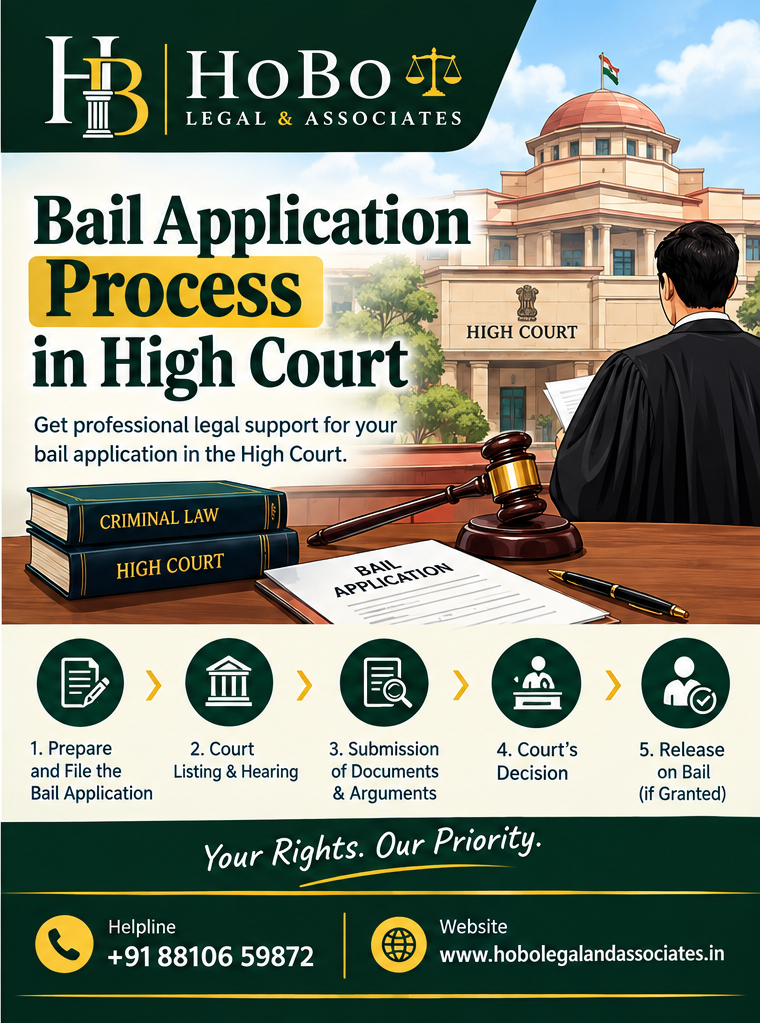
Bail Application Process in High Court: Types, Documents & Procedure
The Bail Application Process in High Court is an important legal remedy in criminal proceedings. The appropriate type of bail depends on whether the accused is already in custody, apprehends arrest or requires another form of temporary or statutory relief.
Under the BNSS, Section 482 BNSS deals with directions for grant of bail to a person apprehending arrest, while Section 483 BNSS deals with the special powers of the High Court or Court of Session regarding bail.
Types of High Court Bail
1. Regular Bail
Regular Bail is generally sought after a person has been arrested and is in custody.
The appropriate court and statutory provision depend on the offence and stage of the case.
2. Anticipatory Bail
Anticipatory Bail provides pre-arrest protection in appropriate cases.
Under Section 482 BNSS, a person having reason to believe that they may be arrested for a non-bailable offence may seek directions from the High Court or Court of Session, subject to the statutory requirements.
3. Interim Bail
Interim Bail provides temporary protection or release for a specified period or until further orders.
4. Bail After Rejection by Lower Court
A person whose bail has been rejected by a lower court may, where legally maintainable, approach the High Court.
The previous order and grounds for rejection are important when preparing the application.
Bail Application Process in High Court
Step 1: Collect FIR and Case Details
The applicant should collect the FIR, sections invoked, police station details, case number and relevant court orders.
Step 2: Determine the Correct Bail Remedy
The appropriate remedy may be Regular Bail, Anticipatory Bail, Interim Bail or another legally available application.
Step 3: Review Previous Orders
If bail has already been rejected, the reasons recorded by the lower court should be examined carefully.
Step 4: Prepare the Bail Application
The Bail Application should contain relevant facts, legal grounds, applicable provisions and the relief requested.
Step 5: File Before the High Court
The application is filed according to the applicable High Court rules and procedural requirements.
Step 6: Hearing Before the Court
The High Court considers the submissions of the parties, case records, applicable law and relevant circumstances.
Step 7: Compliance With Bail Order
If bail is granted, the accused must comply with the conditions and complete the required bond and surety formalities.
Documents Required for High Court Bail
Documents may include:
- FIR copy
- Previous bail application
- Bail rejection order
- Lower court orders
- Charge-sheet, if available
- Identity and address documents, where required
- Medical documents, where relevant
- Supporting documents
- Other documents required by the court
Section 482 BNSS: Anticipatory Bail
Section 482 BNSS provides the statutory framework for directions for grant of bail to a person apprehending arrest in certain non-bailable offence cases.
The High Court or Court of Session may impose conditions relating to:
- Availability for interrogation
- Not influencing witnesses
- Not tampering with evidence
- Restrictions concerning travel outside India
- Other conditions permitted by law
The exact relief depends on the facts and circumstances of the case.
Section 483 BNSS and Bail
Section 483 BNSS concerns the special powers of the High Court or Court of Session regarding bail.
The scope and application of the provision depend upon the nature of the proceedings and circumstances before the court.
What If High Court Bail Is Rejected?
If a High Court Bail application is rejected, the next legal remedy depends upon the order, circumstances and applicable law.
Possible options may include:
- Reviewing the reasons for rejection
- Considering whether circumstances have changed
- Filing a subsequent application where legally maintainable
- Exploring an appropriate remedy before a higher court
A previous rejection order should be carefully examined before taking the next legal step.
HoBo Legal & Associates for High Court Bail
HoBo Legal & Associates assists clients with criminal-law matters, including High Court Bail, Anticipatory Bail, criminal proceedings and related legal remedies.
The appropriate legal course depends on the FIR, previous court orders, applicable provisions and facts of the individual case.
Website: https://hobolegalandassociates.in/
Helpline: +91 88106 59872
Frequently Asked Questions
1. What is the Bail Application Process in High Court?
It involves identifying the appropriate bail remedy, preparing the application, filing it before the High Court, attending the hearing and complying with the court’s order.
2. Can I apply for Anticipatory Bail in High Court?
Yes, Section 482 BNSS provides for anticipatory bail applications before the High Court or Court of Session, subject to applicable requirements.
3. What is Section 483 BNSS?
Section 483 BNSS deals with special powers of the High Court or Court of Session regarding bail.
4. Can I approach the High Court after bail rejection?
Depending on the case and applicable jurisdiction, a person may be able to seek bail before the High Court after rejection by a lower court.
5. What documents are required?
The documents vary but generally include the FIR, previous court orders, bail applications and relevant case records.
6. Can anticipatory bail be granted after an FIR?
The existence of an FIR does not by itself determine the outcome. The applicability of Anticipatory Bail depends on the facts and applicable law.
7. Is a surety required?
The requirement depends on the court’s order and applicable legal provisions.
8. Can bail conditions be modified?
A request to modify bail conditions may be considered by the appropriate court where legally maintainable.
9. Can High Court Bail be cancelled?
Bail may be cancelled in appropriate circumstances according to applicable law and judicial principles.
10. How long does High Court Bail take?
There is no fixed timeline. Urgency, filing requirements, court schedule, objections and case circumstances may affect the time.
Legal Disclaimer: This article is for general legal awareness and does not constitute case-specific legal advice. Legal provisions and procedures should be verified according to the facts of each matter.