Process for Inter-Caste Marriage in India – Legal Procedure, Documents & Marriage Registration
Inter-caste marriage in India is legally permissible when the couple fulfils the applicable legal requirements for marriage. Indian law does not require two adults to belong to the same caste in order to marry. Depending on their circumstances and the applicable personal law, couples may choose a legally recognized marriage procedure, including marriage under the Special Marriage Act, 1954.
For couples from different castes who want a civil marriage, the Special Marriage Act can provide a legal route without requiring the parties to belong to the same caste or follow the same religion. The Act contains provisions relating to notice, objections, solemnization and registration of marriage.
What Is an Inter-Caste Marriage?
An inter-caste marriage is a marriage between two individuals belonging to different castes.
The caste of the parties does not by itself prevent two legally eligible adults from marrying. The important consideration is whether the marriage satisfies the conditions prescribed under the applicable marriage law.
For couples who want a civil marriage, the Special Marriage Act, 1954 is an important legal framework because it provides a special form of marriage and related provisions concerning registration and matrimonial reliefs.
Process for Inter-Caste Marriage in India
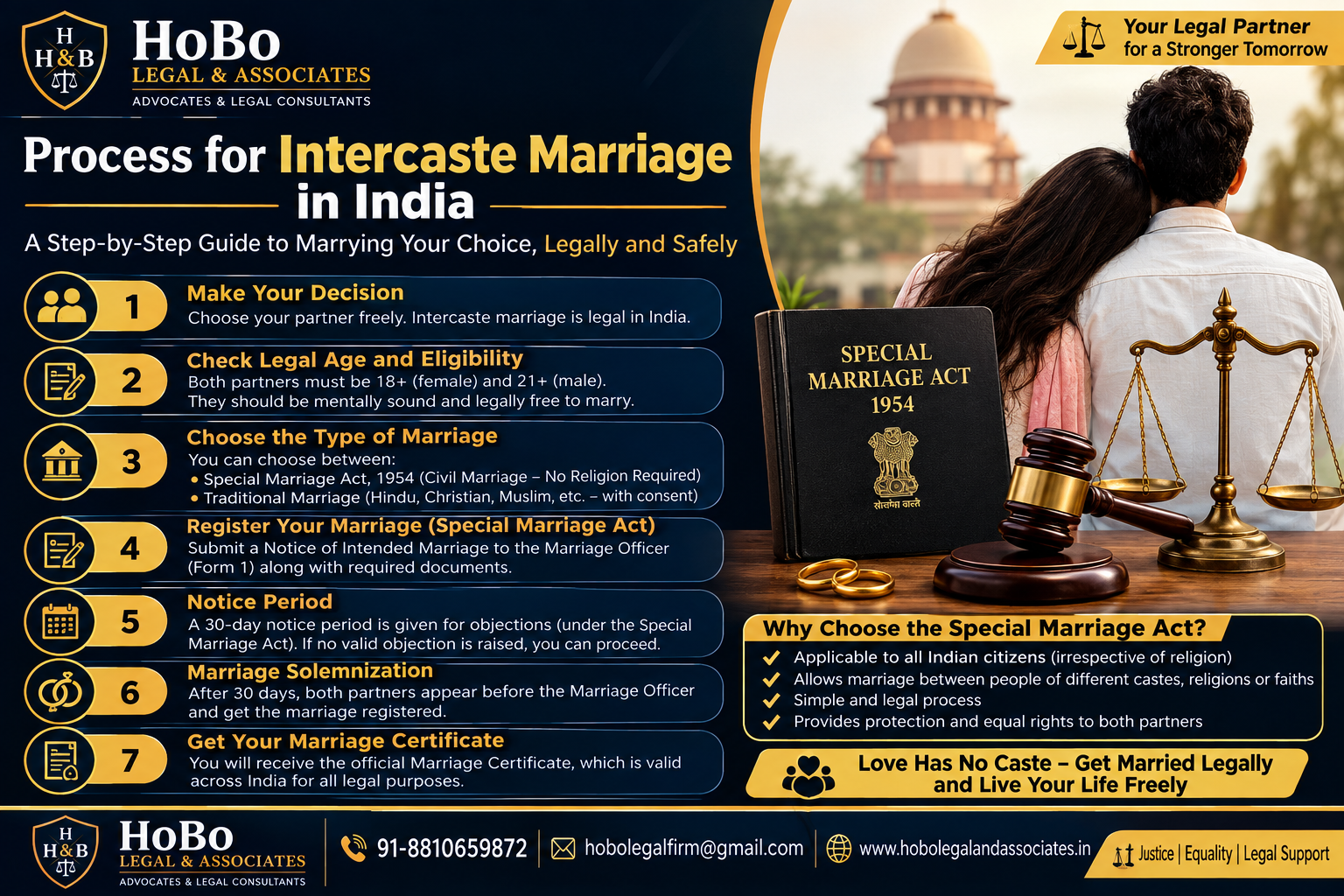
The process can differ depending on the law under which the couple chooses to marry. Where the couple chooses marriage under the Special Marriage Act, the general process involves the following steps.
1. Check Legal Eligibility
Before starting the marriage process, both parties should ensure that they satisfy the statutory conditions.
Under Section 4 of the Special Marriage Act, important conditions include:
- Neither party should have a spouse living at the time of marriage.
- The parties must have the legal capacity to give valid consent.
- The male party must have completed 21 years and the female party 18 years.
- The parties must not fall within the prohibited degrees of relationship, subject to the statutory provisions and exceptions.
2. Decide the Appropriate Marriage Procedure
An inter-caste couple may have different legal options depending on their religion, circumstances and the applicable law.
Where the couple wants a civil marriage, they may consider the Special Marriage Act, 1954.
The Special Marriage Act provides a statutory procedure for solemnization of marriage through a Marriage Officer.
3. Submit Notice of Intended Marriage
Under Section 5 of the Special Marriage Act, the parties intending to marry must give written notice to the Marriage Officer in the prescribed manner.
The Act also contains a residence-related requirement concerning the district of the Marriage Officer before the notice is given.
4. Publication of Marriage Notice
After receiving the notice, the Marriage Officer enters the relevant details in the Marriage Notice Book and follows the publication procedure prescribed under the Act.
This is an important part of the inter-caste marriage process under the Special Marriage Act.
5. 30-Day Objection Period
The Special Marriage Act provides a period of 30 days after publication of the notice during which an objection may be made.
Importantly, an objection must relate to the statutory conditions for marriage. A person’s personal disagreement with an inter-caste marriage does not automatically make the marriage legally invalid.
6. Inquiry Into an Objection
If a valid objection is filed, the Marriage Officer follows the statutory procedure for considering and deciding the objection.
If the Marriage Officer refuses to solemnize the marriage, the Act provides a mechanism for appeal to the District Court in the circumstances specified by law.
7. Marriage Solemnization
Once the statutory requirements have been fulfilled, the marriage can be solemnized before the Marriage Officer in accordance with the Special Marriage Act.
The parties make the required declaration in the presence of the Marriage Officer and witnesses, followed by completion of the statutory formalities.
8. Obtain the Marriage Certificate
After solemnization, the Marriage Officer issues the marriage certificate in accordance with the Act.
The certificate serves as important legal evidence of the marriage and may be required for various official purposes.
Documents Required for Inter-Caste Marriage
The exact documentation can vary according to the Marriage Officer, State rules and the specific circumstances of the couple.
Commonly requested documents may include:
- Proof of age
- Identity proof
- Address or residence proof
- Passport-size photographs
- Affidavit containing required details
- Proof relating to marital status, where applicable
- Divorce decree, where a previous marriage ended in divorce
- Death certificate of a previous spouse, where applicable
- Witness identification and address documents
Couples should confirm the current document requirements with the concerned Marriage Officer before filing the notice.
Is Special Marriage Act Necessary for an Inter-Caste Marriage?
No. An inter-caste marriage is not automatically required to be performed under the Special Marriage Act.
The appropriate legal route depends on the circumstances of the parties and the applicable marriage law.
However, the Special Marriage Act is particularly relevant where the parties want to solemnize a civil marriage under a secular statutory framework. The Act specifically provides for a special form of marriage and related registration and matrimonial provisions.
Inter-Caste Marriage and Inter-Religious Marriage
Inter-caste and inter-religious marriages are not the same legal concept.
An inter-caste marriage involves parties belonging to different castes, while an inter-religious marriage involves parties belonging to different religions.
A couple may be inter-caste without being inter-religious, or may be both inter-caste and inter-religious.
For an inter-religious couple seeking a civil marriage, the Special Marriage Act, 1954 can be particularly relevant.
Can Parents Stop an Inter-Caste Marriage?
For legally eligible adults, family disagreement by itself does not create a statutory condition preventing marriage.
However, situations involving threats, coercion, unlawful confinement or violence can create separate legal issues. A person facing such circumstances should seek appropriate legal protection from the competent authorities or courts.
Legal Protection for Inter-Caste Couples
An inter-caste couple facing threats or harassment may need legal assistance depending on the circumstances.
Possible legal steps can vary according to the nature of the situation and may include approaching the police, seeking appropriate court protection or taking other remedies available under law.
The correct remedy depends on the facts of the individual case.
Financial Assistance for Inter-Caste Marriage
Some government schemes provide incentives or assistance relating to inter-caste marriages, but eligibility and procedure depend on the applicable scheme and State/UT requirements.
The former Dr. Ambedkar Scheme for Social Integration through Inter-Caste Marriages was merged with the Centrally Sponsored Scheme for implementation of the Protection of Civil Rights Act, 1955 with effect from 1 April 2023. Applications are handled through the relevant State/UT mechanism rather than through the Dr. Ambedkar Foundation as a new direct application route.
Therefore, couples should check the current rules of their concerned State or Union Territory before applying for any financial incentive.
Benefits of Legal Marriage Registration
Proper marriage registration can help couples establish documentary proof of their marital status.
A marriage certificate may be useful for:
- Government records
- Passport and visa-related matters
- Banking and financial documentation
- Insurance and nominee-related matters
- Property and succession-related matters
- Other official purposes
The exact legal consequences depend upon the law under which the marriage is solemnized or registered.
Why Legal Guidance May Be Helpful
Although the basic process may appear straightforward, couples can face issues involving:
- Jurisdiction of the Marriage Officer
- Notice requirements
- Documentation
- Objections
- Previous marriage
- Prohibited relationships
- Family opposition
- Threats or harassment
- Marriage registration
- Government incentive schemes
Understanding the applicable law before starting the process can help avoid unnecessary procedural problems.
Frequently Asked Questions About Inter-Caste Marriage in India
1. Is inter-caste marriage legal in India?
Yes. An inter-caste marriage is legally possible when the parties satisfy the requirements of the applicable marriage law.
2. Can two adults from different castes marry without family permission?
Where the parties are legally eligible adults, family disagreement by itself is not a statutory condition that makes the marriage invalid. The applicable marriage procedure must still be followed.
3. Can an inter-caste couple marry under the Special Marriage Act?
Yes. An eligible inter-caste couple can use the Special Marriage Act for a civil marriage, subject to the statutory requirements.
4. Is there a 30-day notice period under the Special Marriage Act?
The Act provides for publication of the notice and a 30-day period during which objections may be made on the statutory grounds.
5. What documents are required for inter-caste marriage?
Documents commonly include age proof, identity proof, address proof, photographs and other documents required by the concerned Marriage Officer. Requirements can vary by jurisdiction.
6. Can parents legally object to an inter-caste marriage?
A personal objection based only on caste difference does not itself establish one of the statutory conditions preventing marriage under the Special Marriage Act.
7. Can an inter-caste couple get a marriage certificate?
Yes. Where the marriage is solemnized or registered under the applicable law, the couple can obtain the relevant marriage certificate.
8. Is there any government financial assistance for inter-caste marriage?
Government schemes may provide incentives in eligible cases. However, the applicable scheme, eligibility conditions and application process depend on the current State/UT framework.
9. Can an inter-caste couple seek legal protection from threats?
Depending on the facts, couples facing threats, violence, harassment or unlawful interference may have legal remedies and can seek appropriate assistance from the competent authorities or courts.
10. Should an inter-caste couple consult a lawyer before marriage?
Legal guidance can be useful where there are questions regarding the marriage procedure, documents, objections, family opposition, protection or other legal complications.
Legal Assistance for Inter-Caste Marriage in India
The process for inter-caste marriage in India depends on the applicable marriage law and the individual circumstances of the couple. For couples choosing a civil marriage, the Special Marriage Act provides a statutory framework covering notice, objections, solemnization and marriage certification.
HoBo Legal & Associates can assist couples in understanding the applicable marriage procedure, documentation, registration requirements and legal remedies relating to inter-caste marriage matters.
Disclaimer
This article is intended only for general legal information and educational purposes. It does not constitute legal advice and does not create an advocate-client relationship. Marriage procedures, documentation, government schemes and administrative requirements may vary by jurisdiction and may change from time to time. Individuals should obtain case-specific legal advice before taking legal action.