Process of Love Marriage in India – Legal Procedure, Court Marriage & Registration
The Process of Love Marriage in India depends on the religion of the parties, the type of marriage they choose and the applicable marriage law. Two legally eligible adults can choose to marry according to the procedure prescribed by the applicable law.
For couples who want a civil marriage, the Special Marriage Act, 1954 provides a statutory framework for solemnization of marriage, including notice, publication, objections and marriage certification.
Understanding the Process of Love Marriage in India before starting the procedure can help couples prepare the required documents and follow the correct legal steps.
What Is Love Marriage in India?
A love marriage is a marriage in which the individuals choose their life partner themselves rather than entering into a marriage arranged primarily by their families.
From a legal perspective, the important issue is not whether a marriage is a “love marriage” or an arranged marriage. The parties must satisfy the legal requirements applicable to their marriage.
The Process of Love Marriage in India may therefore vary depending on whether the couple chooses marriage under a personal law or a civil marriage under the Special Marriage Act.
Process of Love Marriage in India
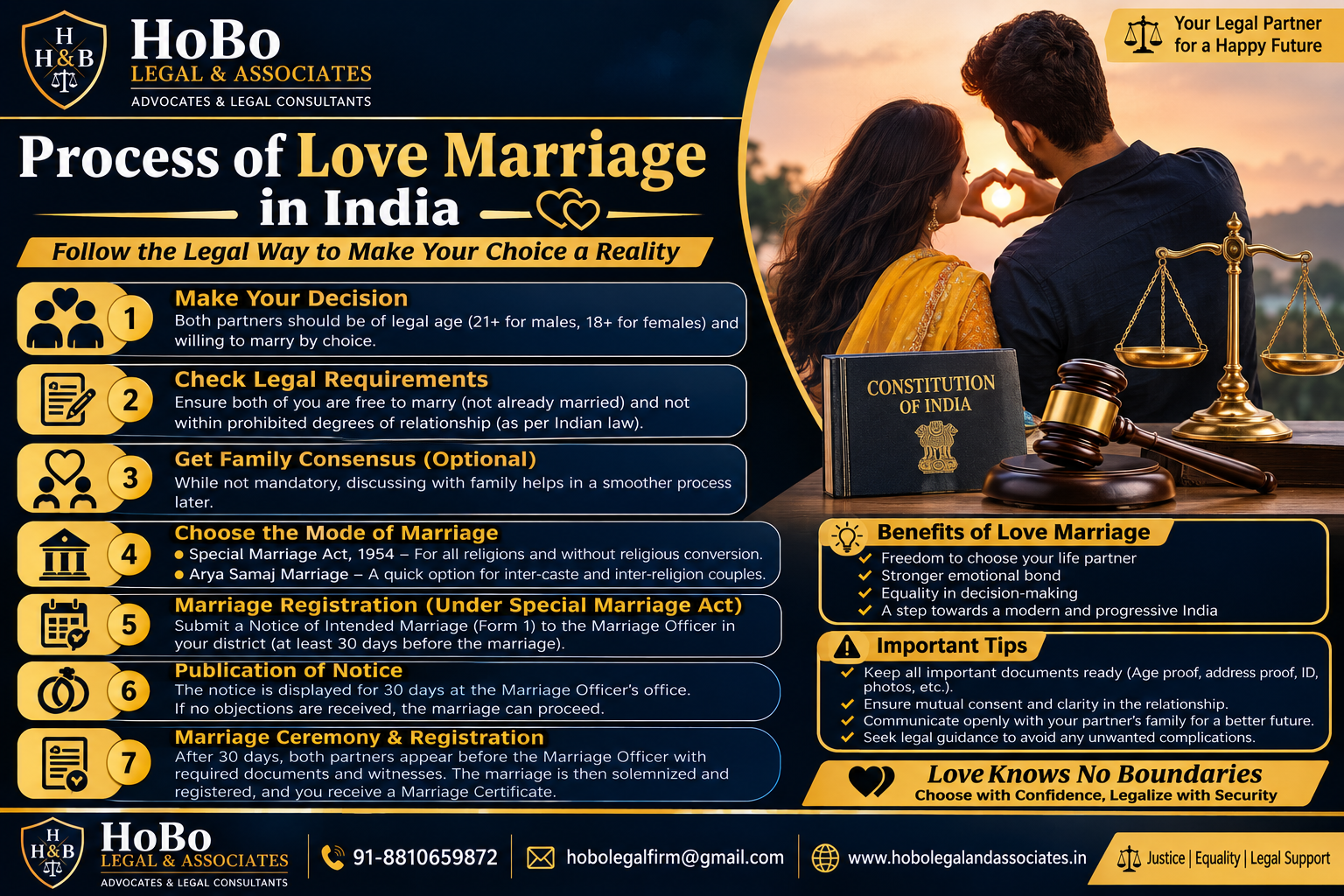
The general Process of Love Marriage in India can involve the following steps.
1. Check the Legal Eligibility
Before starting the Process of Love Marriage in India, both parties should ensure that they fulfil the applicable legal requirements.
For marriage under the Special Marriage Act, important conditions include:
- The male party must have completed 21 years of age.
- The female party must have completed 18 years of age.
- Neither party should have a spouse living at the time of marriage.
- The parties must have the legal capacity to consent.
- The parties should not fall within the prohibited degrees of relationship, subject to the applicable statutory provisions.
These requirements should be checked before beginning the Process of Love Marriage in India.
2. Choose the Appropriate Marriage Procedure
The next step in the Process of Love Marriage in India is determining the appropriate legal route.
Depending on the circumstances, couples may marry under the applicable personal law or may choose a civil marriage under the Special Marriage Act, 1954.
The Special Marriage Act is particularly relevant for couples seeking a civil form of marriage.
3. Notice of Intended Marriage
Where the couple chooses marriage under the Special Marriage Act, the Process of Love Marriage in India includes submitting a written Notice of Intended Marriage to the Marriage Officer.
The Act contains a residence requirement connected with the district of the Marriage Officer before the notice is given.
4. Publication of Notice
After the notice is received, the Marriage Officer follows the statutory procedure for entering and publishing the notice.
This is an important stage in the Process of Love Marriage in India when the marriage is being solemnized under the Special Marriage Act.
5. 30-Day Objection Period
The Special Marriage Act provides a 30-day period after publication of the notice during which an objection may be made on the grounds specified by law.
A family member’s personal disagreement with a love marriage does not, by itself, constitute a statutory ground for preventing a legally eligible marriage.
Therefore, couples should understand the legal requirements rather than assuming that every objection can stop the Process of Love Marriage in India.
6. Inquiry Into an Objection
If an objection is submitted, the Marriage Officer may conduct an inquiry according to the procedure prescribed under the law.
Where the Marriage Officer refuses to solemnize the marriage, the Special Marriage Act provides for an appeal mechanism in the circumstances specified by the Act.
7. Solemnization of Marriage
Once the applicable legal requirements have been completed, the marriage can be solemnized according to the relevant legal procedure.
For a marriage under the Special Marriage Act, the parties complete the required declarations and formalities before the Marriage Officer in the presence of the required witnesses.
8. Marriage Certificate
After completion of the legal formalities, the marriage certificate is issued according to the applicable procedure.
A marriage certificate is important documentary evidence of the legally recognized marriage and can be useful for various official purposes.
Documents Required for Love Marriage in India
The documents required for the Process of Love Marriage in India can vary depending on the Marriage Officer, State rules and the circumstances of the couple.
Commonly required documents may include:
- Age proof
- Identity proof
- Address or residence proof
- Passport-size photographs
- Affidavit containing required particulars
- Documents relating to marital status, where applicable
- Divorce decree, if previously married and divorced
- Death certificate of a previous spouse, where applicable
- Identity and address documents of witnesses
Couples should verify the current documentation requirements with the concerned Marriage Officer before starting the Process of Love Marriage in India.
Love Marriage Under the Special Marriage Act
The Special Marriage Act, 1954 provides a civil legal framework for couples who want to solemnize their marriage without relying on a religious marriage ceremony.
For eligible couples, the Process of Love Marriage in India under the Special Marriage Act generally involves:
- Checking eligibility
- Selecting the appropriate Marriage Officer
- Submitting the notice
- Publication of notice
- Waiting for the statutory objection period
- Dealing with any lawful objection
- Solemnization of marriage
- Obtaining the marriage certificate
The exact administrative procedure may vary according to the applicable State rules.
Can Parents Stop a Love Marriage?
For legally eligible adults, parents do not obtain an automatic legal right to prevent their adult children from choosing their spouse merely because they disagree with the relationship.
However, situations involving threats, violence, coercion, unlawful confinement or harassment can raise separate legal issues.
If a couple faces such circumstances during the Process of Love Marriage in India, they may need appropriate legal assistance and protection from the competent authorities or courts.
Love Marriage Without Family Consent
An adult couple may choose to marry without family consent where the legal requirements for marriage are satisfied.
However, the couple must still follow the applicable legal procedure.
Where the Special Marriage Act is chosen, the statutory notice and publication requirements continue to apply. Family consent does not replace or remove the legal requirements of the Act.
Inter-Religion Love Marriage in India
A love marriage may also involve individuals belonging to different religions.
For an eligible inter-religious couple seeking a civil marriage, the Special Marriage Act can provide a statutory route.
The Process of Love Marriage in India for an inter-religious couple should therefore be planned according to the applicable legal procedure and documentation requirements.
Inter-Caste Love Marriage in India
An inter-caste love marriage is a marriage between individuals belonging to different castes.
Caste difference by itself does not make a marriage between legally eligible adults invalid.
Couples choosing a civil marriage can consider the Special Marriage Act, subject to its statutory requirements.
Legal Protection in Love Marriage Cases
Some couples may face family pressure, threats or harassment because of their relationship.
Depending on the facts, legal remedies may include approaching the police or seeking appropriate protection or relief from a competent court.
The appropriate legal remedy depends on the nature and seriousness of the situation.
Is Court Marriage the Same as Love Marriage?
No. Love marriage describes how the couple chooses their partner, whereas court marriage generally refers to a marriage solemnized or registered through a legally prescribed civil procedure.
A love marriage can be performed through different legal routes depending on the circumstances.
Therefore, Process of Love Marriage in India and court marriage procedure should not automatically be treated as exactly the same thing.
Benefits of Completing the Legal Marriage Procedure
Following the proper Process of Love Marriage in India and obtaining appropriate documentation can provide important proof of the marital relationship.
A marriage certificate may be useful for:
- Government records
- Passport and visa-related matters
- Banking and financial documentation
- Insurance matters
- Nomination-related matters
- Property-related documentation
- Other official purposes
Why Legal Guidance May Be Helpful
The Process of Love Marriage in India can involve different legal and administrative requirements depending on the circumstances of the couple.
Legal guidance can be particularly useful where there are issues involving:
- Special Marriage Act procedure
- Inter-religious marriage
- Inter-caste marriage
- Marriage documentation
- Notice requirements
- Objections
- Family opposition
- Threats or harassment
- Marriage registration
- Previous marriage or divorce
Understanding the correct procedure before taking the next step can help couples avoid unnecessary complications.
Frequently Asked Questions About the Process of Love Marriage in India
1. What is the Process of Love Marriage in India?
The Process of Love Marriage in India depends on the applicable marriage law. It may involve checking eligibility, preparing documents, completing the required marriage procedure and obtaining a marriage certificate.
2. Can two adults have a love marriage without parental consent?
Legally eligible adults can choose their spouse. Parental disagreement alone does not automatically invalidate their marriage.
3. Can love marriage be done under the Special Marriage Act?
Yes. Eligible couples can solemnize a civil marriage under the Special Marriage Act, 1954, subject to its statutory requirements.
4. Is there a 30-day notice period for court marriage?
Under the Special Marriage Act, the notice is followed by a statutory 30-day period during which objections may be made on the grounds specified by the Act.
5. What documents are required for love marriage?
Common documents include age proof, identity proof, residence proof, photographs and other documents required by the concerned Marriage Officer.
6. Can parents object to a love marriage?
Parents may express disagreement, but a personal objection does not automatically constitute a legal ground for preventing a marriage between eligible adults.
7. Can an inter-religious couple have a love marriage?
Yes. An eligible inter-religious couple may marry under an applicable marriage law, including the Special Marriage Act where its requirements are satisfied.
8. Can an inter-caste couple have a love marriage?
Yes. An inter-caste marriage is legally possible when the parties satisfy the requirements of the applicable law.
9. What if the couple faces threats from family members?
Where a couple faces threats, violence, harassment or unlawful interference, appropriate legal remedies may be available depending on the circumstances.
10. Is a marriage certificate important after love marriage?
Yes. A marriage certificate provides important documentary evidence of the marriage and may be required for various official and legal purposes.
Legal Assistance for Love Marriage in India
Understanding the Process of Love Marriage in India is important for couples who want to complete their marriage through the correct legal procedure.
Whether the matter involves a civil marriage, Special Marriage Act procedure, inter-caste marriage, inter-religious marriage, documentation or family-related legal concerns, understanding the applicable law can help couples proceed appropriately.
HoBo Legal & Associates provides legal assistance in matters relating to marriage, family law, documentation and related legal procedures.
Disclaimer
This article is provided for general legal information and educational purposes only. It does not constitute legal advice or create an advocate-client relationship. Marriage laws, procedures, documentation requirements and administrative practices may change or vary by jurisdiction. Case-specific legal advice should be obtained based on the individual circumstances.