
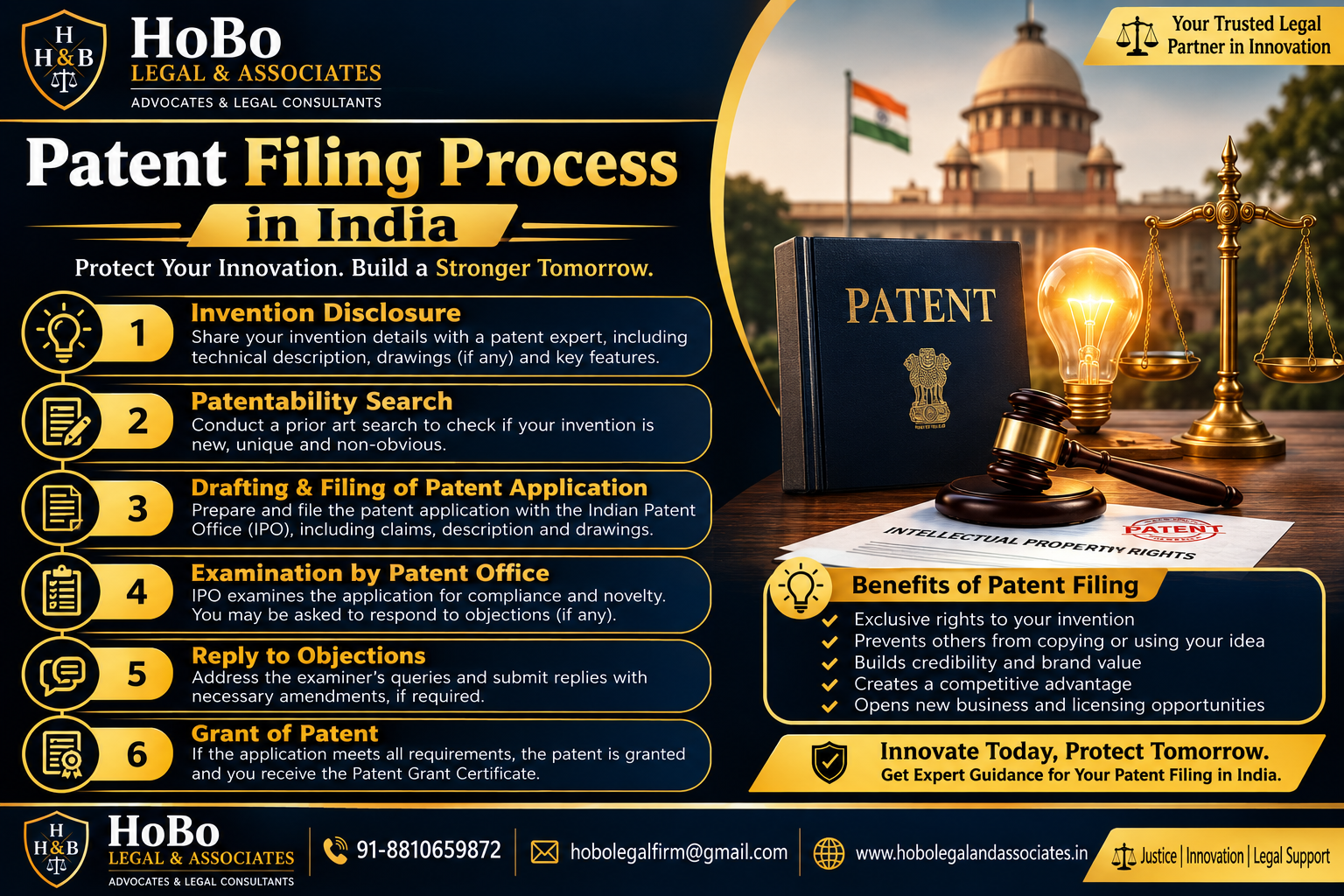
Patent Filing Process in India – Complete Guide to Patent Registration
The Patent Filing Process in India involves several legal and procedural steps, starting from evaluating the invention and preparing the patent specification to filing the application, examination and eventual grant of the patent.
A patent can provide legal protection for an eligible invention and give the patent holder exclusive rights subject to the Patents Act, 1970 and applicable rules.
Understanding the Patent Filing Process in India is important for inventors, startups, businesses, researchers and organizations that want to protect their inventions in India.
What Is a Patent?
A patent is a statutory intellectual property right granted for an invention that satisfies the applicable legal requirements.
Under Indian patent law, an invention generally needs to satisfy requirements relating to novelty, inventive step and industrial applicability, and it must not fall within the categories of inventions excluded from patentability under the Patents Act.
The Patent Filing Process in India is governed primarily by the Patents Act 1970 and the Patents Rules, 2003.
Who Can File a Patent Application in India?
A patent application may be made by a person claiming to be the true and first inventor, by the assignee of the person claiming to be the true and first inventor, or by the legal representative of a deceased person who was entitled to make the application.
The application must comply with the requirements prescribed under Indian patent law.
Patent Filing Process in India
The Patent Filing Process in India generally involves the following important stages.
1. Identify and Evaluate the Invention
The first step in the Patent Filing Process in India is to clearly identify the invention.
The applicant should understand:
-
- What problem does the invention solve?
-
- What is technically new about the invention?
-
- How does it differ from existing products or processes?
-
- Can it be used in industry?
-
- Does it satisfy the applicable patentability requirements?
A proper technical evaluation can help determine whether filing a patent application is appropriate.
2. Conduct a Patent Search
Before filing, it is advisable to conduct a patent search and review existing patents and publicly available technical information.
A search can help identify potentially relevant prior art and may assist in understanding the novelty and patentability of the invention.
The search should be carried out carefully because earlier publications or disclosures may affect the patentability of an invention.
3. Prepare the Patent Specification
Preparing the specification is one of the most important parts of the Patent Filing Process in India.
An applicant may file a provisional specification or a complete specification, depending on the stage of development of the invention.
A complete specification must describe the invention fully and particularly, disclose the best method of performing the invention known to the applicant, define the scope of protection through claims and include an abstract.
4. Provisional Patent Application
If the invention is still being developed, the applicant may consider filing a provisional specification.
A provisional filing can establish a priority date and provide additional time to develop the invention before filing the complete specification.
However, a provisional specification is not mandatory. An applicant may also file directly with a complete specification.
Important 12-Month Deadline
If a patent application is filed with a provisional specification, the complete specification must generally be filed within 12 months from the date of filing the provisional specification.
There is no further extension of this period under Section 9(1), and failure to file the complete specification within the prescribed period results in the application being deemed abandoned.
5. Prepare the Required Patent Forms
The Patent Filing Process in India involves prescribed forms and supporting documents.
The commonly relevant forms include:
-
- Form 1 – Application for Grant of Patent
-
- Form 2 – Provisional or Complete Specification
-
- Form 3 – Statement and Undertaking under Section 8
-
- Form 5 – Declaration as to Inventorship
-
- Form 26 – Power of Authority where a registered patent agent is appointed
The exact forms required can depend on the type and circumstances of the application. The Indian Patent Office provides the current forms and official fee information.
6. File the Patent Application
A patent application can be filed electronically through the Indian Patent Office’s online filing system.
The applicant can create an e-filing account, select the relevant forms, upload the required documents, digitally sign them and pay the prescribed fee.
After successful payment, an acknowledgement receipt is generated.
Therefore, the Patent Filing Process in India can generally be completed online without the need to visit the Patent Office for ordinary e-filing.
7. Publication of Patent Application
After filing, the patent application proceeds through the statutory publication process.
Publication makes the application available to the public according to the applicable provisions and rules.
In certain circumstances, an applicant may seek early publication subject to the prescribed procedure and requirements.
8. Request for Examination
Filing a patent application does not by itself mean that the application will automatically be examined.
A request for examination must be filed in the prescribed form and within the applicable period.
The Indian Patent Office states that an application can be examined only after receipt of the appropriate request for examination, including the applicable Form 18/18A procedure.
9. Patent Examination
During examination, the Patent Office considers whether the application satisfies the applicable requirements of Indian patent law.
The examination may involve issues relating to:
-
- Novelty
-
- Inventive step
-
- Industrial applicability
-
- Sufficiency of disclosure
-
- Clarity of claims
-
- Patentable subject matter
-
- Formal requirements
-
- Prior art
The Patent Office may issue an examination report raising objections that the applicant needs to address.
10. Respond to Patent Office Objections
If objections are raised, the applicant may need to submit a written response and, where appropriate, amend the specification or claims.
The response should address the objections raised by the Patent Office and comply with the applicable statutory requirements.
Professional assistance can be useful when objections involve complex issues of patentability, claim construction or prior art.
11. Hearing, If Required
In appropriate cases, the Patent Office may provide an opportunity for a hearing in accordance with the applicable procedure.
The applicant or authorized patent agent can make submissions addressing the outstanding objections.
12. Grant of Patent
If the application satisfies the applicable requirements and the objections are successfully addressed, the patent may be granted.
The grant of a patent gives the patentee the rights provided under the Patents Act, subject to the statutory framework and limitations applicable to the patent.
Documents Required for Patent Filing in India
The documents required for the Patent Filing Process in India depend on the type of application and applicant.
Common documents may include:
-
- Patent application
-
- Provisional or complete specification
-
- Drawings, where required
-
- Abstract
-
- Details of applicant
-
- Inventor details
-
- Declaration relating to inventorship, where applicable
-
- Statement and undertaking regarding foreign applications, where applicable
-
- Priority documents, where applicable
-
- Power of authority where a patent agent is appointed
-
- Prescribed government fee
The Indian Patent Office publishes the applicable forms and official fee schedule.
Provisional vs Complete Patent Application
Understanding the difference is important when planning the Patent Filing Process in India.
Provisional Specification
A provisional specification can be useful where the invention has reached a stage where priority needs to be secured but development is continuing.
It can help establish the filing date while giving the applicant time to prepare the complete specification.
Complete Specification
A complete specification contains the detailed disclosure and claims defining the scope of protection sought.
It must satisfy the requirements prescribed under the Patents Act and applicable rules.
How Long Does the Patent Filing Process Take in India?
The total duration of the Patent Filing Process in India can vary considerably.
The timeline may depend on factors such as:
-
- Type of patent application
-
- Time taken for publication
-
- Filing of request for examination
-
- Patent Office examination
-
- Number and nature of objections
-
- Amendments required
-
- Hearings
-
- Procedural compliance
Therefore, there is no single fixed timeline applicable to every patent application.
Patent Filing Fees in India
Patent filing involves government fees prescribed under the applicable fee schedule.
The amount may depend on factors such as the applicant category, number of claims, pages and other circumstances.
The official Patent Office fee schedule should be checked before filing because fees and applicable requirements may change.
Can a Patent Be Filed Online in India?
Yes. The Indian Patent Office provides an online filing facility.
Applicants can register on the e-filing system and submit the relevant forms and documents electronically.
Why Patent Drafting Is Important
Patent drafting is one of the most important aspects of the Patent Filing Process in India.
A patent specification should clearly disclose the invention while the claims should appropriately define the protection being sought.
Poorly drafted claims or insufficient disclosure can create difficulties during examination or may affect the scope and enforceability of the eventual patent.
Common Mistakes During Patent Filing
Applicants should be careful about common mistakes such as:
-
- Publicly disclosing the invention before filing without considering the legal consequences
-
- Failing to conduct an adequate prior-art search
-
- Missing the 12-month deadline after provisional filing
-
- Preparing unclear or overly broad claims
-
- Providing insufficient technical disclosure
-
- Filing incorrect forms
-
- Missing examination-related deadlines
-
- Failing to respond properly to Patent Office objections
Proper planning can make the Patent Filing Process in India more organized and legally compliant.
Legal Assistance for Patent Filing in India
The Patent Filing Process in India involves technical, legal and procedural considerations.
Inventors, startups and businesses may require assistance with:
-
- Patentability assessment
-
- Prior-art searches
-
- Patent drafting
-
- Provisional specifications
-
- Complete specifications
-
- Patent application filing
-
- Patent Office objections
-
- Examination responses
-
- Patent registration
-
- Patent-related documentation
HoBo Legal & Associates can assist clients with legal matters relating to intellectual property and patent-related procedures.
Frequently Asked Questions About Patent Filing Process in India
1. What is the Patent Filing Process in India?
The Patent Filing Process in India generally includes evaluating the invention, conducting a patent search, preparing the specification, filing the application, publication, examination, responding to objections and, where requirements are satisfied, grant of the patent.
2. Can I file a patent application online in India?
Yes. The Indian Patent Office provides an online patent filing system through which applications and documents can be submitted electronically.
3. Is a provisional patent application mandatory?
No. A provisional specification is optional. An applicant may file directly with a complete specification where appropriate.
4. How long do I have to file a complete specification after provisional filing?
Generally, the complete specification must be filed within 12 months from the date of filing the provisional specification.
5. What is Form 1 in patent filing?
Form 1 is the prescribed application form for grant of a patent. The Patent Office lists Form 1 among the official patent forms.
6. What is Form 2?
Form 2 is used for the provisional or complete specification accompanying a patent application.
7. Does filing a patent application automatically result in a patent grant?
No. The application must go through the applicable publication and examination process and satisfy the requirements of Indian patent law.
8. Is a patent search necessary before filing?
Although the precise requirements depend on the circumstances, conducting a patent and prior-art search can be highly useful for assessing novelty and planning the application.
9. Can a patent application be amended after filing?
Certain amendments may be permitted under the Patents Act and Rules, subject to statutory limitations and the applicable procedure.
10. Why should I take professional assistance for patent filing?
Patent applications involve technical drafting, claim construction, statutory requirements and procedural deadlines. Professional assistance can help in preparing and managing these aspects appropriately.
The Patent Filing Process in India involves much more than simply submitting a patent application. From evaluating the invention and preparing the specification to examination, responding to objections and obtaining grant, each stage requires careful attention.
For inventors and businesses, understanding the applicable requirements before filing can help protect valuable intellectual property and avoid procedural complications.
HoBo Legal & Associates can provide legal assistance relating to intellectual property and patent matters based on the specific requirements of the client.
Disclaimer
This article is provided for general legal information and educational purposes only. It does not constitute legal advice or create an advocate-client relationship. Patent laws, rules, forms, fees and procedures may change from time to time. Case-specific advice should be obtained from a qualified legal or patent professional.