Special Marriage Act in India – Complete Guide to Court Marriage, Registration & Legal Rights
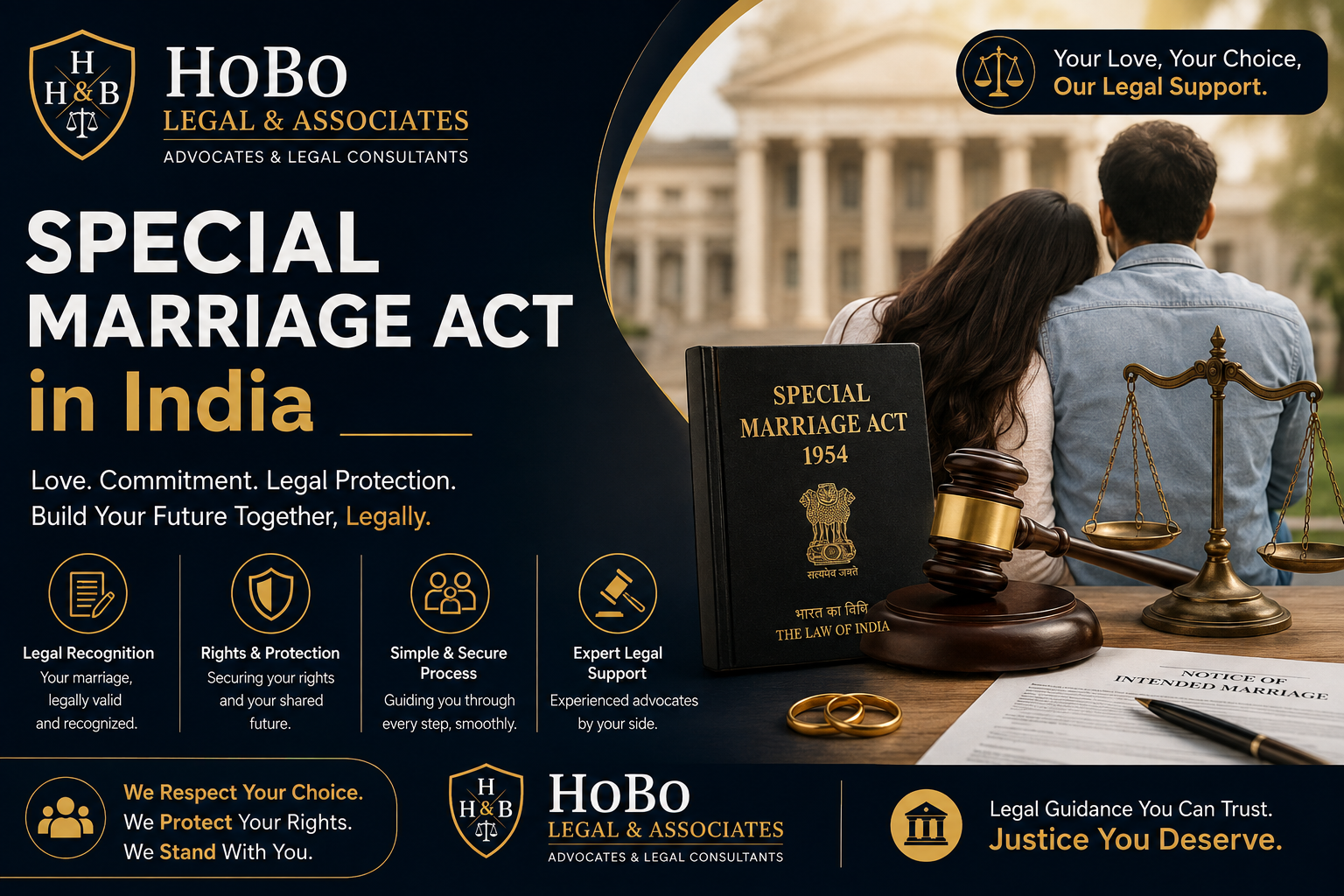
The Special Marriage Act in India provides a legal framework for couples who want to solemnize their marriage without being governed by their personal religious marriage laws. The Act provides a civil form of marriage and is particularly relevant for couples from different religions, as well as couples who choose a marriage under the secular legal framework.
The Special Marriage Act, 1954 also contains provisions relating to solemnization, registration of certain marriages, and matrimonial reliefs.
What is the Special Marriage Act in India?
The Special Marriage Act in India is a central law enacted in 1954 to provide a special form of marriage. A marriage can be solemnized under this Act when the statutory conditions are fulfilled.
Unlike marriages performed under personal religious laws, a marriage under the Special Marriage Act is a civil marriage conducted through the Marriage Officer.
The Act applies throughout India and provides a legal procedure for couples who wish to marry under its provisions.
Who Can Marry Under the Special Marriage Act?
The Special Marriage Act allows eligible individuals to marry irrespective of their religion, provided the conditions prescribed under the Act are satisfied.
Some important statutory conditions include:
- Neither party should have a spouse living at the time of marriage.
- The parties must be capable of giving valid consent as required by law.
- The male must have completed 21 years of age and the female must have completed 18 years of age.
- The parties should not fall within the prohibited degrees of relationship, subject to the statutory exception relating to applicable custom.
Therefore, couples planning a Special Marriage Act court marriage should ensure that all statutory requirements are satisfied before beginning the process.
Special Marriage Act Court Marriage Process
The process generally involves several important legal steps.
1. Notice of Intended Marriage
The parties intending to marry are required to give written notice to the Marriage Officer in the prescribed form.
At least one of the parties must have resided within the district of the Marriage Officer for not less than 30 days immediately preceding the date of giving the notice.
2. Publication of Notice
After receiving the notice, the Marriage Officer enters the details in the Marriage Notice Book and publishes the notice as prescribed under the Act.
The Act provides for publication by affixing a copy of the notice at a conspicuous place in the Marriage Officer’s office.
3. Objection Period
An objection to the intended marriage can be made before the expiration of 30 days from publication of the notice, but the objection must be based on the statutory conditions specified under Section 4.
A mere personal disagreement with the marriage does not itself constitute a statutory ground of objection.
4. Inquiry into Objection
If an objection is filed, the Marriage Officer is required to inquire into the matter.
The Act provides that the Marriage Officer should complete the inquiry and arrive at a decision within the prescribed period. If the objection is upheld and the Marriage Officer refuses to solemnize the marriage, either party may appeal to the concerned District Court within the statutory period.
5. Solemnization of Marriage
If the legal requirements are fulfilled and there is no valid objection preventing solemnization, the marriage can be solemnized according to the procedure prescribed by the Special Marriage Act.
The parties and required witnesses complete the formalities before the Marriage Officer.
Documents Required for Special Marriage Act Marriage
The exact document requirements and administrative procedure may vary according to the concerned Marriage Officer and applicable State rules.
Commonly required documents may include:
- Proof of age
- Address/residence proof
- Identity proof
- Passport-size photographs
- Affidavit containing required particulars
- Documents relating to marital status, where applicable
- Divorce decree, if previously married and divorced
- Death certificate of a previous spouse, where applicable
Couples should verify the current requirements with the concerned Marriage Officer before submitting the application.
Is Notice Mandatory Under the Special Marriage Act?
The Act expressly provides for notice of intended marriage under Section 5. The notice is connected with the statutory procedure for solemnization under the Act.
Therefore, couples planning marriage under the Special Marriage Act should understand the notice and publication requirements before choosing this route.
Special Marriage Act and Inter-Religious Marriage
One of the important features of the Special Marriage Act in India is that it provides a civil legal framework for marriage between individuals who may belong to different religions.
The marriage is solemnized under the Act rather than being dependent upon the religious ceremony of either party.
This makes the Special Marriage Act an important legal option for couples seeking a secular form of marriage.
Special Marriage Act and Inter-Caste Marriage
The Act can also be used by eligible couples from different castes, provided they satisfy the statutory conditions.
The law focuses on the legal eligibility of the parties rather than requiring them to belong to the same caste.
Rights and Legal Protection of Married Couples
A marriage legally solemnized under the Special Marriage Act creates a legally recognized marital relationship.
Depending on the circumstances, issues relating to matrimonial disputes, maintenance, divorce, succession, and other legal rights may arise.
Because the applicable legal position can depend upon the facts and the relevant statutory provisions, couples should obtain appropriate legal advice where a dispute or complex issue is involved.
Divorce Under the Special Marriage Act
The Special Marriage Act also contains provisions relating to divorce and other matrimonial reliefs.
A spouse seeking matrimonial relief must satisfy the applicable statutory requirements and follow the appropriate legal procedure.
Depending on the circumstances, matters may involve:
- Divorce proceedings
- Judicial separation
- Restitution of conjugal rights
- Maintenance-related issues
- Custody and related family disputes
- Other matrimonial reliefs available under applicable law
The appropriate remedy depends upon the facts and circumstances of the particular case.
Why Legal Guidance Can Be Important
Although the Special Marriage Act provides a statutory procedure, couples may face practical or legal issues relating to documentation, jurisdiction, notice, objections, previous marriage, or matrimonial disputes.
Professional legal guidance can help couples understand:
- Eligibility requirements
- Marriage Officer jurisdiction
- Notice procedure
- Documentation
- Objection procedure
- Marriage solemnization formalities
- Matrimonial remedies
- Legal rights after marriage
Special Marriage Act in India – Frequently Asked Questions
1. What is the Special Marriage Act in India?
The Special Marriage Act, 1954 is a central law providing a civil legal framework for solemnization of marriage and related matrimonial matters.
2. Can people of different religions marry under the Special Marriage Act?
Yes. Eligible individuals from different religions can marry under the Act provided the statutory conditions are satisfied.
3. What is the minimum age for marriage under the Special Marriage Act?
The statutory requirement is that the male must have completed 21 years and the female must have completed 18 years.
4. Is a notice required for marriage under the Special Marriage Act?
Yes. Section 5 provides for a written notice of intended marriage to the Marriage Officer.
5. Is there a 30-day notice period?
The Act provides a 30-day period following publication of the notice during which an objection based on the statutory conditions may be made.
6. Can someone object to a Special Marriage Act marriage?
An objection may be made on the grounds that the proposed marriage would contravene one or more conditions specified under Section 4.
7. What happens if an objection is filed?
The Marriage Officer is required to inquire into the objection and decide the matter according to the procedure prescribed by the Act. A statutory appeal is available in certain circumstances if the Marriage Officer refuses to solemnize the marriage.
8. Can an inter-caste couple marry under the Special Marriage Act?
Yes, provided both individuals satisfy the statutory requirements of the Act.
9. Can an inter-religious couple marry under the Special Marriage Act?
Yes. The Act provides a civil form of marriage and does not require both parties to belong to the same religion.
10. Can a person who was previously married use the Special Marriage Act?
A person cannot have a spouse living at the time of solemnization under the conditions specified by Section 4. Where a previous marriage has ended through divorce or death, the relevant legal documentation and circumstances should be properly verified.
Legal Assistance for Special Marriage Act Matters
The Special Marriage Act in India provides an important legal route for couples seeking a civil marriage and legal recognition of their marital relationship.
Understanding the eligibility requirements, notice procedure, documentation, objection process and matrimonial remedies can help couples approach the process properly.
HoBo Legal & Associates can assist individuals and couples in understanding legal procedures relating to marriage, matrimonial disputes, documentation and other family law matters.
For legal assistance, couples should obtain advice based on their specific circumstances and the applicable law.
Disclaimer
This article is provided for general legal information and educational purposes only. It does not constitute legal advice or create an advocate-client relationship. Laws, procedures and administrative requirements may change, and the applicable position can depend upon the facts of an individual matter. Professional legal advice should be obtained for case-specific issues.