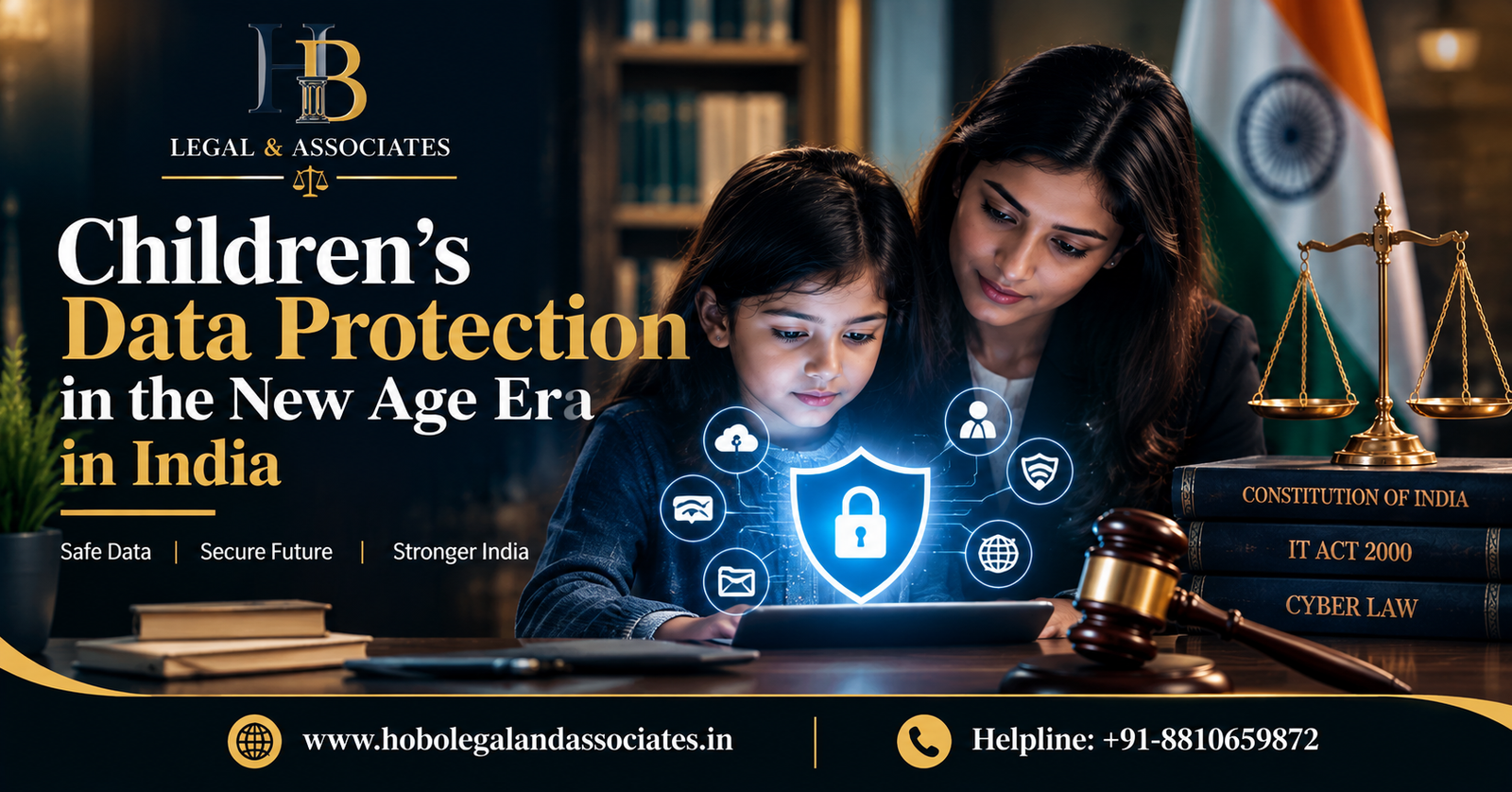
Children’s Data Protection in the New Age Era in India: Complete Guide to Child Privacy, Parental Consent and Digital Data Protection
Children are increasingly using smartphones, social media platforms, online gaming services, educational applications, video platforms, e-commerce websites and other digital services. As a result, a significant amount of personal information relating to children may be collected, processed, stored and shared online.
This makes Children’s Data Protection in India an increasingly important legal and compliance issue for parents, schools, educational institutions, technology companies, online platforms, app developers and businesses processing children’s personal data.
India’s Digital Personal Data Protection Act, 2023 (DPDP Act) contains specific provisions concerning the processing of personal data of children. Section 9 requires a Data Fiduciary to obtain verifiable consent of the parent or lawful guardian before processing a child’s personal data, subject to the statutory framework and prescribed exemptions. The Act also restricts processing likely to have a detrimental effect on a child’s well-being and prohibits tracking, behavioural monitoring and targeted advertising directed at children, subject to prescribed exceptions.
The Digital Personal Data Protection Rules, 2025 provide further details concerning verification of parental consent and certain exemptions for specified entities and purposes.
What Is Children’s Data Protection in India?
Children’s Data Protection refers to the legal, technical and organisational measures used to protect the personal data of children from unlawful, excessive or inappropriate collection, processing, disclosure, retention or use.
Children may provide or generate personal information through:
- Mobile applications
- Online games
- Social media
- Educational platforms
- School portals
- Online classes
- Video-sharing platforms
- E-commerce platforms
- Health applications
- Smart devices
- Websites
- Digital payment-related services
- Online competitions
- AI-powered applications
The information may include:
- Name
- Age
- Date of birth
- Contact details
- Photographs
- Videos
- School information
- Location information
- Device information
- Online activity
- Account information
- Identifiers
- Behavioural information
- Educational information
- Other personal data
The legal framework is therefore particularly important where digital services are designed for, offered to or used by children.
Why Is Children’s Data Protection Important?
Children may not fully understand the long-term consequences of sharing personal information online.
Improper handling of children’s data may create risks involving:
- Privacy violations
- Unauthorised disclosure
- Online profiling
- Behavioural monitoring
- Targeted advertising
- Cyberbullying
- Online exploitation
- Identity-related misuse
- Unauthorised sharing of photographs
- Location-related risks
- Unwanted digital tracking
- Long-term digital footprints
The legal framework therefore places additional obligations on entities processing children’s personal data.
Children’s Data Protection Law in India
The primary modern framework for digital personal data protection is the Digital Personal Data Protection Act, 2023.
Section 9 of the Act deals specifically with the processing of personal data of children.
The provision requires a Data Fiduciary to obtain verifiable consent of the parent or lawful guardian before processing the personal data of a child, in the manner prescribed.
The Act also provides that a Data Fiduciary must not:
- Process children’s personal data in a manner likely to cause detrimental effects on their well-being.
- Track children.
- Undertake behavioural monitoring of children.
- Direct targeted advertising at children.
These provisions are subject to the exceptions and conditions prescribed under the law.
Who Is a Child Under the DPDP Act?
For purposes of the DPDP Act, a child is an individual who has not completed eighteen years of age.
This is significant because the special requirements applicable to children’s personal data can apply until the individual reaches the statutory age threshold.
Businesses therefore need to consider age-related compliance when designing digital services.
What Is a Data Fiduciary?
A Data Fiduciary is broadly the entity that determines the purpose and means of processing personal data.
Depending on the circumstances, this may include:
- Technology companies
- Mobile application operators
- Online platforms
- Educational platforms
- E-commerce businesses
- Gaming companies
- Healthcare organisations
- Service providers
- Other organisations determining how personal data is processed
The exact obligations depend upon the nature of processing and the applicable provisions.
What Is Verifiable Parental Consent?
One of the most important aspects of Children’s Data Protection in India is verifiable parental consent.
The requirement is not simply about placing a checkbox saying:
“I am the parent.”
The prescribed framework provides mechanisms intended to verify that the person giving consent is actually the parent or lawful guardian.
The explanatory material issued with the Rules describes verification measures involving reliable identity details or a virtual token mapped to such details.
This is intended to reduce the possibility of a child simply providing false information to bypass parental-consent requirements.
How Can Parental Consent Be Verified?
The prescribed framework contemplates mechanisms through which a Data Fiduciary can establish that the consenting individual is an adult parent or lawful guardian.
Depending on the applicable circumstances, verification may involve:
- Reliable identity details
- Existing verified information
- Digital identity-related mechanisms
- Virtual tokens
- Digital Locker-related mechanisms
The exact compliance mechanism depends on the applicable Rules and the circumstances of the Data Fiduciary.
The objective is to establish that:
The consenting person is identifiable + is an adult + is the parent or lawful guardian.
The Rules’ explanatory note specifically discusses mechanisms for establishing parental identity and adult status.
Can a Child Give Consent for Their Own Data?
The special framework under Section 9 requires verifiable consent of the parent or lawful guardian before processing a child’s personal data, subject to applicable statutory exemptions.
Therefore, businesses should not assume that a child’s own click on an online consent button is sufficient to satisfy the special parental-consent requirement.
The compliance process should be designed around the requirements applicable to children’s data.
What Data Can Be Collected From Children?
The fact that data belongs to a child does not automatically mean that every form of processing is prohibited.
However, organisations should consider:
- Whether the data is necessary
- Why it is being collected
- How it will be used
- How long it will be retained
- Who will receive it
- Whether parental consent is required
- Whether an exemption applies
- Whether the processing could adversely affect the child
Data minimisation and purpose limitation are therefore important components of responsible children’s data processing.
Prohibition on Tracking Children
The DPDP Act specifically addresses tracking of children.
A Data Fiduciary generally cannot undertake tracking of children except where a prescribed exception applies.
This is particularly relevant to:
- Mobile applications
- Gaming platforms
- Social platforms
- Educational applications
- Advertising technology
- Location-enabled services
- Behavioural analytics
Organisations should therefore examine whether their technical systems continuously monitor or record children’s activities.
Behavioural Monitoring of Children
Behavioural monitoring is another important concern.
A platform may potentially collect information about:
- What a child watches
- How long the child remains on a page
- Which products the child views
- Which games the child plays
- Search activity
- Interaction patterns
- Preferences
- Behavioural characteristics
The DPDP Act restricts behavioural monitoring of children, subject to prescribed exceptions.
Businesses should therefore carefully evaluate analytics and profiling systems used in child-oriented products.
Targeted Advertising to Children
The DPDP Act also restricts targeted advertising directed at children, subject to prescribed exceptions.
This is particularly relevant for:
- Social media platforms
- Gaming applications
- Video platforms
- Children’s websites
- EdTech applications
- Advertising networks
- Mobile applications
A business should carefully assess whether advertising technology uses children’s personal information or behavioural information to personalise advertisements.
Children’s Data Protection and Educational Institutions
Schools, colleges and digital education providers may process significant amounts of student information.
Examples include:
- Student names
- Attendance
- Academic records
- Photographs
- Parent information
- Contact information
- Transport information
- Health-related information
- Online classroom information
The 2025 Rules provide certain exemptions for specified classes of Data Fiduciaries, including educational institutions, for specified purposes and subject to conditions. The explanatory note identifies activities such as educational activities, safety monitoring and transportation tracking within the relevant framework.
An educational institution should therefore not assume that every form of student-data processing is automatically exempt.
The purpose, nature of processing and applicable conditions remain important.
Children’s Data Protection in EdTech Platforms
EdTech businesses may process children’s data through:
- Online classes
- Student accounts
- Tests
- Homework systems
- Learning analytics
- Attendance systems
- Parent dashboards
- Video classes
- AI-based educational tools
A compliance review may examine:
- Age verification
- Parental consent
- Data collection
- Purpose limitation
- Data security
- Retention
- Third-party processors
- Access controls
- Deletion mechanisms
- Grievance mechanisms
Children’s Data Protection in Online Gaming
Online gaming platforms can collect substantial behavioural information.
This may include:
- Player profiles
- Game activity
- Device identifiers
- Usage patterns
- Communication information
- Purchase information
- Location-related information
- Interaction history
Where children use gaming services, businesses should assess whether their systems involve prohibited tracking, behavioural monitoring or targeted advertising.
The analysis should be based on the actual design and operation of the platform.
Children’s Data Protection on Social Media
Social media platforms may process:
- Photos
- Videos
- Usernames
- Messages
- Location information
- Device information
- Interaction data
- Content preferences
- Account activity
Child accounts therefore raise significant privacy and compliance questions.
Businesses operating such platforms should consider:
- Age identification
- Parental consent
- Privacy notices
- Data minimisation
- Security safeguards
- Retention
- Advertising practices
- Profiling
- Third-party sharing
Children’s Data and AI Applications
The growth of artificial intelligence creates new questions concerning Children’s Data Protection.
AI applications may process:
- Text entered by children
- Images
- Voice recordings
- Learning information
- Questions
- Behavioural patterns
- User preferences
Before processing children’s information through an AI system, organisations should consider:
- Whether the information is personal data
- Whether the user is a child
- Whether parental consent is required
- Whether the processing is necessary
- Whether third-party AI providers receive the data
- How long information is retained
- Whether the system creates profiling risks
Children’s Photographs and Videos
Photographs and videos can constitute personal data where they relate to an identifiable individual.
Schools, event organisers, apps and digital platforms may therefore need to consider:
- Purpose of collection
- Consent requirements
- Publication
- Sharing
- Storage
- Access
- Retention
- Security
Special care may be required when children’s images are published publicly or made available to third parties.
Children’s Location Data
Location information can be particularly sensitive from a child-safety perspective.
Applications may collect location information through:
- GPS
- Mobile devices
- Transport systems
- Smart watches
- School transport applications
- Location-enabled games
Organisations should determine whether collection is necessary and whether an applicable statutory provision or exemption permits the processing.
Data Security for Children’s Personal Data
Protecting children’s information requires appropriate technical and organisational safeguards.
Businesses may consider:
- Access controls
- Encryption where appropriate
- Authentication
- Secure databases
- Logging
- Monitoring
- Vulnerability management
- Employee access restrictions
- Vendor controls
- Incident response procedures
- Data retention controls
Security should be designed according to the nature and risks of the processing.
Data Retention and Deletion
Children’s information should not simply remain stored indefinitely without a lawful purpose.
Organisations should consider:
- Why the data is being retained
- Whether the original purpose continues
- Applicable legal retention requirements
- Whether deletion is required
- Whether processors have also deleted the information
- Whether backups are appropriately managed
The DPDP framework includes obligations concerning retention and erasure of personal data, subject to applicable legal requirements and exceptions.
Children’s Data Protection and Data Processors
A Data Fiduciary may use third-party Data Processors to process children’s information.
Examples include:
- Cloud service providers
- Analytics providers
- Payment service providers
- Communication platforms
- Hosting companies
- Software providers
- Security vendors
Businesses should therefore examine:
- Contracts
- Data access
- Security obligations
- Sub-processors
- Retention
- Deletion
- Incident reporting
- Data-sharing arrangements
Children’s Data Breach
A data breach involving children’s personal information can create serious privacy and compliance concerns.
A business should have an incident-response process covering:
- Identification of the incident
- Containment
- Investigation
- Preservation of evidence
- Assessment of affected data
- Applicable notifications
- Remediation
- Security improvements
- Documentation
The exact notification and compliance requirements depend on the applicable legal framework and circumstances.
Children’s Data Protection Compliance Checklist
Businesses handling children’s data can consider the following checklist:
| Compliance Area | Key Question |
|---|---|
| Age | Is the user a child? |
| Consent | Is verifiable parental consent required? |
| Identity | Can the consenting parent/guardian be verified? |
| Purpose | Why is the data being processed? |
| Minimisation | Is all collected information necessary? |
| Tracking | Does the service track children? |
| Behavioural Monitoring | Is children’s behaviour being monitored? |
| Advertising | Is targeted advertising directed at children? |
| Security | Are appropriate safeguards implemented? |
| Retention | How long is the data retained? |
| Processors | Who else processes the information? |
| Deletion | Is there an appropriate erasure process? |
| Governance | Who is responsible for compliance? |
Step-by-Step Children’s Data Protection Compliance Process
Step 1: Identify Child Users
Determine whether the platform or service is likely to be used by individuals below eighteen.
Step 2: Map Personal Data
Identify what information is collected.
Step 3: Identify the Purpose
Document why each category of information is processed.
Step 4: Determine the Legal Basis
Assess the applicable legal basis and whether parental consent is required.
Step 5: Implement Parental Verification
Where required, establish a compliant mechanism for verifiable parental consent.
Step 6: Review Tracking Technologies
Audit cookies, SDKs, analytics tools, advertising systems and other tracking mechanisms.
Step 7: Review Behavioural Monitoring
Identify whether the platform profiles or monitors children’s behaviour.
Step 8: Review Advertising
Determine whether children’s data is used for targeted advertising.
Step 9: Review Third Parties
Identify processors, vendors and other recipients.
Step 10: Implement Security Measures
Establish appropriate technical and organisational safeguards.
Step 11: Review Retention
Determine when children’s data should be deleted.
Step 12: Maintain Compliance Records
Keep appropriate documentation demonstrating how compliance requirements are being addressed.
Children’s Data Protection for Startups
Startups developing child-focused applications should consider privacy compliance from the product-design stage rather than after launch.
A startup may review:
- Product architecture
- Age verification
- Consent mechanisms
- Privacy notices
- Data collection
- Third-party SDKs
- Advertising technology
- Analytics
- Data storage
- Vendor contracts
- Deletion systems
A Children’s Data Protection Compliance review before launch can help identify legal and technical issues early.
Children’s Data Protection for Businesses
Businesses should conduct a periodic privacy review if they process children’s data.
The review may cover:
Legal Review
Applicable provisions and obligations.
Technical Review
Data collection, storage and access.
Contractual Review
Data Processor and vendor agreements.
Product Review
Features that collect or use children’s information.
Advertising Review
Targeting and profiling mechanisms.
Security Review
Controls protecting personal information.
Role of Parents in Protecting Children’s Data
Parents can also take practical steps to reduce unnecessary exposure of children’s information.
Parents may:
- Review app permissions
- Check privacy settings
- Avoid unnecessary sharing of children’s photographs
- Review online accounts
- Teach children not to share personal information
- Monitor suspicious messages
- Use appropriate parental controls
- Review privacy notices
- Report suspected misuse
- Ask platforms how children’s information is being processed
Parents should also teach children that information shared online may be difficult to completely remove later.
What Should Businesses Do If They Discover Non-Compliance?
A business that identifies a possible children’s-data compliance problem should consider:
- Identifying the affected processing.
- Temporarily reviewing or restricting problematic processing where appropriate.
- Preserving relevant records.
- Conducting a legal and technical assessment.
- Reviewing parental-consent mechanisms.
- Reviewing third-party processors.
- Correcting privacy notices.
- Reviewing data retention.
- Assessing whether any reporting or notification obligation applies.
- Implementing corrective measures.
The appropriate response depends upon the nature of the issue and applicable law.
Children’s Data Protection and Legal Risk Assessment
A legal risk assessment may examine:
Consent Risk
Whether required parental consent has been properly obtained and verified.
Collection Risk
Whether unnecessary children’s data is being collected.
Tracking Risk
Whether prohibited tracking or behavioural monitoring is occurring.
Advertising Risk
Whether children’s data is being used for targeted advertising.
Security Risk
Whether appropriate safeguards are implemented.
Vendor Risk
Whether third-party processors comply with contractual requirements.
Retention Risk
Whether information is retained longer than legally or operationally necessary.
Regulatory Risk
Whether the organisation may face regulatory consequences for non-compliance.
Recent Legal Development in India
India’s children’s digital privacy framework has continued to develop alongside wider questions about children’s access to online platforms.
In September 2026, the Supreme Court issued notice in a PIL concerning whether children below eighteen can independently create accounts on digital platforms and the need for mechanisms involving verified parental consent. The case illustrates that children’s online participation, platform terms and parental consent remain active legal issues in India.
This development should be distinguished from the statutory requirements of the DPDP Act: court proceedings may clarify particular legal questions, but they should not be treated as replacing the text of the Act and Rules.
Children’s Data Protection Law Firm in India
A legal review of children’s data processing may be relevant for:
- Technology companies
- Social media platforms
- Gaming companies
- EdTech businesses
- Schools
- Educational institutions
- Healthcare platforms
- AI companies
- E-commerce businesses
- Mobile application developers
- Online service providers
- Startups
Legal assistance may include:
- DPDP Act compliance review
- Children’s data privacy assessment
- Parental consent review
- Privacy policy review
- Data processing assessment
- Data mapping
- Vendor agreement review
- Data protection compliance
- Data breach response
- Regulatory representation
- Privacy litigation support
HoBo Legal & Associates – Children’s Data Protection Legal Assistance
HoBo Legal & Associates can assist businesses and organisations in reviewing legal issues relating to Children’s Data Protection in India, including data privacy, digital platforms, parental consent, technology-related compliance and data protection obligations.
Depending on the nature of the matter, legal review may cover:
- Digital Personal Data Protection Act, 2023
- Digital Personal Data Protection Rules, 2025
- Children’s personal data
- Parental consent
- Data processing
- Privacy policies
- Technology contracts
- Data protection compliance
- Cyber and IT law
- Data breach-related legal issues
- Regulatory compliance
- Digital-platform disputes
For organisations developing or operating child-focused digital services, a legal review can be structured around the actual data flows, platform functionality, consent process and applicable statutory requirements.
Frequently Asked Questions About Children’s Data Protection in India
What is Children’s Data Protection?
It refers to legal, technical and organisational measures designed to protect the personal data of children and regulate how such information is collected, processed, stored and used.
What law protects children’s digital personal data in India?
The Digital Personal Data Protection Act, 2023 contains specific provisions concerning the processing of children’s personal data. The Digital Personal Data Protection Rules, 2025 provide further implementation details.
Is parental consent required for children’s personal data?
Section 9 of the DPDP Act requires verifiable consent of the parent or lawful guardian before processing a child’s personal data, subject to applicable exemptions and conditions.
Can companies track children online?
The DPDP Act restricts tracking of children, subject to prescribed exceptions.
Can businesses use children’s data for targeted advertising?
The DPDP Act restricts targeted advertising directed at children, subject to prescribed exceptions.
What is verifiable parental consent?
It is a consent mechanism designed to establish that the person providing consent is the child’s parent or lawful guardian and meets the prescribed verification requirements.
Do schools have to comply with children’s data protection requirements?
Schools and educational institutions may process student data for legitimate educational and related purposes, and the Rules contain specified exemptions subject to conditions. The exact applicability depends on the processing activity and circumstances.
Does children’s data include photographs?
A photograph may constitute personal data where it relates to an identifiable individual. The applicable processing requirements depend on the circumstances.
What should an EdTech company do before launching a children’s application?
It should review age identification, parental consent, data collection, security, retention, third-party processors, analytics, advertising and other relevant processing activities.
Can AI applications process children’s data?
AI applications may process children’s personal data only within the applicable legal framework. Organisations should assess the purpose, data involved, consent requirements, security, retention and third-party processing.
What happens if children’s personal data is breached?
The organisation should follow an appropriate incident-response process and assess applicable legal notification, security and remedial requirements.
Can parents ask how their child’s data is being processed?
The rights and mechanisms available under the DPDP framework depend on the applicable statutory provisions and circumstances. Organisations should maintain appropriate channels for handling data-related requests and grievances.
Why is children’s data protection important in the digital age?
Children increasingly interact with digital platforms, making privacy, security, consent, tracking, profiling and responsible data processing important components of digital safety.
Children’s Data Protection in India has become an important legal issue as children increasingly use digital platforms, educational applications, gaming services, social media and AI-powered technologies.
The Digital Personal Data Protection Act, 2023 provides specific protections for children’s personal data, including requirements concerning verifiable parental consent, restrictions on detrimental processing, and restrictions concerning tracking, behavioural monitoring and targeted advertising, subject to the statutory exceptions.
The Digital Personal Data Protection Rules 2025 add important implementation details, including mechanisms for verifying parental consent and specified exemptions for certain entities and purposes.
For businesses, compliance should not be limited to adding a privacy-policy paragraph. A meaningful Children’s Data Protection Compliance programme should examine the entire data lifecycle—from collection and consent to processing, security, third-party sharing, retention and deletion.
For parents and children, understanding digital privacy can also help reduce unnecessary exposure of personal information in an increasingly connected environment.
Legal Disclaimer: This article is provided for general informational and educational purposes only and does not constitute legal advice or a legal opinion on any specific platform, organisation, child, data-processing activity or dispute. The application of the DPDP Act, 2023 and DPDP Rules, 2025 depends on the facts, processing activity, applicable exemptions and commencement of the relevant provisions.