
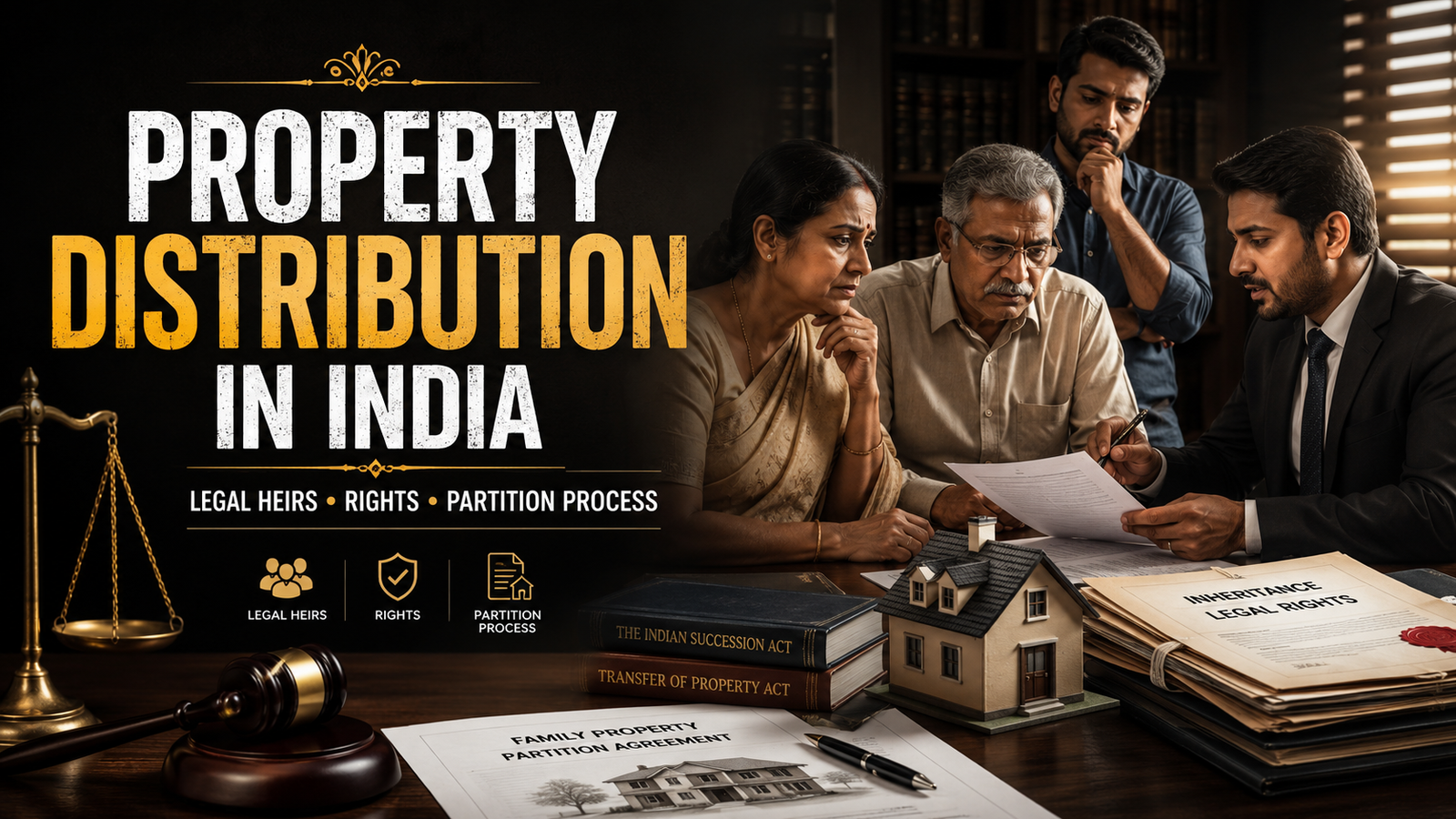
Property Distribution in India – Legal Heirs, Rights, Rules & Partition Process
Property distribution in India can become complicated when several family members claim rights over the same property. The legal position may depend on whether the property is self-acquired, ancestral, jointly owned, or inherited after the death of the owner.
Understanding the applicable succession law, legal heirs, ownership documents and the nature of the property is important before dividing or transferring any share.
What is Property Distribution?
Property distribution means legally dividing or transferring ownership of property among persons who are entitled to receive a share. Distribution may take place during the owner’s lifetime through a valid transfer or after death through a Will or succession laws.
Where multiple heirs have rights in a property, they may mutually divide their respective shares through a family settlement or partition. If an agreement cannot be reached, a legal partition proceeding may become necessary.
How is Property Distributed Among Legal Heirs?
The distribution of inherited property depends on the personal law applicable to the deceased and the circumstances of ownership.
For example, where a Hindu dies without leaving a valid Will, succession is generally governed by the Hindu Succession Act, 1956. The legal heirs may include the deceased’s children, spouse and mother, subject to the applicable statutory rules.
The exact share cannot always be determined simply by counting family members. The nature of the property, surviving heirs and previous ownership interests must also be examined.
Property Distribution Without a Will
When a person dies intestate, meaning without leaving a valid Will, the property is distributed according to the applicable succession law.
Before determining individual shares, it is important to identify:
- The legal heirs of the deceased
- Whether the property was self-acquired or ancestral
- Existing ownership or co-ownership
- Any previous partition or family settlement
- Applicable personal and succession laws
- Liabilities connected with the estate
Therefore, legal heirship should be established before assuming that a particular family member owns a specific percentage.
Property Distribution Between Son and Daughter
Under the Hindu Succession Act, daughters have important statutory rights in ancestral/coparcenary property. The Supreme Court has also clarified that a daughter’s coparcenary right is not dependent simply on whether her father was alive when the 2005 amendment came into force.
However, the precise share depends on the facts of the property and the succession involved.
A daughter may also inherit from a deceased parent as a legal heir in accordance with the applicable succession provisions.
Property Distribution Among Brothers and Sisters
When brothers and sisters inherit property, their respective rights depend on the applicable succession law and the nature of the property.
If the heirs agree on division, they may document the arrangement through an appropriate partition deed or family settlement, depending on the circumstances.
If there is disagreement regarding ownership or share, a civil court may be approached for appropriate relief.
Can One Heir Claim the Entire Property?
Generally, one legal heir cannot simply take exclusive ownership of jointly inherited property merely because the property is in that person’s possession.
Physical possession and legal ownership are different concepts.
An heir claiming exclusive ownership may need to establish a legally valid basis, such as:
- A valid Will
- A registered transfer
- A legally effective partition
- A relinquishment/release by other entitled persons
- A valid family settlement
- Other legally recognised grounds
Ancestral Property Distribution
Ancestral property has a different legal character from ordinary self-acquired property.
In Hindu joint-family/coparcenary situations, eligible coparceners may have rights by birth, subject to the statutory framework and facts of the case.
Before claiming a share in ancestral property, it is important to examine the property’s historical ownership and whether it actually qualifies as ancestral/coparcenary property under law.
A property is not automatically ancestral merely because it has been owned by the family for a long period.
Self-Acquired Property Distribution
A person generally has broader rights over their self-acquired property during their lifetime.
The owner may, subject to applicable law, transfer or otherwise deal with the property. After death, succession may take place through a valid Will or under the applicable intestate succession law.
This is why determining whether a property is self-acquired or ancestral is often the first important step in a property dispute.
Property Partition Process in India
When several people have rights in the same property, a partition can be completed through mutual agreement or court proceedings.
Step 1: Collect Property Documents
Gather documents such as:
- Sale deed
- Previous title documents
- Mutation records
- Revenue records
- Property tax documents
- Will, if any
- Death certificate
- Legal heir documents
- Existing partition or settlement documents
Step 2: Identify the Legal Heirs and Owners
The parties entitled to the property should be identified based on the applicable succession law and ownership records.
Step 3: Determine Each Person’s Share
The legal share should be calculated after examining the property type, ownership history, surviving heirs and applicable law.
Step 4: Try an Amicable Settlement
If all parties agree, they can document the agreed division through an appropriate legal instrument.
Step 5: Execute and Register the Necessary Document
Depending on the transaction and applicable law, registration and stamp-duty requirements may apply.
Step 6: Approach the Court if Necessary
If the parties cannot agree, an eligible co-owner or legal heir may consider filing a partition suit before the competent court.
What if Family Members Disagree About Property Distribution?
Property disputes often arise because family members have different interpretations of ownership or inheritance rights.
Common disputes include:
- One heir refusing to divide the property
- Disputes regarding ancestral property
- Disputes over a Will
- Allegations of forged property documents
- Unauthorised sale of jointly owned property
- Disputes between siblings
- Claims concerning daughters’ shares
- Possession disputes
In such cases, the documents and ownership history should be examined before deciding the appropriate legal remedy.
Documents Required for Property Distribution
The documents may vary depending on the case, but commonly include:
- Title or sale deed
- Previous ownership documents
- Death certificate of the deceased owner
- Will, if available
- Legal heir or succession documents
- Identity and address documents of parties
- Property tax and mutation records
- Revenue records, where applicable
- Existing family settlement or partition documents
- Other documents proving ownership or inheritance
Why Legal Advice Matters in Property Distribution
A property dispute should not be handled only by calculating shares informally. A mistake in identifying ownership or legal heirs can create further litigation.
A proper legal review can help determine:
- Who may have a legal interest in the property
- Whether the property is ancestral or self-acquired
- Whether a Will affects succession
- What documents are required
- Whether a partition deed or family settlement is appropriate
- Whether court proceedings may be required
For complicated inheritance and partition matters, obtaining legal advice before signing a property document can help avoid unnecessary disputes.
Frequently Asked Questions About Property Distribution
1. What is property distribution?
Property distribution is the legal division or transfer of property among persons who have a recognised ownership or inheritance right.
2. How is property divided when there is no Will?
When a person dies without a Will, the property is generally distributed according to the succession law applicable to the deceased.
3. Does a daughter have a right in ancestral property?
Under the Hindu Succession Act, daughters have coparcenary rights in ancestral/coparcenary property subject to the statutory requirements and facts of the case.
4. Can siblings divide inherited property without going to court?
Yes. If all concerned parties mutually agree, they may document their arrangement through an appropriate legal settlement or partition instrument.
5. What happens if one family member refuses partition?
If an amicable settlement is not possible, an eligible person may seek appropriate relief through legal proceedings, including a partition suit where applicable.
6. Can one legal heir sell the entire inherited property?
A legal heir generally cannot transfer the rights of other co-owners as though they were the sole owner. The exact legal position depends on the person’s actual share and the circumstances of the transaction.
7. Is a Will important for property distribution?
Yes. A valid Will can significantly affect how a person’s property is distributed after death, subject to applicable law and the validity of the Will.
8. What is the difference between partition and property distribution?
Property distribution is a broader term covering the allocation of property interests, while partition generally refers to separating the respective shares of co-owners or persons having joint rights.
9. Can property distribution be challenged?
Yes, depending on the circumstances. A distribution, settlement, Will or transfer may be challenged on legally recognised grounds such as fraud, coercion, lack of authority, invalid execution or other applicable grounds.
10. Should I consult a lawyer before dividing family property?
For significant or disputed property, legal advice is advisable. A lawyer can review the title, ownership history, legal heirs and documents before a settlement or partition is finalised.
Property distribution in India depends on several factors, including the nature of the property, ownership records, legal heirs, succession law and the existence of a valid Will or family settlement.
Before dividing inherited or family property, it is important to verify the title and determine the legal rights of every concerned person. Where a mutual settlement is possible, a properly documented arrangement may help avoid prolonged litigation. If the dispute cannot be resolved amicably, appropriate legal proceedings may be considered.
HoBo Legal & Associates can assist with legal issues involving property ownership, inheritance, family property disputes, partition and related civil proceedings.
Disclaimer: This article is intended for general legal information only and does not constitute legal advice. Property and succession matters depend on their individual facts, documents and applicable law. Professional legal advice should be obtained for a specific matter.