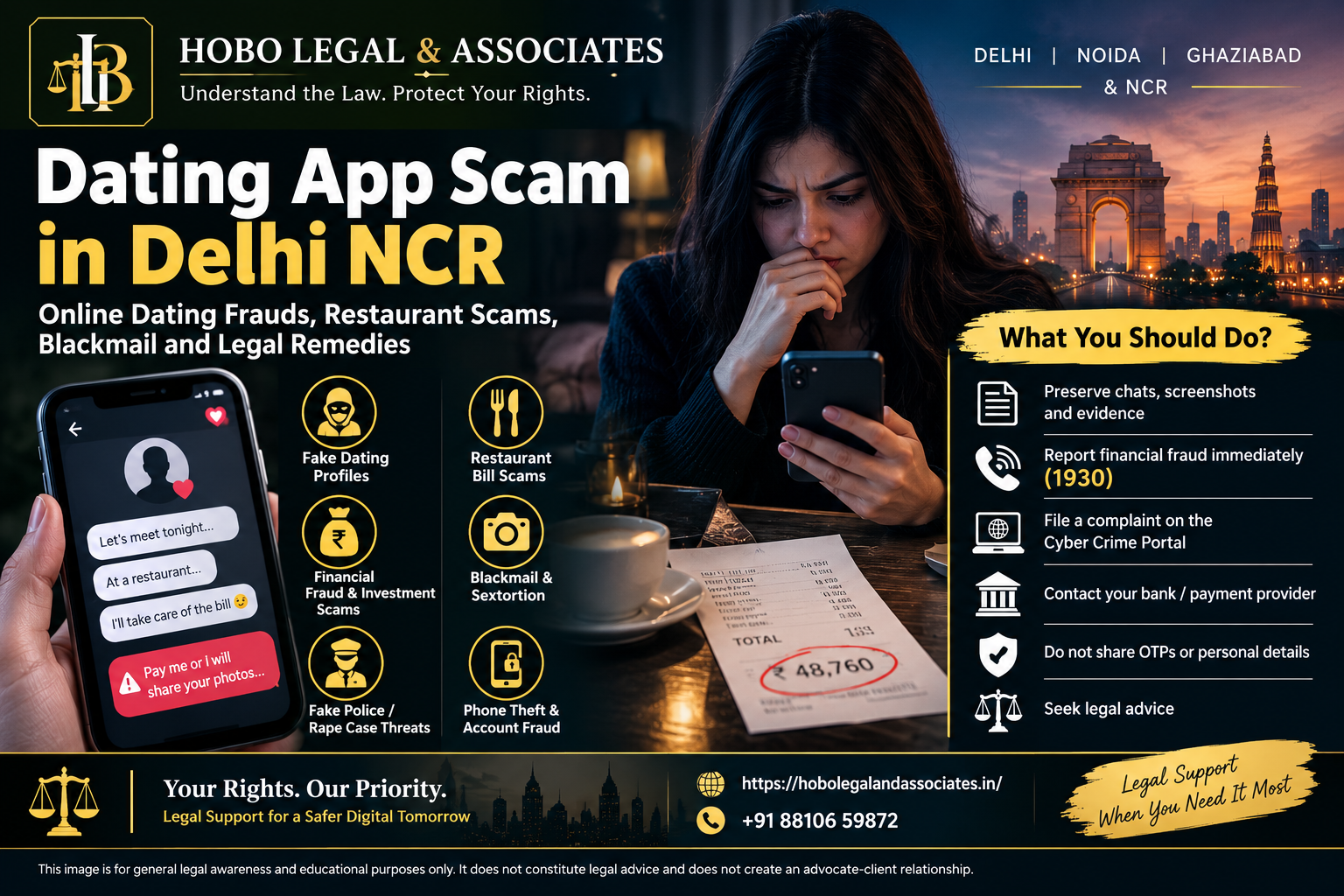
Dating App Scam in Delhi NCR: Ti*der, Bu*ble & Other Online Dating Frauds, Restaurant Scams and Legal Remedies
Online dating has become a common way for people to meet new individuals, make friends and develop relationships. Dating platforms can provide genuine opportunities to connect, but they can also be misused by fraudsters.
In Delhi NCR, complaints and reported cases have involved different forms of dating-related fraud, including fake dating profiles, financial scams, restaurant or inflated-bill scams, extortion, blackmail, theft and investment fraud.
Recent Delhi cases reported by the media illustrate how a dating-app interaction can move from an online conversation to a physical meeting and eventually result in financial loss or alleged extortion. In one 2026 Delhi case, police arrested two women after a 67-year-old man was allegedly lured through a fake dating profile and subsequently lost money from his bank accounts.
Another recent Delhi case involved an alleged dating-app extortion scheme in which a man was reportedly threatened and forced to pay money after being lured into a meeting.
This article explains how dating app scams work, what warning signs to look for, what evidence should be preserved and what legal steps may be available to victims in Delhi, Noida, Ghaziabad and other parts of Delhi NCR.
What Is a Dating App Scam?
A dating app scam generally involves the dishonest use of an online dating or social platform to obtain money, personal information, access to financial accounts, private photographs, or some other benefit from a victim.
The fraud may begin with a normal-looking profile and friendly conversation.
A scammer may:
- use a fake identity;
- use photographs belonging to another person;
- move the conversation quickly to WhatsApp or another platform;
- create an emotional connection;
- request money;
- introduce an investment opportunity;
- arrange a meeting at a particular restaurant;
- demand payment of an unusually high bill;
- steal a phone or personal belongings;
- threaten the victim;
- obtain intimate photographs or videos;
- use those photographs for blackmail or sextortion.
The National Cyber Crime Reporting Portal recognises categories including online/social-media crimes, financial fraud and online sextortion.
Common Dating App Scams in Delhi NCR
1. Fake Dating Profile Scam
One of the simplest methods is creating a fake dating profile.
The person may use:
- stolen photographs;
- false occupation;
- false age;
- fake educational qualifications;
- fake location;
- fake relationship status;
- fabricated social-media accounts.
After establishing communication, the person may attempt to obtain money or arrange a meeting.
Delhi Police has also warned about fake profiles being used in sextortion-related cases involving dating and matrimonial platforms.
2. Ti*der and Bu*ble Dating Scams
A person may match with someone on a dating platform such as Ti*der, Bu*ble or another dating service.
The mere fact that a person is using Tinder or Bumble does not mean the profile is fraudulent. The legal issue arises from the conduct of the particular person or group involved.
A common pattern reported in Delhi has been:
Match → Conversation → WhatsApp → Meeting → Restaurant/Private Location → Financial Demand or Threat
Delhi Police has dealt with cybercrime categories including mobile-app-related crimes, social-media crimes, cheating scams, online transaction frauds and sextortion.
3. Dating App Restaurant Scam
This is particularly important for people using dating apps in Delhi NCR.
In a reported form of this scam, the person met through the dating platform insists on meeting at a particular café, lounge or restaurant.
The victim may be encouraged to order expensive food, drinks or other items.
The final bill can allegedly be far higher than the victim expected.
There have been reports from Delhi of dating-app users being taken to restaurants and facing allegedly inflated bills and pressure to pay. The Indian Express reported a 2023 Delhi case involving a dating-app meeting, an unusually high restaurant bill and alleged assault after the victim objected.
A recent September 2026 Delhi report also described an alleged “date racket” involving an inflated restaurant bill and intimidation.
How the restaurant scam may work
A reported pattern can look like this:
Step 1: Match on dating app.
Step 2: Person quickly suggests meeting.
Step 3: Victim is directed to a particular restaurant.
Step 4: Expensive food/drinks are ordered.
Step 5: A surprisingly high bill is produced.
Step 6: Victim objects.
Step 7: Staff or other persons allegedly pressure or threaten the victim.
Step 8: Victim pays because of fear or intimidation.
Importantly, an expensive restaurant bill by itself does not automatically establish a criminal offence. The legal position depends on the actual conduct, representations, threats, deception, evidence and surrounding circumstances.
4. Dating App Blackmail and Sextortion
Another serious form of dating fraud involves private photographs or videos.
A scammer may develop an online relationship and eventually persuade the victim to share intimate material.
The person may then threaten:
“Pay money or your photographs/videos will be sent to your family, friends or posted online.”
This type of conduct can amount to online sextortion.
Delhi Police explains that sextortion can involve obtaining private or nude photographs/videos and subsequently using them to demand money. It also specifically notes that victims may first encounter offenders through dating or matrimonial apps.
The National Cyber Crime Reporting Portal also identifies online sextortion as a cybercrime category.
5. Dating App Investment Scam
Some dating scams do not involve a restaurant at all.
The fraudster first develops an emotional relationship and later introduces:
- cryptocurrency;
- online trading;
- forex;
- investment apps;
- online businesses;
- high-return schemes.
The victim may initially transfer a small amount and later be persuaded to invest much larger sums.
The I4C issued an advisory in October 2025 regarding the misuse of matrimonial and dating platforms for investment/crypto frauds, specifically identifying fake profiles and platforms including Tinder, Bumble and other dating services as part of the observed modus operandi.
A Delhi case reported in September 2026 involved a man who allegedly lost more than ₹80 lakh after meeting a woman through a dating app and subsequently being encouraged to participate in an online business/investment scheme.
6. Fake Police or Fake Rape-Case Threat Scam
Another dangerous pattern involves blackmail through threats of arrest or false criminal cases.
For example, after a dating-app meeting, the victim may receive calls from people pretending to be:
- police officers;
- advocates;
- investigators;
- relatives of the woman;
- cybercrime officers.
They may demand money by threatening:
- arrest;
- FIR;
- rape allegations;
- police raid;
- public humiliation.
Delhi Police reportedly arrested several people in 2026 in connection with an alleged extortion racket using fake dating profiles and threats involving false rape cases.
If someone demands money by putting a person in fear of an accusation or other harm, the exact criminal provisions applicable will depend on the facts and evidence.
7. Phone Theft and Account Fraud After a Dating Meeting
A dating scam may also involve physical theft.
For example:
Dating app → meeting → restaurant → distraction → phone stolen → bank/UPI accounts accessed
A Delhi case reported in August 2026 involved an alleged fake dating profile, a restaurant meeting and subsequent theft of a victim’s mobile phone followed by alleged withdrawal/transfer of money from his accounts.
This demonstrates why victims should not only preserve dating-app conversations but also immediately secure their banking, UPI, email and social-media accounts if a phone or device is compromised.
Is a Dating App Scam a Cyber Crime?
It can be.
The exact legal classification depends upon what happened.
A dating-app incident may involve one or more different forms of criminal conduct, such as:
- cheating;
- dishonest inducement;
- extortion;
- criminal intimidation;
- identity-related offences;
- unauthorised access or misuse of digital accounts;
- theft;
- online financial fraud;
- publication/transmission of prohibited sexually explicit material;
- offences involving private images;
- other offences depending on the facts.
Therefore, it is important not to assume that every dating dispute is automatically a “cybercrime” or that one particular section applies to every case.
What Laws May Apply to Dating App Fraud in India?
The applicable provisions depend upon the conduct.
The Bharatiya Nyaya Sanhita, 2023 (BNS) contains offences dealing with conduct such as cheating, extortion and criminal intimidation.
The Information Technology Act, 2000 may also become relevant in cases involving certain forms of computer-related offences or electronic content.
The exact sections should be determined after examining:
- what representation was made;
- how the victim was induced;
- whether money was transferred;
- whether threats were made;
- whether accounts were accessed;
- whether private material was obtained or circulated;
- whether physical force or confinement was involved;
- what electronic evidence exists.
What Should You Do If You Are Victim of a Dating App Scam?
Step 1: Do Not Delete the Chats
Preserve:
- dating-app profile screenshots;
- profile name;
- profile photographs;
- username;
- phone number;
- WhatsApp chats;
- SMS;
- emails;
- call details;
- voice messages;
- payment requests;
- QR codes;
- UPI IDs;
- bank details;
- restaurant details;
- bills;
- photographs;
- CCTV-related information, if available.
The National Cyber Crime Reporting Portal specifically advises complainants to preserve evidence such as transaction receipts, bank statements, emails, URLs, chat transcripts, suspect numbers, videos and images.
Step 2: If Money Was Transferred, Act Immediately
For a cyber financial fraud, 1930 is the national cybercrime helpline.
The official Cyber Crime Reporting Portal states that immediate reporting of cyber financial fraud can be made through 1930, and complaints can also be submitted online.
Speed can matter because authorities may need to attempt to trace or place holds on funds moving through banking/payment channels.
Step 3: File a Cyber Crime Complaint
The official portal is:
National Cyber Crime Reporting Portal
The portal provides options for:
- Financial Fraud
- Other Cyber Crime
- Women/Children Related Crime
- reporting suspicious identifiers
- tracking complaints.
The portal’s complainant checklist asks for information such as the incident date/time, incident details and relevant evidence. For financial fraud, transaction information such as the UTR/transaction ID, bank/wallet/merchant and amount is requested.
Step 4: Report the Dating Profile or Account
If the fraudster is still using the dating profile, preserve the profile information before it disappears.
The National Cyber Crime Reporting Portal also provides a facility to report suspicious:
- website URLs;
- WhatsApp numbers;
- Telegram handles;
- phone numbers;
- email IDs;
- SMS numbers;
- social-media URLs.
Step 5: Contact Your Bank or Payment Provider
If money has been transferred:
- Contact the bank immediately.
- Report the transaction as fraudulent.
- Obtain the complaint/reference number.
- Preserve the transaction statement.
- Report the matter through 1930 where applicable.
- Keep UTR/transaction IDs safely.
Do not wait for the scammer to return the money voluntarily.
Step 6: If You Were Threatened or Extorted
If the person is threatening you, preserve the threat.
Do not:
- delete the conversation;
- alter screenshots;
- send additional intimate material;
- disclose OTPs;
- give remote access to your phone;
- transfer additional money merely because the scammer promises to delete the material.
If there is an immediate physical threat, contact the police/emergency services.
Dating App Scam in Delhi, Noida and Ghaziabad
Dating-app fraud is not restricted to one locality.
People in Delhi, Noida, Greater Noida, Ghaziabad and the wider NCR region may encounter scams involving online dating, social-media communication, restaurant meetings, financial transfers or blackmail.
For a legal complaint, the relevant police/cybercrime authority and jurisdiction will depend on the facts, location of the incident, electronic transactions and other circumstances.
A victim should therefore preserve the complete timeline instead of relying only on the dating-app profile.
Warning Signs of a Dating App Scam
Be particularly cautious when someone:
1. Immediately wants to move away from the dating app
For example:
Dating app → WhatsApp → Telegram → private number
This alone does not prove fraud, but it can be one warning sign.
2. Insists on a particular restaurant
Especially when the person refuses reasonable alternatives and repeatedly insists on one particular venue.
3. Avoids video verification
A person repeatedly refusing a reasonable video call while making strong claims about their identity may warrant caution.
4. Starts discussing money
Requests involving:
- emergency expenses;
- hotel bills;
- medical expenses;
- travel;
- investments;
- cryptocurrency;
- business opportunities
should be treated carefully.
5. Requests intimate photographs
Never assume that an online relationship is sufficient reason to share sensitive material.
6. Threatens you
Threats such as:
- “I will leak your photos”
- “I will send this to your family”
- “Police will arrest you”
- “Pay immediately”
- “I know where you live”
should be preserved as evidence.
What Evidence Is Important in a Dating App Scam?
| Evidence | Why it may matter |
|---|---|
| Dating profile | Helps identify the account |
| Screenshots | Preserves communication |
| WhatsApp chats | Shows representations and demands |
| Phone numbers | May assist investigation |
| UPI ID | Important in financial fraud |
| Bank statement | Shows money movement |
| UTR/transaction ID | Helps trace transaction |
| Restaurant bill | Relevant in restaurant-related disputes |
| CCTV details | May support events at the venue |
| Audio/video | May preserve threats or demands |
| Emails | May establish identity or representations |
| Social-media profile | May help establish connections |
| Location/timeline | Helps reconstruct events |
The Cyber Crime Reporting Portal specifically recommends preserving documentary and digital evidence when making a complaint.
Can a Dating App Victim Recover the Money?
Recovery depends on the circumstances.
Factors may include:
- how quickly the fraud was reported;
- where the money was transferred;
- whether funds remain in the recipient account;
- whether intermediary accounts were used;
- whether the accused can be identified;
- whether digital evidence is available;
- whether investigation leads to recovery.
There is no automatic guarantee of recovery merely because a cybercrime complaint has been filed.
This is why immediate reporting is important.
What If Someone Is Being Blackmailed With Private Photos?
Do not panic.
Preserve the evidence and report the matter.
The National Cyber Crime Reporting Portal specifically recognises online sextortion, while Delhi Police has separately issued information about sextortion involving dating and matrimonial platforms.
Depending on the conduct, criminal provisions concerning extortion, intimidation, electronic offences and unlawful publication/transmission of content may become relevant.
The precise sections depend upon the facts.
Can a Dating App Restaurant Scam Become a Criminal Case?
Potentially, yes—but an expensive bill alone is not automatically proof of a criminal offence.
Investigators may need to examine questions such as:
- Was there deception?
- Was the victim induced through false representation?
- Was there a coordinated plan?
- Was the bill deliberately manipulated?
- Were threats used?
- Was force used?
- Was the victim prevented from leaving?
- Was money obtained through intimidation?
- Were false identities used?
- Is there evidence connecting the dating profile and restaurant?
The legal outcome depends on evidence.
How HoBo Legal & Associates Can Help With Dating App and Cyber Fraud Matters
A dating-app scam can involve multiple legal issues at the same time.
Depending on the facts, legal assistance may involve:
- reviewing digital evidence;
- preparing a cybercrime complaint;
- assisting with a police complaint/FIR;
- analysing financial transactions;
- identifying relevant legal provisions;
- dealing with online blackmail or extortion;
- advising on preservation of electronic evidence;
- assisting in appropriate criminal proceedings;
- advising persons facing allegations arising from a dating-app dispute.
HoBo Legal & Associates handles legal matters involving cyber crime, criminal law, online fraud, blackmail, financial disputes and related legal issues.
For case-specific advice, the complete facts and available evidence should be reviewed before deciding the appropriate legal course.
Frequently Asked Questions
1. Is dating app fraud a cyber crime in India?
It can be, depending on the conduct. Online financial fraud, social-media crime, identity misuse and certain forms of digital blackmail may fall within cybercrime reporting mechanisms.
2. Can I complain about a fake Tinder or Bumble profile?
Yes. Preserve the profile details, screenshots, messages and other evidence and report the matter through the appropriate platform and, where applicable, the National Cyber Crime Reporting Portal.
3. What should I do if someone takes me to a restaurant and gives me a huge bill?
Preserve the bill, payment proof, restaurant details, communications and any threats or intimidation. If you believe a criminal offence occurred, report it to the appropriate police/cybercrime authority.
4. What if someone threatens to leak my private photographs?
Do not delete the threats. Preserve the original chats, profile details and files. Report the matter promptly. Online sextortion is recognised by the National Cyber Crime Reporting Portal.
5. Should I pay a blackmailer?
There is no general legal rule that paying a blackmailer will solve the problem. Payment may lead to further demands. Preserve the evidence and seek appropriate legal/police assistance.
6. Can dating app scammers be arrested?
Arrest depends on the alleged offences, evidence, investigation and applicable criminal procedure. A complaint does not automatically mean that every person named will be arrested.
7. What if I transferred money through UPI?
Immediately contact the bank/payment provider and report the transaction. For cyber financial fraud, the official national helpline is 1930.
8. Can I file a cybercrime complaint if the scammer is outside India?
The National Cyber Crime Reporting Portal states that Indian citizens can report cybercrime involving foreign individuals or companies as well.
9. What if I only have WhatsApp chats as evidence?
Keep the original device and preserve the chats, screenshots, numbers, media and relevant account information. Additional evidence such as transaction records or platform information may also be useful.
10. Is every failed dating relationship a fraud?
No. A relationship ending badly does not by itself establish fraud. Criminal liability depends on the specific conduct, intention, representations and evidence.
Dating App Scam in Delhi NCR can take several forms—from fake profiles and emotional manipulation to restaurant bill scams, financial fraud, investment scams, theft, extortion and online blackmail.
Recent Delhi cases show that the risk is not merely theoretical. Reported incidents have included fake dating profiles, alleged restaurant-related extortion, financial losses and threats.
The most important steps are simple:
Preserve the evidence.
Do not delete the chats.
Do not share OTPs or banking credentials.
Report financial fraud immediately.
Use 1930 where applicable.
File the appropriate cybercrime/police complaint.
Take legal advice based on the actual facts.
A dating-app conversation may look personal, but once deception, financial loss, threats or blackmail enter the picture, it can become a serious legal matter.
Understand the Law. Protect Your Rights.
Legal Disclaimer
This article is provided for general legal information and educational purposes only. It does not constitute legal advice and does not create an advocate-client relationship. The applicable law and legal position depend on the facts and evidence of each individual case. Laws, regulations and judicial interpretations may change. For advice regarding a specific dating-app scam, cyber fraud, blackmail, extortion or financial loss, appropriate professional legal advice should be obtained after reviewing the complete facts and evidence.